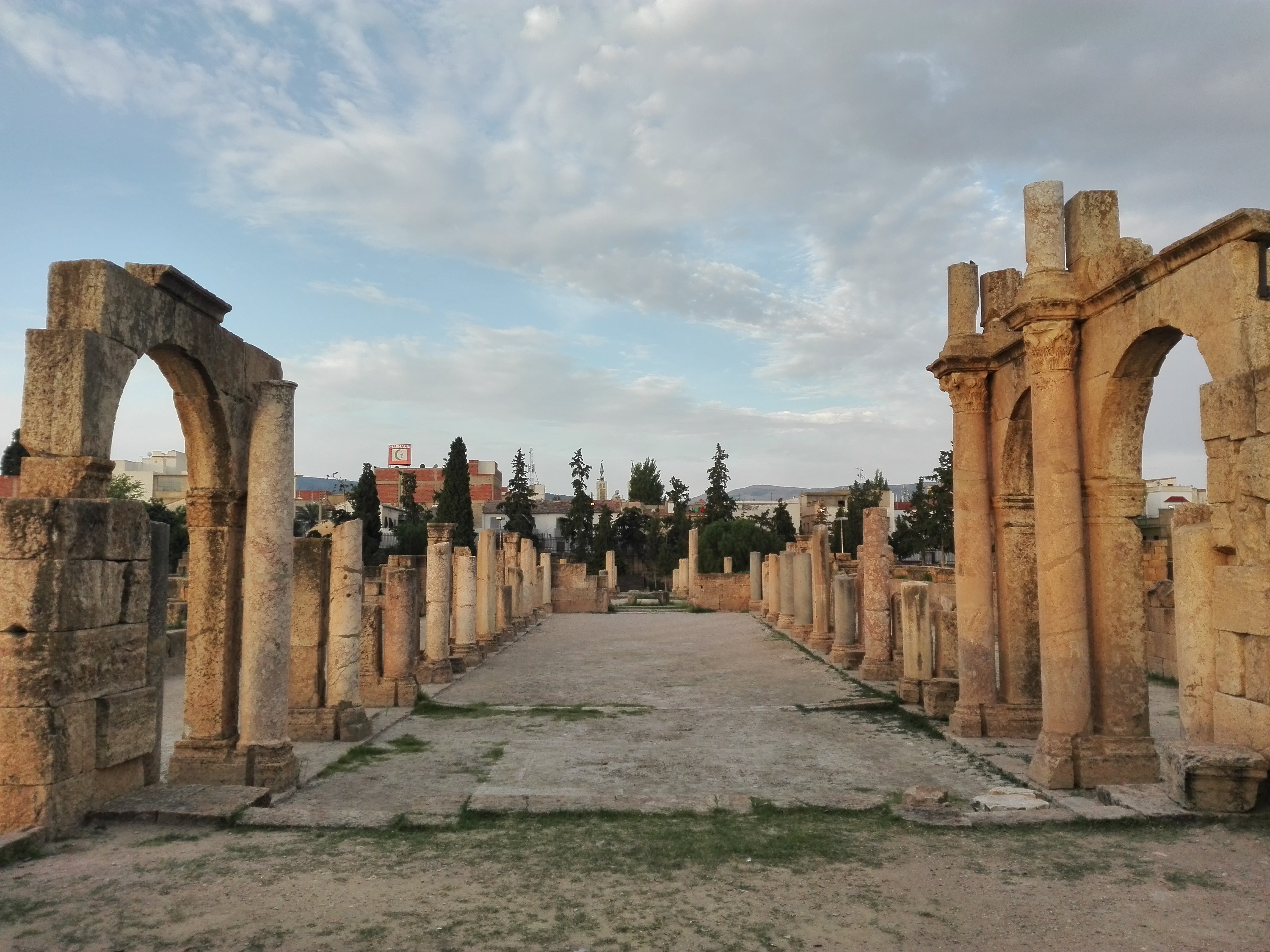
Tebessa Basilica
A mosaic inscription dated to 350 CE names her: Crispina, executed half a century earlier for refusing to renounce her Christian faith. That dedication transformed what had been a utilitarian Roman structure in the garrison town of Theveste into something sacred, drawing pilgrims across North Africa to a shrine at the edge of empire. The Tebessa Basilica, one of the largest surviving Roman church complexes on the continent, stands today as testimony to how a single act of defiance could reshape a city's identity for centuries.
From Tax House to Temple
Theveste began as a military outpost. When Legio III Augusta established its presence here, the legion's engineers built roads radiating outward to Carthage, Thamugade, and Lambaesis, binding this inland city to the commercial arteries of Roman North Africa. The building that would become the basilica likely served a mundane purpose at first: collecting taxes on olive oil and grain moving along those roads. Julius Caesar's economic reforms had imposed levies on trade goods, and Theveste sat at a profitable crossroads. But as the empire's grip on North Africa tightened, and as Christianity took root in the region's soil, the building's purpose began to shift. In 295 CE, a young man named Maximillian was martyred here for refusing military service. A decade later, Crispina followed him to execution. The tax collector's hall was becoming holy ground.
A Martyr's Legacy in Stone
The mosaic floor inscription dedicating the basilica to Crispina marks the pivot point. By the mid-fourth century, pilgrims were traveling to Theveste to honor her memory, and the building expanded to meet their needs. What had been a practical Roman structure grew into a sprawling religious complex across the fourth and fifth centuries, as successive Roman and Byzantine leaders added new elements. The basilica likely served as a xenodochium, a hostel for travelers and the poor, in addition to hosting baptisms and regular church services. Its scale suggests ambition: a staircase of twenty steps, roughly sixty-six feet wide, leads through the nave and aisles. A massive piscina carved into the wall opens onto a large open-air atrium, its center graced by a four-lobed fountain. Three archways still stand at the intersection of hallways leading to the main chapel. The architecture speaks of a community that invested deeply in this place.
Centuries of Addition
Walking through the ruins today, the basilica reads like a geological core sample of North African Christianity. The original structure gives way to later additions: a bathhouse, gardens, ground-floor stables, and a martyrion commemorating the site's sacred significance. A smaller basilica was appended to the complex in the sixth century. The mosaic floors, surviving in fragments, chart the changing artistic sensibilities of each era. Columns support architraves where galleries once displayed artwork. A pair of altar footings in the main chapel nave hint at liturgical arrangements that evolved over generations. Between the fourth and seventh centuries, the complex never stopped growing, each dynasty leaving its mark on the stone. The Byzantines fortified it; successive builders expanded its capacity. Even as empires rose and fell across the Maghreb, the basilica endured, anchored by the memory of a woman who chose death over compromise.
Ruins at the Edge of Memory
The basilica that remains today is skeletal but impressive. Rows of balustrades mark the processional pathway into what was once the great forecourt. The baptistery sits just down a staircase from the open-air atrium, its placement suggesting the ritual journey new converts would have made through the complex. Galleries that once displayed portable artwork are now open to the sky. Yet the scale still communicates something of the ambition that drove this place: the basilica is among the largest Roman church ruins in all of North Africa. An 1860 photograph, taken shortly after France renamed Theveste to Tebessa, shows the ruins still commanding the landscape. In a region where Roman, Byzantine, and Islamic civilizations layered their histories atop one another, the Tebessa Basilica preserves a specific moment: the centuries when Christianity was reshaping North Africa from the ground up, one shrine at a time.
From the Air
Located at 35.41°N, 8.13°E in eastern Algeria near the Tunisian border. The site lies within the modern city of Tebessa, visible as a distinct archaeological complex. Nearest major airport is Tebessa Airport (DABS). Approach from the north or east at 3,000-5,000 ft AGL for best visibility of the ruins within the urban landscape. The Atlas Mountains provide a dramatic backdrop to the west.