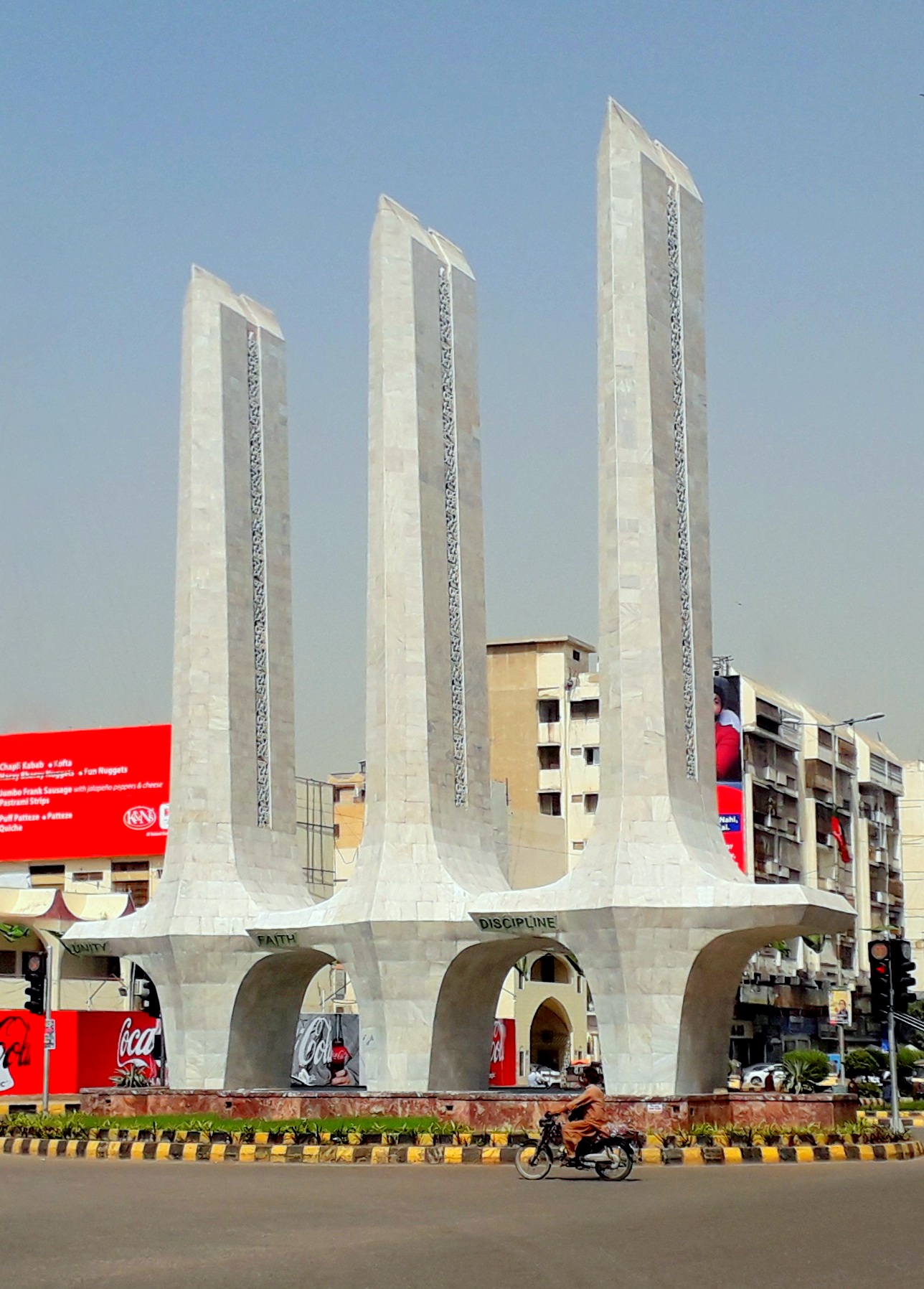
Teen Talwar
The three swords were supposed to be black, green, and red -- the electoral colors of the Pakistan Peoples Party. Zulfikar Ali Bhutto commissioned the monument in 1973 as part of a beautification scheme for Clifton, and the sword was the PPP's electoral symbol. But somewhere between political vision and architectural reality, the concept shifted. Zoroastrian architect Minu Mistri designed the final monument in white marble instead, inscribing each blade with one of Quaid-e-Azam Muhammad Ali Jinnah's three creeds: Unity, Faith, and Discipline. A party symbol became a national one.
A Monument That Outgrew Its Politics
Bhutto had specific reasons for placing the monument at the intersection of Chartered Accountants Avenue, Bath Island Road, and Khayaban-e-Iqbal Road in Clifton. This was one of Karachi's most visible intersections, a junction that thousands of people passed through daily. The three swords -- Teen Talwar in Urdu -- would make the PPP's symbol impossible to ignore. But Mistri's choice of white marble and Jinnah's universal creed rather than party colors elevated the monument beyond partisan messaging. The three blades now represent the founding principles of the nation rather than the ambitions of any single party, a transformation that has given the monument a permanence Bhutto's original concept might not have achieved.
Marooned in Traffic
The grassy roundabout that once gave Teen Talwar a dignified setting has been whittled down to a small asphalt island. Traffic signals replaced the original roundabout, but the remaining circular patch of road stubbornly causes congestion. A 2008 restoration cleaned up the monument and reduced the roundabout's size further, but the fundamental problem persists: a monument designed for a generous traffic circle now sits stranded in an intersection that has outgrown it. Political banners, advertising flyers, and campaign posters are continually plastered on the structure, taking advantage of its high visibility.
Three Blades, One City
Despite the traffic and the flyers, Teen Talwar endures as one of Karachi's most recognizable landmarks. The monument functions as a navigational reference point -- 'near Teen Talwar' is a shorthand that every Karachiite understands. The three white marble swords catch the light differently at various times of day, their clean geometry standing in contrast to the visual chaos of the surrounding streets. That Bhutto, who would be overthrown by coup in 1977 and executed in 1979, created a monument that transcended his own political downfall is one of Karachi's quieter ironies. The swords still stand. The party colors were never applied. Jinnah's words -- Unity, Faith, Discipline -- remain carved into stone that Bhutto chose but could not ultimately claim.
From the Air
Located at 24.834N, 67.034E in the Clifton area of Karachi, Sindh, Pakistan. The three white marble swords are visible from low altitude as a distinctive geometric form at a major intersection. Nearest airport is Jinnah International Airport (OPKC). The monument sits at the junction of Khayaban-e-Iqbal Road and Chartered Accountants Avenue, with the Arabian Sea coastline visible a short distance to the south.