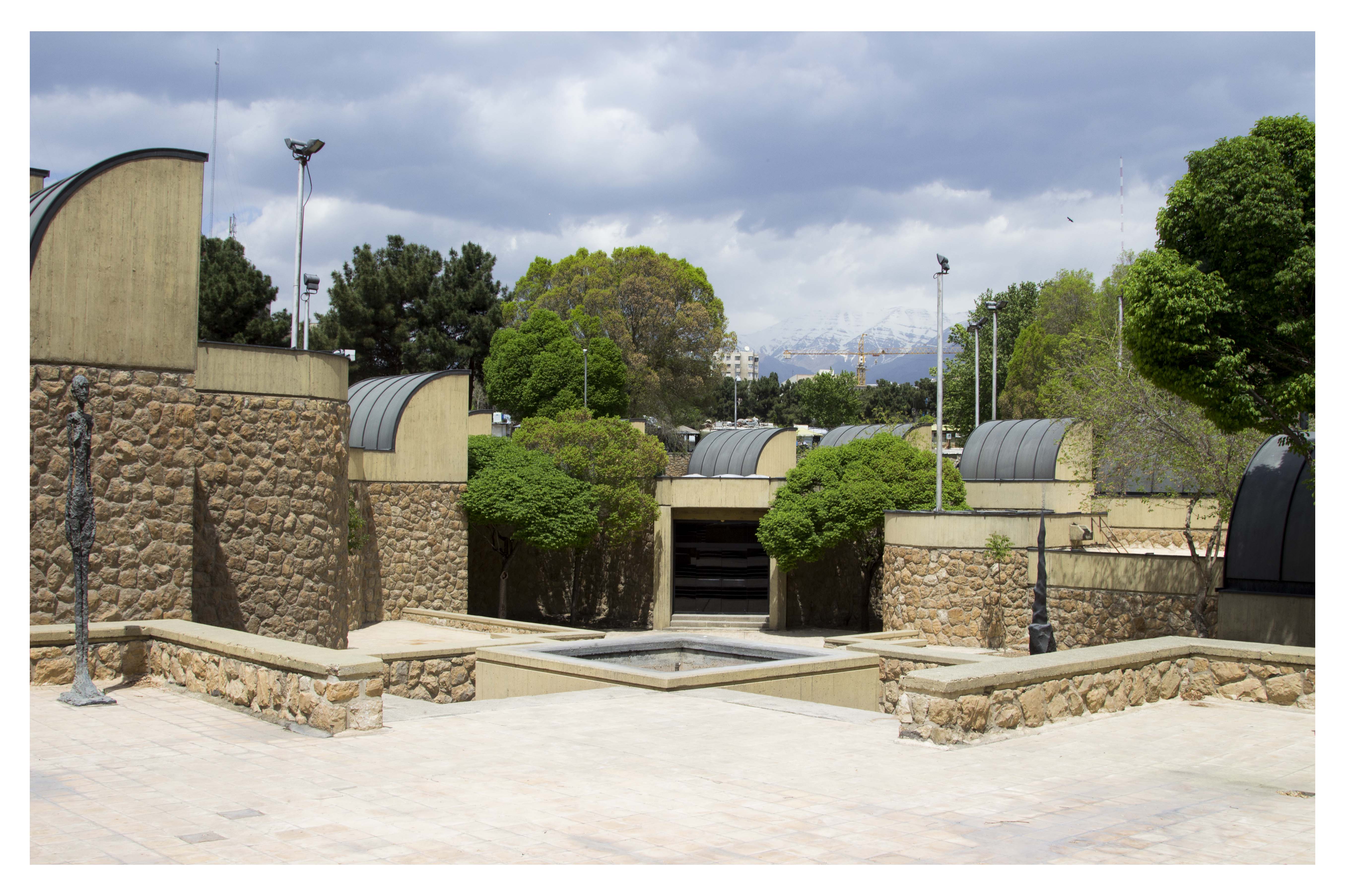
Tehran Museum of Contemporary Art
Somewhere beneath a spiral ramp in Tehran, in a climate-controlled vault that most of the world has never seen, hang paintings worth an estimated 2.5 billion pounds. Works by Picasso, Monet, Warhol, Francis Bacon, and Jackson Pollock share darkness with canvases by Gauguin and Van Gogh. They were collected in a frenzy of imperial ambition during the 1970s, inaugurated in a gleaming new museum in 1977, and then -- two years later, when the revolution came -- sealed away. The Tehran Museum of Contemporary Art, known as TMoCA, holds what is arguably the most valuable cache of Western modern art outside the Western world. For decades, almost nobody in Iran was allowed to see it.
An Empress and Her Vision
The idea began with a conversation. At a gallery opening in the early 1970s, Iranian artist Iran Darroudi mentioned to Empress Farah Pahlavi her wish for a permanent exhibition space. Farah, already a patron of the arts, seized the concept and expanded it beyond anything Darroudi had imagined. The empress commissioned architect Kamran Diba, who collaborated with Nader Ardalan to design a building that was itself a work of contemporary art -- a spiraling, semi-subterranean structure reminiscent of a Guggenheim turned inside out. Funded by the National Iranian Oil Company, the museum's collection was assembled with breathtaking speed and bottomless resources. Curators traveled to New York, London, and Paris, acquiring masterworks at a pace that stunned the international art market. By the time TMoCA opened in 1977, its permanent collection held more than 3,000 items.
The Collection in the Vault
The list reads like a survey course in Western modernism. Paul Gauguin's Still Life with Head-Shaped Vase and Japanese Woodcut from 1889. A lithograph of Van Gogh's Worn Out: At Eternity's Gate, formerly in the Nelson Rockefeller collection. Francis Bacon's triptych Two Figures Lying on a Bed With Attendants. Andy Warhol's Suicide (Purple Jumping Man). Alberto Giacometti's Walking Man I. Works by Degas, Chagall, Toulouse-Lautrec, Roy Lichtenstein, Alexander Calder, and dozens more. Alongside the Western art, TMoCA houses one of the finest collections of Iranian modern and contemporary work, including pieces by Parviz Tanavoli, Behjat Sadr, and Marcos Grigorian. In 1994, the museum traded Willem de Kooning's Woman III for a rare sixteenth-century Persian manuscript of the Tahmasbi Shahnameh -- the Book of Kings -- containing precious miniatures, a swap that valued cultural heritage over market price.
Revolution and Darkness
The Islamic Revolution of 1979 changed everything. Western art -- with its nudes, its secular provocations, its associations with the deposed Shah's regime -- was deemed unsuitable for public display. The paintings were rolled, crated, and locked in the museum's basement vaults. For twenty years, the most extraordinary collection of modern art in the Middle East sat in darkness. There were persistent rumors that works had been sold, damaged, or lost. None proved true. The vault's climate control kept the canvases intact. In 1999, the first post-revolution exhibition cautiously displayed works by Hockney, Lichtenstein, Rauschenberg, and Warhol. The paintings emerged blinking into a country that had transformed around them.
An Exhibition That Almost Traveled
In 2016, Berlin's Prussian Cultural Heritage Foundation announced plans to exhibit TMoCA's Western collection in Germany -- the first time these works would leave Iran. Anticipation was enormous. Then Iranian authorities failed to grant export permits, and on December 27, 2016, the exhibition was cancelled. What happened next was unexpected. In early 2017, TMoCA's director staged the Berlin-Rome Travellers exhibition in Tehran itself, displaying the very works that had been selected for Europe. It was, in the words of observers, an act of quiet resistance -- a museum asserting its own relevance against political currents that had grown more conservative since Mahmoud Ahmadinejad's presidency began in 2005. The art world watched from afar, both frustrated and fascinated by a collection that remained tantalizingly just out of reach.
A Museum Between Worlds
TMoCA occupies a peculiar position in global culture. Its building sits in Laleh Park in central Tehran, its sculpture garden displaying works by Ernst, Giacometti, Magritte, and Henry Moore in the open air. Inside, the spiral gallery descends underground, a deliberate inversion of the Guggenheim's famous ascending ramp. Le Monde's art critic once questioned the connection between an Iranian child and a Picasso or a Pollock. Farah Pahlavi's response was pointed: Iranians understand modern art perfectly well, and the assumption otherwise revealed more about European prejudice than Iranian capacity. The collection she built remains intact, a time capsule of 1970s acquisition ambition preserved by the very revolution that tried to erase its significance. Today, TMoCA continues staging exhibitions that navigate the boundaries between what Iranian authorities permit and what the art itself demands.
From the Air
TMoCA is located in Laleh Park in central Tehran at approximately 35.71N, 51.39E. From the air, Laleh Park is visible as a green rectangle amid dense urban fabric, roughly 2 km west of the University of Tehran campus. Mehrabad International Airport (OIII) lies about 8 km to the southwest. The museum's low-profile, semi-subterranean architecture makes it nearly invisible from altitude, but the park's distinctive shape and the surrounding boulevard grid provide clear orientation.