Telangana Movement
For nearly fifty years, a single question consumed the politics of southern India: should Telangana be its own state? The answer arrived on June 2, 2014, when India's 29th state came into existence with K. Chandrashekar Rao as its first chief minister. But the road from question to answer was paved with hunger strikes, student protests, army deployments, and the kind of political maneuvering that makes democracies both maddening and magnificent. What began as a dispute over government jobs in the 1950s became one of independent India's longest sustained movements for self-determination.
A Merger Built on Mistrust
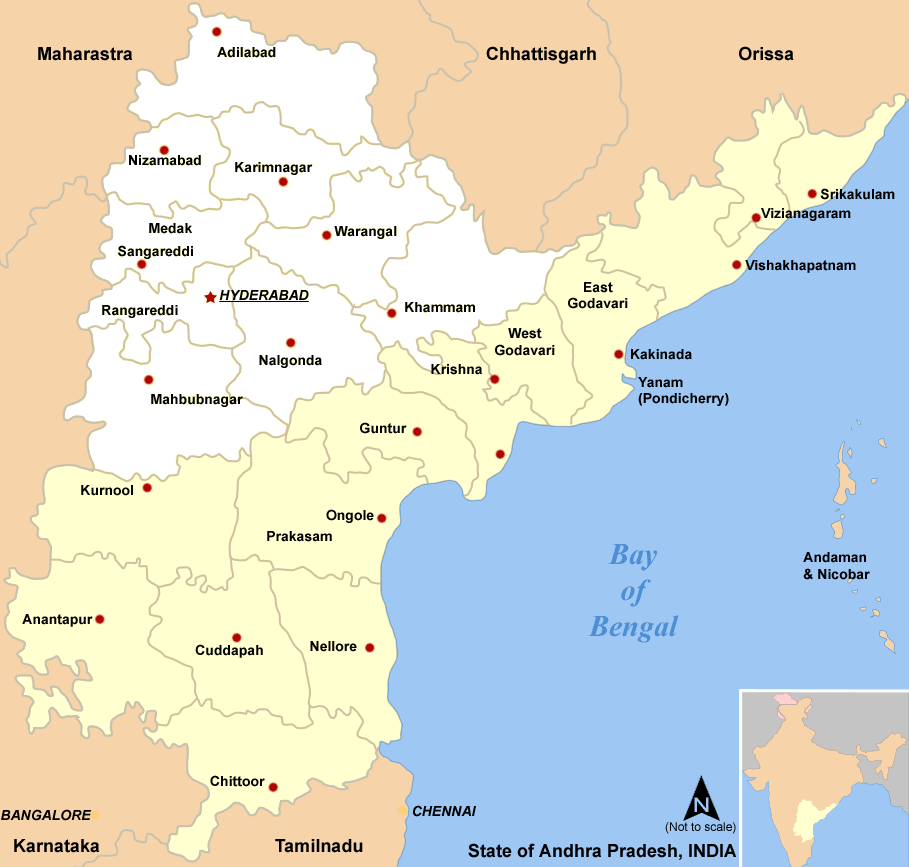
The roots of the movement reach back to 1956, when the Telugu-speaking areas of the former princely state of Hyderabad were merged with Andhra state to form Andhra Pradesh. The States Reorganisation Commission had actually recommended against immediate merger, warning in paragraph 378 of its report that the "educationally backward people of Telangana" feared being "swamped and exploited by the more advanced people of the coastal areas." Safeguards were promised -- protections for local employment, education funding, and water rights. Within a decade, people in Telangana were arguing that those safeguards had been systematically ignored. The Telangana region covered over 41 percent of Andhra Pradesh's total area and held more than 40 percent of its population, yet budget allocations to the region consistently fell below a third of the state total. The grievance was not abstract. It showed up in hiring statistics, irrigation canals, and medical colleges.
Streets on Fire
The first eruption came in 1969, when a student from Khammam district began a hunger strike demanding implementation of the employment safeguards. The protest spread rapidly through universities and cities across the Telangana region, evolving from a demand for fair treatment into an outright call for a separate state. Violence flared. Crowds attempted to set fire to a sub-inspector's residence; police opened fire, injuring seventeen people. The Indian Army was deployed. Then came the backlash: a counter-movement from coastal Andhra, with students there accusing the government of discriminating against their own people through employee transfers. Prime Minister Indira Gandhi proposed an eight-point plan that Telangana leaders flatly rejected. The cycle of agitation, negotiation, and disappointment would repeat itself across the next four decades, each generation inheriting the frustration of the one before.
Water, Jobs, and the Arithmetic of Resentment
At the heart of the movement lay a brutal arithmetic. The Krishna and Godavari rivers -- the lifeblood of southern Indian agriculture -- have roughly 69 percent of their catchment areas in the Telangana plateau. Yet proponents of statehood argued that 74 percent of irrigation water from major canal projects flowed to coastal Andhra, with Telangana receiving barely 18 percent. The employment numbers told a similar story: by some estimates, only 20 percent of state government employees came from Telangana, fewer than 10 percent of secretariat staff, and fewer than 5 percent of department heads. Eight of eleven new medical colleges established since 1956 were built outside the region. These were not the complaints of identity politics alone. They were the complaints of people who watched their rivers flow past them toward someone else's fields.
The Final Push
The modern phase of the movement intensified after 2009, with political parties shifting positions so frequently that tracking their stances became an exercise in frustration. The Congress Party, which controlled the central government, oscillated between support and delay. On December 9, 2009, the government announced the process for forming Telangana -- then reversed course just two weeks later on December 23rd, sparking fresh outrage. K. Chandrashekar Rao, who had founded the Telangana Rashtra Samithi specifically to campaign for statehood, undertook dramatic hunger strikes that galvanized public support. By July 2013, the Congress Working Committee unanimously resolved to create the state. The Andhra Pradesh Reorganisation Act passed the Lok Sabha by voice vote on February 18, 2014, and the Rajya Sabha two days later. Hyderabad would serve as the shared capital of both states for up to ten years.
A State Is Born
On the morning of June 2, 2014, Telangana officially came into existence. The new state encompassed the Deccan Plateau's distinctive landscape of granite outcrops, semi-arid scrubland, and the river valleys that had been at the center of so many grievances. Hyderabad, with its tech corridors, Mughal-era monuments, and biryani stalls, became the capital of a state that had spent half a century arguing it deserved one. The Kakatiya Kala Thoranam -- the ornamental gateway from the medieval Warangal Fort -- was adopted as the official emblem of the new state, a deliberate nod to Telangana's pre-colonial identity. Whether the promises that fueled the movement will ultimately be fulfilled remains an open question. But the movement itself stands as proof that in the world's largest democracy, persistence is not futile -- even when it takes five decades to prove it.
From the Air
Centered at approximately 17.99°N, 79.59°E over the Telangana region of the Deccan Plateau. From cruising altitude, the landscape reveals the semi-arid terrain of the plateau with the Godavari and Krishna river systems threading through it. Hyderabad (VOHS / Rajiv Gandhi International Airport) is the primary airport. Warangal and the surrounding region are visible to the northeast. The flat plateau terrain contrasts sharply with the Eastern Ghats to the east and south.