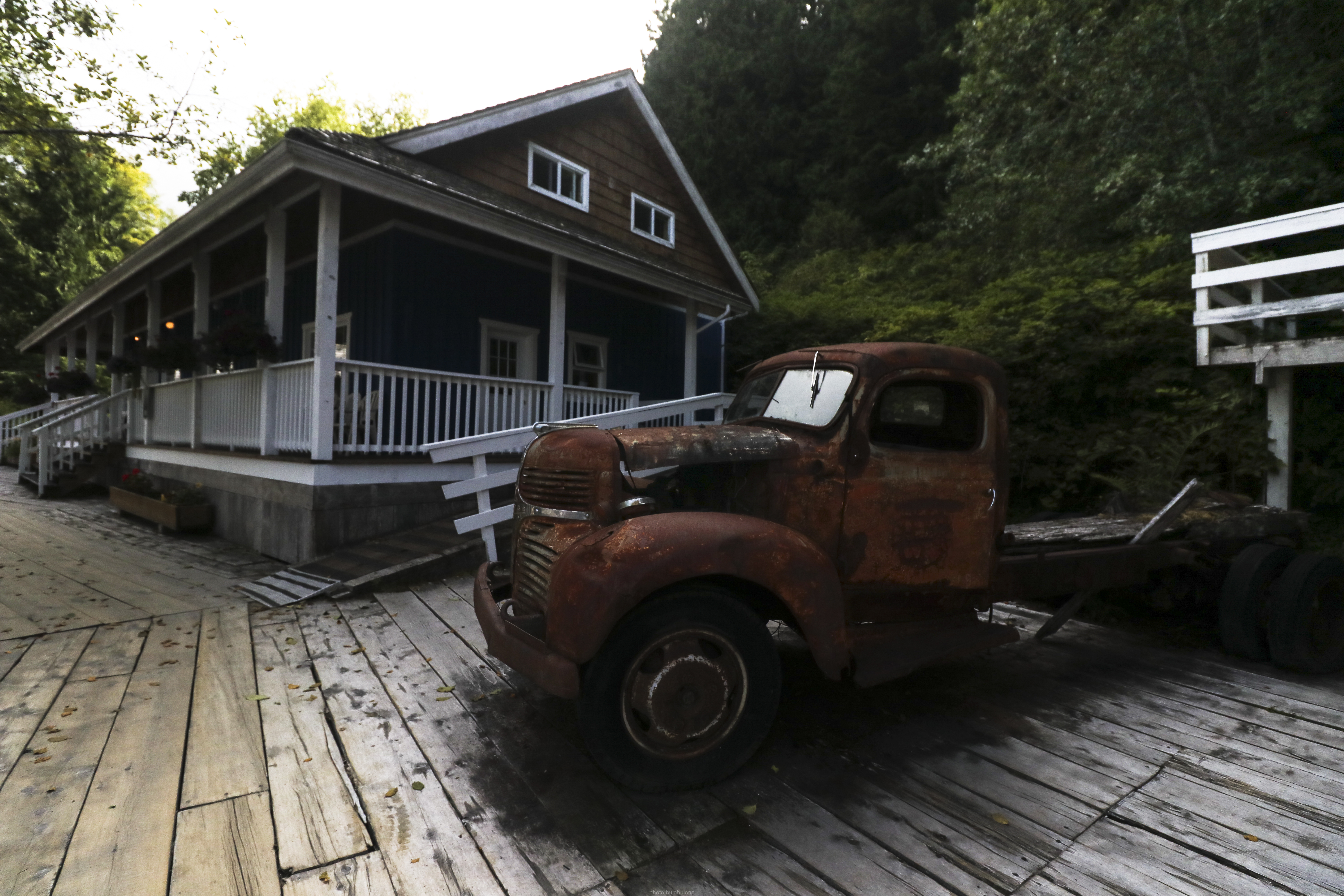
Telegraph Cove
It started with a single room and a telegraph wire. In 1911, the Canadian federal government strung a line north from Campbell River to connect the remote settlements scattered along Vancouver Island's rugged coast. At the northern terminus, where the wire ended and the forest began, they built a one-room relay station on the edge of a sheltered cove. That station became a settlement. The settlement became a mill town. The mill town nearly died. And then the whales saved it. Telegraph Cove, population roughly twenty, is one of the smallest communities in British Columbia -- a handful of heritage buildings perched on stilts above the water, connected by a wooden boardwalk that has been rebuilt, extended, burned, and rebuilt again. Its survival is improbable. Its transformation from industrial outpost to eco-tourism destination is one of the quieter reinvention stories on the Pacific coast.
The Wastell Years
Fred Wastell's father purchased most of the land surrounding the cove, and Fred built a life on it. His house still stands on the hillside above the boat shed at the entrance to the cove, looking down on the water where he and Japanese investors established a chum salmon saltery -- a place where fish were packed in salt for preservation and export. A small sawmill followed, and for decades Telegraph Cove operated as a working industrial village, its economy measured in board feet and barrels of salted fish.
The mill ran well into the 1980s, outlasting most of the small coastal operations that once dotted Vancouver Island's shoreline. When it finally closed, the cove faced the same question that confronted dozens of similar communities up and down the coast: what now? The buildings remained, weathered but sound, their pilings sunk deep into the tidal mud. The boardwalk still connected them. The cove still offered shelter from the swells of Johnstone Strait. All that was missing was a reason to stay.
Where the Orcas Run
The reason arrived on black dorsal fins. Johnstone Strait, the narrow passage separating northern Vancouver Island from the smaller islands and mainland to the northeast, turns out to be one of the richest killer whale corridors in the world. Northern resident orca pods spend their summers here, feeding on salmon runs that funnel through the strait's constricted waters. Robson Bight ecological reserve, just ten kilometers to the southeast, protects the rubbing beaches where these whales engage in behavior found nowhere else on Earth.
In 1980, Stubbs Island Charters launched British Columbia's first commercial whale-watching operation from Telegraph Cove's dock. For nearly four decades, the company put the cove on the global map for marine wildlife tourism, drawing visitors from Europe, Asia, and across North America. The old mill village transformed into Telegraph Cove Resort, its heritage buildings converted to visitor accommodations, its boardwalk lined with small businesses offering kayak tours, bear-watching expeditions, and boat trips into the strait. The Graham family, who own and operate the resort, preserved the village's character while reinventing its purpose -- a trick that requires equal parts stubbornness and vision.
Bones and Memory
The Whale Interpretive Centre opened in 2002 and grew into something remarkable: the largest public collection of marine mammal skeletons in British Columbia. Its centerpiece was a twenty-meter-long fin whale skeleton suspended from the rafters, a cathedral of bone that gave visitors a visceral sense of the animals they had come to see alive in the strait outside. Skeletons arrived from beaches up and down the coast, each one cleaned, articulated, and mounted with the care of a natural history museum operating on a shoestring budget in a town of twenty people.
The collection represented years of painstaking work -- a labor of love, as those involved described it. Whale researchers used the facility for study. Schoolchildren made the journey up the gravel road to stand beneath the fin whale's ribcage and understand, in a way no photograph could convey, the sheer scale of the creatures swimming just offshore. The museum became as much a part of Telegraph Cove's identity as the boardwalk itself.
New Year's Eve, 2024
On the evening of December 31, 2024, fire broke out on the north end of the boardwalk. It spread fast. By the time fire departments from Port McNeill, Hyde Creek, Port Hardy, Sointula, and Alert Bay arrived -- some crossing open water to reach the blaze -- the flames had consumed the Old Saltery Pub, the Killer Whale Cafe, the Tide Rip Tours office, the Prince of Whales office, one heritage house, and the Whale Interpretive Centre. A large section of the boardwalk burned with them.
The fin whale skeleton was lost. The entire marine mammal collection was destroyed. For a community that had already reinvented itself once, the fire posed the hardest question yet. But within weeks, whale skeletons began arriving from institutions and beaches across the country -- donations to help rebuild what the fire had taken. Telegraph Cove set a target of May 2026 to reopen the museum and restore the damaged boardwalk. The cove has burned before, in the way that all wooden places eventually do. It has always been rebuilt. The whales in the strait do not know about the fire. They return each summer regardless, following the salmon, rubbing on the beaches, indifferent to the small dramas of the shore.
From the Air
Telegraph Cove sits at 50.55°N, 126.83°W on the northeast coast of Vancouver Island, tucked into a small protected inlet three kilometers southeast of Beaver Cove. From altitude, look for the narrow finger of water cutting into the forested coastline -- the cove is small but distinctive, with the boardwalk village visible as a line of structures along the water's edge. The nearest airport is Port Hardy (CYZT), approximately 35 km to the northwest, with scheduled service to Vancouver. Campbell River Airport (CYBL) lies about 210 km to the southeast. Johnstone Strait stretches to the northeast, and Robson Bight ecological reserve is visible about 10 km to the southeast along the Vancouver Island shore. The 2024 fire damage may be visible as cleared areas along the northern section of the boardwalk. Marine traffic in summer will be heavy with whale-watching boats heading into Johnstone Strait. Weather is typical of northern Vancouver Island's coast: morning fog common, afternoon clearing frequent, with rain possible year-round.