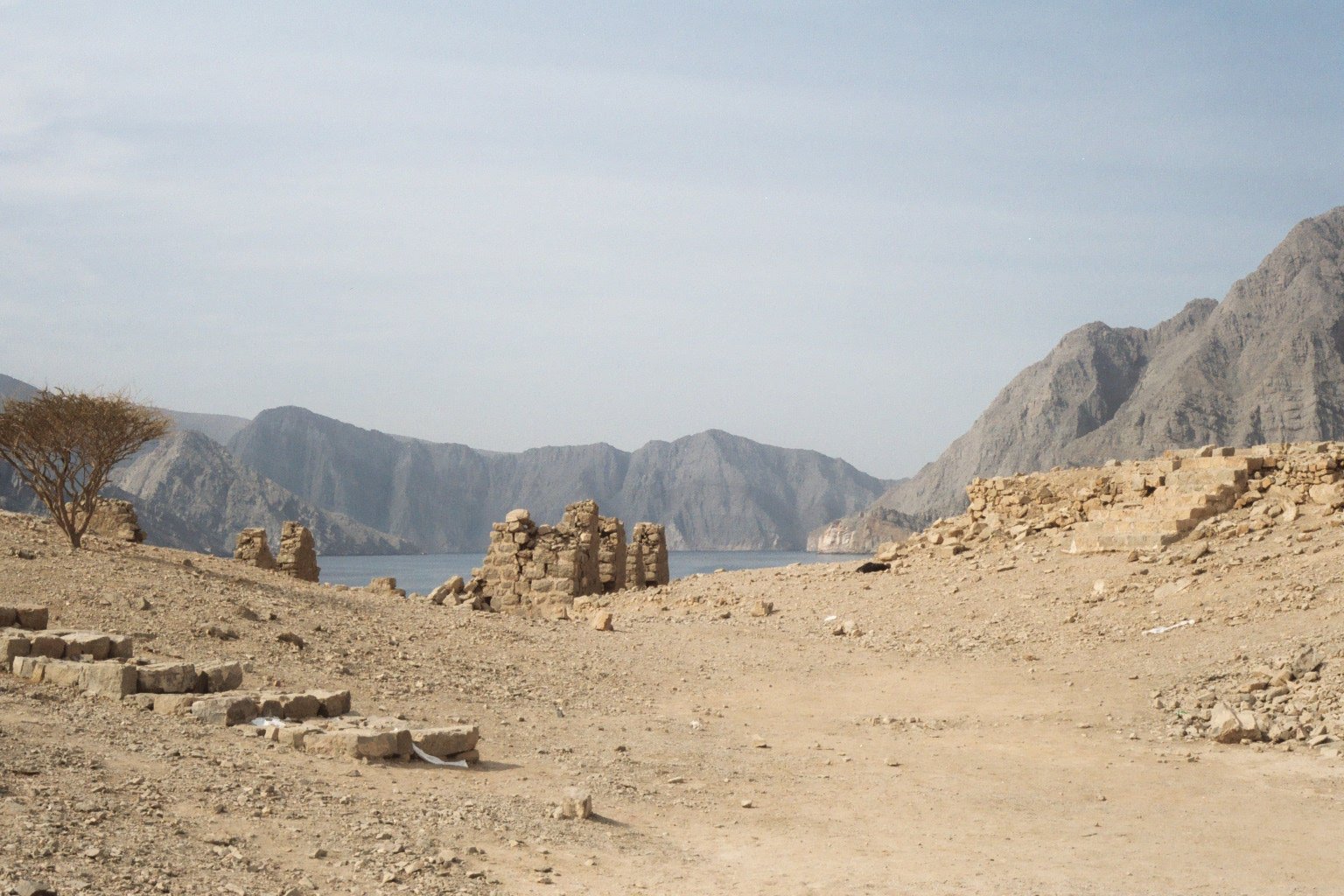
Telegraph Island
The English expression "going round the bend" -- meaning losing one's mind -- may trace its origins to a speck of rock barely 160 meters long, tucked inside a fjord on the Musandam Peninsula of Oman. Telegraph Island, also known as Jazirat al Maqlab, sits less than 400 meters off shore in the Elphinstone Inlet, surrounded by mountains so steep they seem to press the sky into a narrow strip overhead. In 1864, the British Empire chose this sweltering, isolated outcrop as the site for a telegraph repeater station, part of an ambitious submarine cable linking London to Karachi. The operators posted here endured crushing summer heat and the hostility of local tribes. Their only escape meant a long voyage back around the bend in the Strait of Hormuz toward India -- or so the story goes.
The Wire That Bound an Empire
The Indian Rebellion of 1857 sent shockwaves through the British government. Instructions from London took weeks to reach India by ship. The empire needed a faster way to communicate. By 1858, the government was subsidizing schemes to lay telegraph cables across seas and deserts. The Red Sea Telegraph Company tried first, running a submarine cable through the Red Sea to Bombay, but the line proved too fragile for the conditions. It failed completely. Attention turned to the Persian Gulf route. A cable would run from Karachi to Fao at the head of the Gulf, then overland through Ottoman territory to Baghdad and beyond. But the cable needed a midway boost. The repeater station was built on Telegraph Island rather than the mainland because the Zahuriyeen tribe on the nearby Maqtab Isthmus was considered too dangerous for a permanent British presence. Siemens supplied the telegraphic equipment. The Musandam-to-Bushire section was completed on 25 March 1864. The full through-connection to London was achieved in 1865.
Madness in the Heat
Life on Telegraph Island tested the limits of British endurance. The operators had quarters on the rock, along with servants and two decommissioned ship hulks fitted up as living space for staff who needed a break from the monotony. They received regular newspaper deliveries and had a couple of boats for leisure. But the summer heat in the inlet was ferocious, and the surrounding mountains trapped it like an oven. The nearest civilization meant a voyage out of the inlet, through the strait, and around the bend of Musandam -- a phrase that allegedly entered the English language as shorthand for going mad. Whether this etymology is genuine remains debated, but the story has attached itself to the island with the stubbornness of barnacles on a hull. The posting was so miserable that it became a cautionary tale within the telegraph service.
Where Tectonic Plates Collide
The geology of Telegraph Island is as dramatic as its history. The Elphinstone Inlet is a true fjord, carved between mountains whose rock strata visibly dip and buckle under the pressure of the Arabian tectonic plate subducting beneath the Eurasian Plate. This collision zone means the entire Musandam Peninsula is sinking -- its northernmost point drops measurably each year. Fresh-water springs that once flowed over land may now bubble up from the seafloor, giving rise to old stories of sailors diving beneath the waves to collect fresh water in leather bags. The rock itself tells a story of immense forces operating over millions of years, visible in the twisted strata exposed along the inlet walls. From above, the inlet appears as a narrow blue wound cut into otherwise barren, sun-bleached mountains.
A New Chapter for a Forgotten Rock
For over a century after the telegraph era ended, Telegraph Island sat empty, visited only by occasional dhow tours and adventurous kayakers who paddled into the fjord. The ruins of the repeater station crumbled slowly in the heat. But the island has not been entirely forgotten. A major tourism development project is underway to build a multi-purpose hall, marine platform, and mountain walkway, transforming this forgotten outpost into a destination. The island even found its way into fiction: in an episode of the television show Warehouse 13, a fictional military telegraph from the island causes "violent insanity" in anyone who taps its lever. The real telegraph is long gone, but the island endures -- a small monument to imperial ambition, technological daring, and the breaking point of human patience.
From the Air
Telegraph Island sits at 26.195N, 56.343E in the Elphinstone Inlet (Khor Ash Sham), a dramatic fjord on the Musandam Peninsula of Oman. Approach from the northeast over the Strait of Hormuz for the most dramatic view of the inlet cutting into the mountains. The island is tiny -- only 160m long -- so descend below 3,000 feet for a clear view. The nearest airport is Khasab Airport (OOKB), approximately 20 km to the northeast. The surrounding mountains rise steeply on both sides of the inlet, creating dramatic terrain for low-altitude approaches.