Telfair Academy
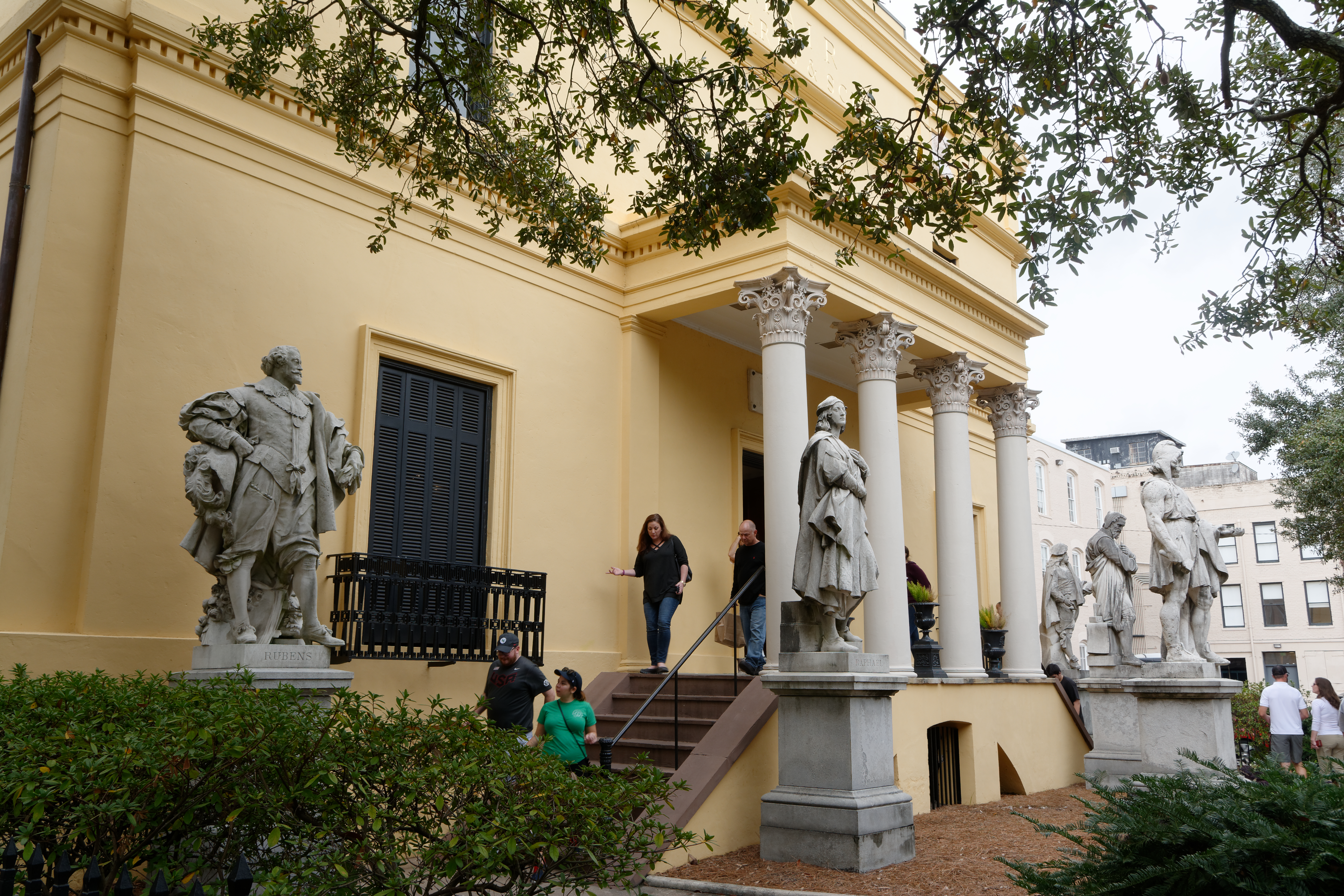
William Jay was barely 26 years old when he designed the mansion at 121 Barnard Street. The son of a former Chief Justice of the United States, Jay had trained in London and arrived in Savannah with a head full of Regency neoclassicism and an ambition to reshape the young city's skyline. The house he built for Alexander Telfair in 1818 -- on the west side of Telfair Square, on land that had once held the colonial Governor's mansion -- was unlike anything Georgia had seen: asymmetrical rooms behind a symmetrical facade, an octagonal drawing room, a round-ended dining room, columns of composite order supporting a projecting portico reached by side-facing stairs. Jay would leave Savannah within a decade, and only a handful of his buildings survive. But this one endures, and it carries two centuries of the city's cultural life inside its stuccoed walls.
The Telfair Legacy
Alexander Telfair was the son of Edward Telfair, one of Georgia's early governors after independence. The family occupied the mansion on Barnard Street for decades, and the house became a center of Savannah's social life. But it was Alexander's sister, Mary Telfair -- the last to bear the family name -- who would determine the building's fate. Before her death in 1875, Mary bequeathed the family home to the Georgia Historical Society with a single, transformative condition: it was to be opened as a public art museum. The conversion took more than a decade. The building's west wing, originally a carriage house, was adapted in the 1880s with fine Adam-style woodwork to serve as gallery space. In 1883, the museum's board elected artist Carl Ludwig Brandt as its first director. When the doors finally opened in 1886, the Telfair Academy became one of the first ten art museums in America and the oldest public art museum in the South.
Rooms That Refuse Straight Lines
Jay's architecture rewards close attention. The exterior is deceptively orderly: a two-story masonry structure of brick finished in stucco, its four-column portico projecting forward with classical confidence. The entablature continues around the entire building as a stringcourse, binding the facade into a single composition. Step inside, though, and symmetry dissolves. The octagonal drawing room catches light from unexpected angles. The dining room's rounded ends soften what could be a rigid formal space. A long drawing room stretches the length of one side, its own ends curved as well. Jay was playing a game with his patrons: authority on the outside, surprise within. The building occupies an entire block, bounded by Barnard, West President, North Jefferson, and West State Streets -- a footprint that speaks to the Telfairs' ambitions and to the scale of early Savannah's civic architecture.
The Girl Who Came Inside
Among the Telfair Academy's most celebrated residents is a 50-inch bronze sculpture of a young girl in a simple dress, her gaze contemplative and tilted. Bird Girl was created in 1936 by sculptor Sylvia Shaw Judson in Lake Forest, Illinois. One cast was purchased by a Savannah family who placed it in their plot at Bonaventure Cemetery, where it stood for decades in near-anonymity. That changed in 1993, when photographer Jack Leigh shot the statue for the cover of John Berendt's "Midnight in the Garden of Good and Evil." The book became a bestseller, and suddenly the cemetery plot was swarmed with visitors. The family removed the statue for its protection and lent it to Telfair Museums. In 2014, Bird Girl was moved to the Telfair Academy itself, where she continues to draw visitors who first met her on a book cover.
A National Landmark on a Colonial Square
In 1976, the Telfair Academy was declared a National Historic Landmark, recognizing both Jay's architectural achievement and the building's role in American cultural history. It sits on Telfair Square, originally called St. James Square after the famous green space in London. The square was one of Savannah's original four, laid out by James Oglethorpe in 1733, and it remains one of the most graceful corners of the Historic District. The Telfair Academy is now one of three sites operated by Telfair Museums, alongside the Owens-Thomas House -- another Jay design -- and the Jepson Center for the Arts. Together they anchor Savannah's identity as a city that preserves not just its buildings but the creative life that fills them. Mary Telfair's gift, made a century and a half ago, continues to pay dividends in a city that understands the value of keeping its doors open.
From the Air
Coordinates: 32.079N, 81.095W. The Telfair Academy occupies a full block on the west side of Telfair Square in Savannah's Historic District. From the air, look for the grid of green squares along the Savannah River bluff; Telfair Square is in the northwest quadrant of the original grid. Nearest airport: Savannah/Hilton Head International (KSAV), approximately 8 nm northwest. Hunter Army Airfield (KSVN) is about 5 nm south. Best viewed at 1,500-3,000 feet AGL.