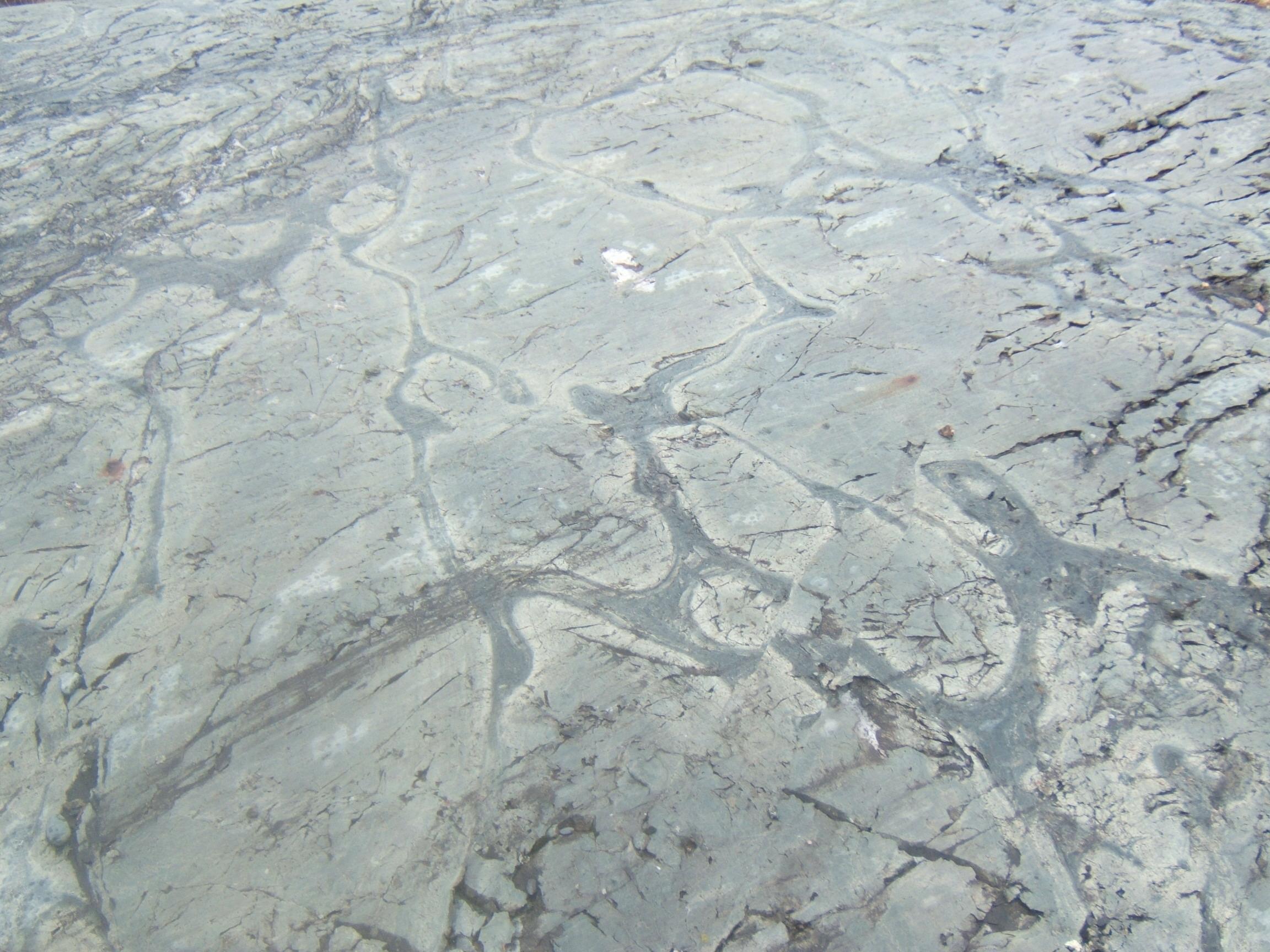
Temagami Greenstone Belt
Two point seven billion years. That is how long the rocks beneath the Temagami Greenstone Belt have been sitting here, in what is now northeastern Ontario, waiting for someone to notice. When the volcanic eruptions that created this narrow strip of metamorphosed basalt and rhyolite were taking place, there were no continents as we know them -- just the ancient Superior craton, a slab of early lithosphere that would eventually become the core of North America. The belt formed underwater, through eruptions that ranged from passive lava flows to violent explosions, building layers of pillow lava, pyroclastic debris, and mineral-rich intrusions that geologists are still cataloging today. It is a window into the deep past -- not deep in the human sense, but in the planetary sense, when the Earth's crust was still figuring out what it wanted to be.
The Fabric of the Shield
The Temagami Greenstone Belt is part of the Canadian Shield, one of the largest single exposures of Precambrian rock on Earth. Within the belt, a remarkable variety of geologic features are packed into a relatively compact area: batholiths, volcanic complexes, layered intrusions, deformation zones, and networks of dikes cutting through older formations. The oldest exposed rocks are fine to medium-grained basalts and andesites. Overlying them are dacitic and rhyolitic lava flows and tuffs, remnants of increasingly explosive volcanic episodes. Uranium-lead dating has established that the Iceland Lake Pluton and an adjacent rhyolitic lava flow are approximately 2,736 million years old -- predating even the closest exposed portion of the Abitibi Subprovince to the north. Pillow lava, formed when molten rock erupted into water, is found throughout the belt, physical proof that these volcanoes once rose from the floor of a primordial ocean.
Four Supercontinents and Counting
The rocks of the Temagami Greenstone Belt have been passengers on a slow-motion planetary journey spanning billions of years. When the belt formed 2.7 billion years ago, it was part of the supercontinent Kenorland, a landmass that included the Baltic and Siberian shields of Eurasia along with Archean provinces of North America. Kenorland began rifting apart 2.45 billion years ago, splitting into fragments that drifted for hundreds of millions of years before reassembling. By 1.1 billion years ago, the belt had been incorporated into Rodinia, another supercontinent whose core was Laurentia -- the ancient craton that includes northeastern Ontario. Rodinia broke apart, reformed as Pannotia around 600 million years ago, broke apart again after just 65 million years, then became part of Euramerica, and then Pangaea, and then Laurasia, before finally ending up in North America as we know it. The greenstone belt has been on every major continental raft the Earth has assembled.
Ghosts of Prehistoric Volcanoes
Several locations within the belt preserve evidence of ancient volcanic vents -- the throats of volcanoes that erupted billions of years ago. Remnants of a large vent lie west of Sherman Mine, where two felsic lava flows outcrop between Link Lake and Turtle Lake. The direction the lava traveled and the coarseness of volcanic fragments suggest a prominent volcanic structure once stood near the western shore of Link Lake -- possibly the remains of a prehistoric volcano that has been ground down to its roots. The Younger Volcanic Complex, southeast of these vents, consists mainly of mafic volcanic rocks forming four distinct geologic formations. The Arsenic Lake Formation is composed of dark green, iron-rich tholeiitic basalts, both massive and pillowed. Chert-magnetite iron formations extend under a chain of small lakes from Vermilion Lake to Net Lake, tracing the mineral seams that would attract miners thousands of years later.
The Mines That Followed
Where there are greenstone belts, there are usually mines, and Temagami is no exception. Sherman Mine, northwest of the town of Temagami, was a major iron ore producer. Mining began in 1968 across seven open pits -- North, East, South, West, and three smaller Turtle Pits. A railroad was built from the Ontario Northland Railway specifically to move the ore. The resource town of Temagami North was constructed in the 1960s to house mine workers, and when the mine eventually closed, the economic impact rippled through the entire region. The Kanichee Mine, first discovered just before World War I, yielded a massive sulfide deposit containing palladium, nickel, copper, gold, cobalt, platinum, and silver. Mining took place in the 1930s and again in the 1970s; the flooded open pit and underground workings remain today. Copperfields Mine on Temagami Island in Lake Temagami operated from 1955 to 1972, extracting copper, gold, and silver. Even the smaller Big Dan mine shipped gold from two shallow shafts sunk in 1906.
Deep Water, Old Name
The name Temagami itself is Ojibwe, meaning "deep water by the shore." Until 1968 it was spelled Timagami on all official maps and documents, a spelling adopted on June 25, 1906. The change to Temagami came at the instigation of the general public, processed through the Canada Post Office and the Geographical Names Board of Canada. The original spelling has stubbornly persisted in some published works, including Kent C. Condie's 1981 academic text Archean Greenstone Belts -- a book literally about the geology underfoot. From the air, the greenstone belt is invisible in any conventional sense. The boreal forest and Shield lakes give no visual hint of the volcanic complexity below. But the open pits of Sherman Mine and the flooded workings of Kanichee offer geometric scars in the canopy, evidence that what lies beneath this quiet landscape was valuable enough to reshape the surface.
From the Air
Located at 47.08°N, 79.81°W in the Temagami region of northeastern Ontario, Canada. The greenstone belt stretches across several townships including Chambers, Strathy, Strathcona, and Briggs. Sherman Mine's open pits are visible as large geometric clearings northwest of the town of Temagami. The flooded Kanichee Mine pit is visible north of the belt. Highway 11 traverses the area. Nearest airport: North Bay/Jack Garland Airport (CYYB), approximately 45nm south-southeast. The terrain is Canadian Shield boreal forest with numerous lakes. Best viewed from 3,000-6,000 ft AGL; the mine scars and geological features are most apparent in winter when snow contrasts with exposed rock. Lake Temagami lies immediately to the south.