Temple Expiatori del Sagrat Cor
The mountain's name comes from the Latin 'tibi dabo' -- 'I will give you' -- the words the devil spoke to Christ during the Temptation, offering all the kingdoms of the world visible from the summit. Whether that story is apocryphal or not, standing at 512 meters above sea level on the highest point of the Serra de Collserola, you can see why someone chose this peak for a church dedicated to the Sacred Heart of Jesus. The view takes in all of Barcelona, the Mediterranean, and on clear days, Montserrat and the Pyrenees. The Temple Expiatori del Sagrat Cor crowns this summit with a layered confection of stone -- part fortress, part cathedral, part skyline punctuation mark visible from almost anywhere in the city below.
A Race Against a Casino
The church exists because of a real estate panic. In the late nineteenth century, rumors circulated that developers planned to build a Protestant church and a hotel-casino on Tibidabo's summit. A group calling themselves the 'Board of Catholic Knights' moved quickly, purchasing the land and presenting it to Saint John Bosco during his 1886 visit to Barcelona, at the invitation of patron Dorotea de Chopitea. The idea took shape: a church dedicated to the Sacred Heart, following the devotional momentum encouraged by Pope Leo XIII and inspired by the Sacre-Coeur in Paris. A neo-Gothic hermitage went up in 1886. But an astronomical observatory project delayed the main church -- the observatory eventually moved to a nearby hill, becoming the Fabra Observatory -- and the foundation stone was not laid until December 28, 1902.
Fifty-Nine Years of Stone
Architect Enric Sagnier designed a building of deliberate contrasts. The lower crypt, built between 1903 and 1911, is a Romanesque fortress of Montjuic stone -- heavy, grounded, bunker-like. The upper church, constructed between 1915 and 1951, soars above it in neo-Gothic verticality, accessed by two grand outdoor stairways. Sagnier's son, Josep Maria Sagnier i Vidal, completed the project after his father. The church was consecrated in 1952 during Barcelona's 35th Eucharistic Congress, and the towers were finished by 1961, when Pope John XXIII granted it the title of minor basilica. The entire construction spanned fifty-nine years -- a marathon by any measure, though modest compared to the Sagrada Familia down the hill.
Destruction and Replacement
The crowning bronze statue of the Sacred Heart, arms spread wide over Barcelona, is not the original. Sculptor Frederic Mares created the first figure in 1935, but it survived barely a year: when the Spanish Civil War erupted in 1936, the statue was destroyed, along with a mosaic of the Holy Trinity by Daniel Zuloaga on the crypt facade. The replacement statue, by sculptor Josep Miret, went up in 1950. Miret's hand is everywhere in the church -- he also carved the Twelve Apostles on the exterior towers, the polychrome alabaster Stations of the Cross in the crypt, and numerous other sculptural elements. The crypt's mosaic was replaced in 1955 by the Bru Workshop of Barcelona, depicting an allegory of Spain's devotion represented by its patron saints.
Light and Ascent
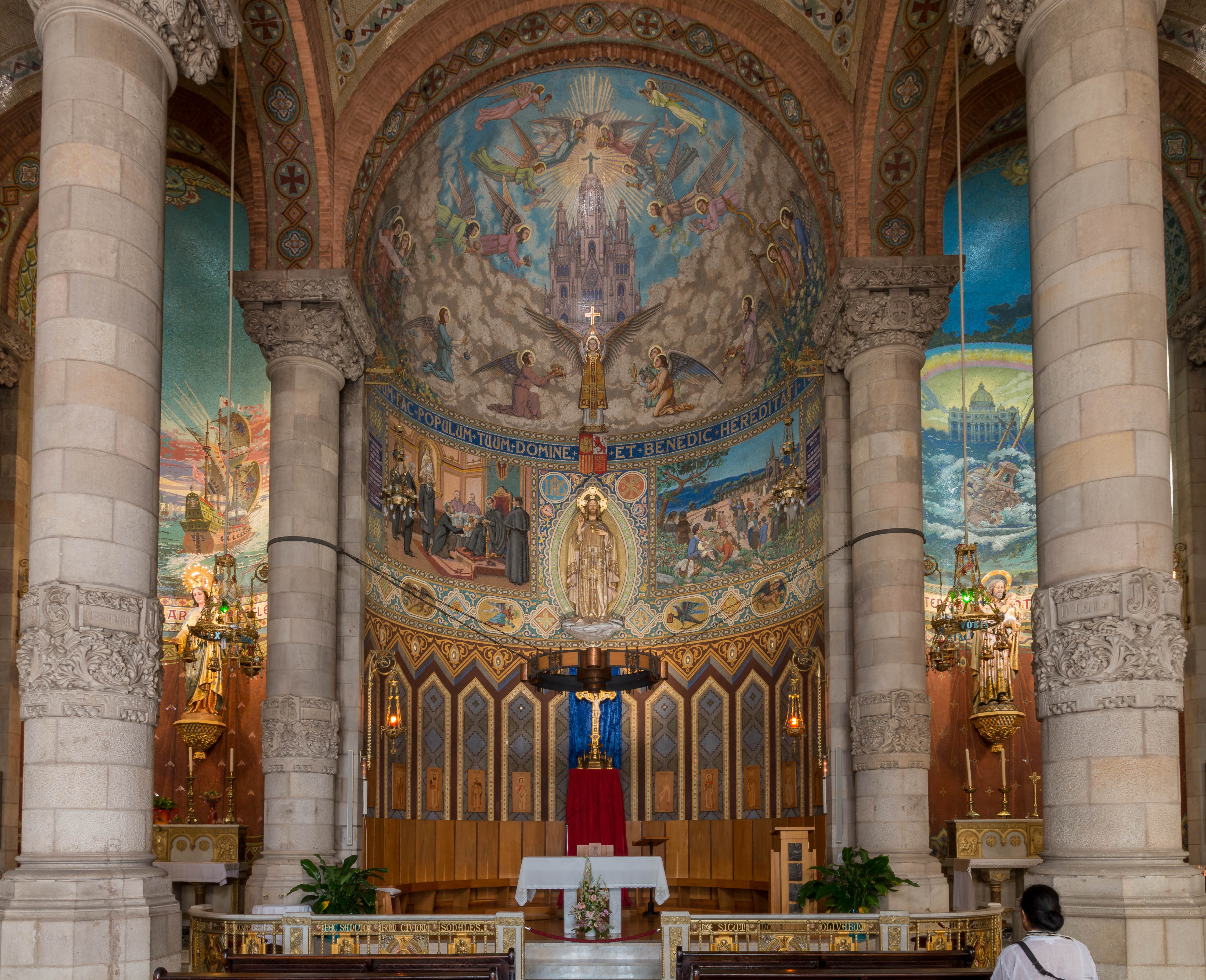
The interior layers experiences as deliberately as the exterior layers architectural styles. The crypt is intimate and dim, its five naves separated by columns, walls lined with alabaster and decorated with mosaics depicting the altars' dedications: Mary Help of Christians, Saint Anthony of Padua, the Blessed Sacrament, Saint Joseph, and the Virgin of Montserrat. Deeper still, a chapel for Perpetual Adoration was excavated into the mountain itself in the late 1940s. Climbing from crypt to upper church, the space opens dramatically: stained glass windows and four rose windows flood the nave with color. The windows of the four towers contain the Latin words 'tibi dabo,' the mountain's name made visible in glass. The progression from underground darkness to summit light was designed as a spiritual metaphor -- the ascent from crypt through church to the outstretched arms of Christ above representing the purification of the human condition.
From the Air
Located at 41.422N, 2.119E on the summit of Mount Tibidabo (512m), the highest point of the Serra de Collserola ridge behind Barcelona. The church is highly visible from the air due to its elevated position and the large bronze Sacred Heart statue on top. From any approach to Barcelona, the Sagrat Cor is one of the first landmarks identifiable on the skyline. Nearest airport is Barcelona-El Prat (LEBL), 18 km south-southwest. Best viewed at 3,000-5,000 feet AGL from the southeast, where the church is silhouetted against the mountain with the full panorama of Barcelona and the Mediterranean below.