Temple of Amun, Jebel Barkal
Before a Kushite could be crowned king, a journey was required. Government officials and the candidate left the capital and traveled by boat to a flat-topped sandstone butte 400 kilometers north of modern Khartoum. At the base of that butte, at Jebel Barkal, lay the Temple of Amun - one of the holiest places in the ancient world. The king walked through its pylons, past its hypostyle halls, into the Holy of Holies. There, a priestly oracle confirmed - or withheld - the god's approval. Whoever emerged with Amun's blessing was king. Whoever did not was not. The god lived in the mountain. The temple was how you met him.
A Mountain Home for Amun
The Temple of Amun sits at the eastern foot of Jebel Barkal, a striking isolated sandstone butte about 400 kilometers north of Khartoum near the modern town of Karima. The mountain, with its near-vertical cliffs and a free-standing pinnacle at one corner, was identified by the Egyptians as a home of the god Amun - a cosmic cousin of his main dwelling at Karnak in Thebes. Thutmose III founded the temple in the 15th century BCE, shortly after his military campaign into Nubia. In his Jebel Barkal Stele, he called the temple "Amun's Resting Place of Eternity" and told a story of a miraculous star that Amun sent to help him in battle - an omen, a divine intervention, propaganda, depending how you read it. The earliest temple was mud brick. Later pharaohs replaced it with stone, built of the peculiar brick-like blocks called talatat that Amenhotep IV - soon to be Akhenaten - had invented.
Religion, Reversed and Reversed Again
The temple's construction runs across one of the most turbulent religious periods in Egyptian history. Under Amenhotep IV, who became Akhenaten, the old cult of Amun was briefly suppressed in favor of worship of the sun-disc Aten, and the temple's second phase reflects this - open-air sanctuaries, roofless chapels, the kind of courtyards you needed if your god was the sun itself. When Akhenaten died, his successors Tutankhamun and Horemheb reversed all of it. Amun was restored. The pylon was rebuilt in white sandstone talatat and extended. Green-glazed tiles were added under the portico. During the Nineteenth Dynasty, Ramesses II and his father Seti I continued the additions - second and third pylons, a hypostyle court, a hall with annexes, another courtyard, several chapels. The temple kept growing as the empire it served kept changing shape.
The Kushite Renovation
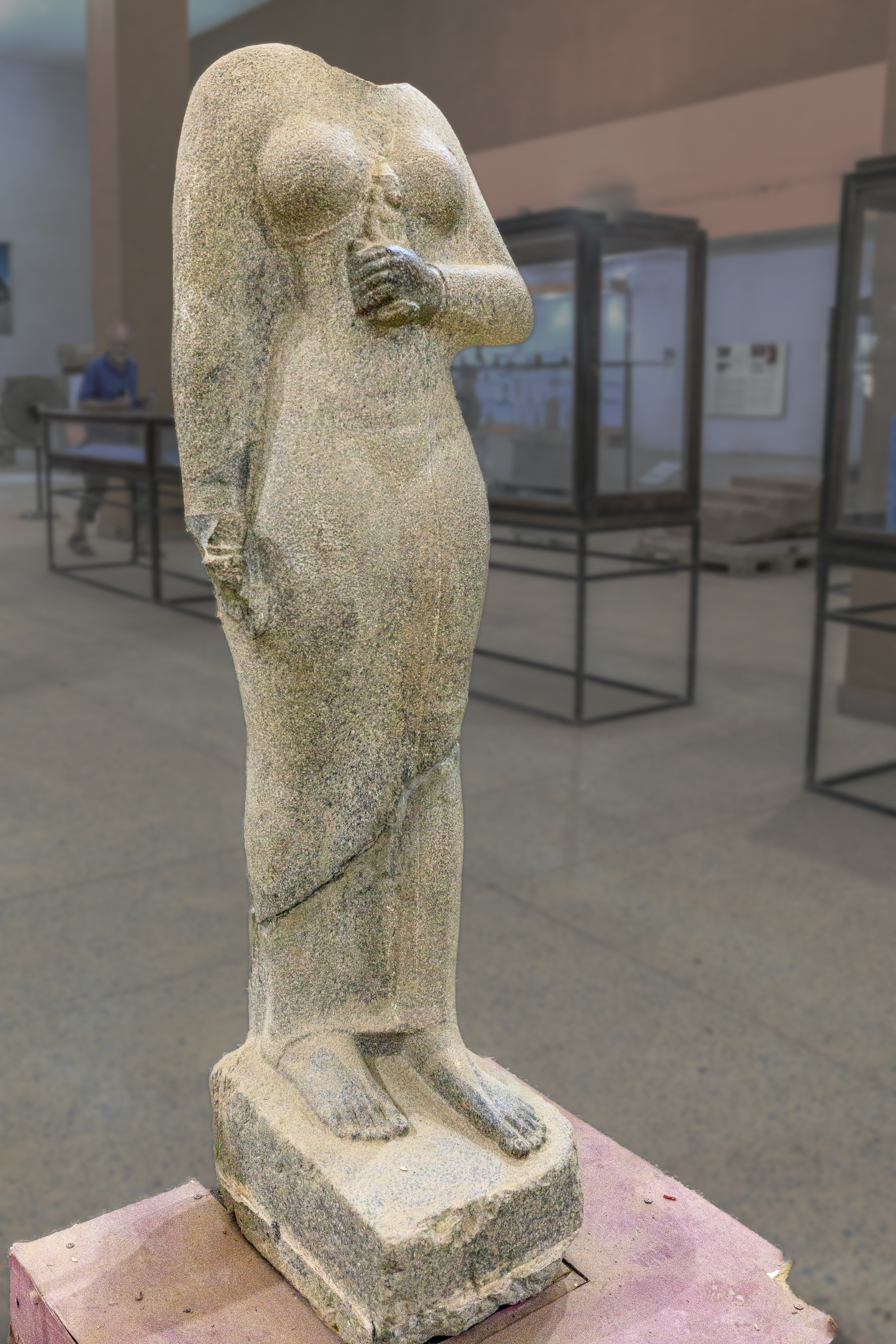
The most dramatic rebuilding came from Kushite pharaohs, who ruled Egypt as the Twenty-fifth Dynasty in the 8th and 7th centuries BCE. King Piye, after his conquest of Egypt around 740 BCE, returned to Jebel Barkal and undertook a three-stage renovation: strengthening the old walls with new additions, building a 50-column great hall with sandstone pillars set into unbaked brick walls, and adding a large farm or temple courtyard decorated with columns. The whole complex grew past 150 meters in length. Taharqa built ten colossal figures. Tantamani erected a small shrine in the portico. North of the First Pylon, archaeologists excavated a cache that included the headless statue of Tantamani - Taharqa's successor - hidden perhaps during an invasion. Pillars bear the names of Piye and Harsiotef. Many of the stelae, statues, and inscriptions now sit at the Museum of Fine Arts in Boston, where the Harvard-Boston expedition carried them between 1909 and 1916.
The Romans Come, the Romans Go
In 25/24 BCE, the Roman governor Gaius Petronius invaded Nubia during Augustus's reign, campaigning against the Kushites under Queen Amanirenas - one of the ruling Kandakes of Kush, and a woman who went on to sign a negotiated treaty with Rome that the Romans, for once, actually kept. Petronius destroyed the Temple of Amun and took Jebel Barkal from Amanirenas. He razed Napata to the ground. But the Romans could not hold what they had taken. They withdrew. Amanirenas and her successors came back. The last large-scale construction at the temple was the work of King Natakamani, who restored some of the Roman destruction, enlarged the complex, and renovated the first pylon. After that, the temple slowly declined as the religious center of Kushite culture shifted elsewhere. By the middle of the 19th century CE, it was subject to vandalism and plundering - until modern state protection finally took hold. Today the Temple of Amun stands as part of the Jebel Barkal UNESCO World Heritage Site, its ruins still working the same trick they have worked for three thousand years: bringing you up close to a mountain, and letting it do the rest.
From the Air
Located at 18.54N, 31.83E on the east bank of the Nile in Sudan's Northern State, at the foot of Jebel Barkal near the modern town of Karima. Recommended viewing altitude: 3,000-5,000 feet AGL to see both the temple ruins and the distinctive flat-topped sandstone mountain together - one of the most photogenic archaeological landscapes in Africa. The free-standing pinnacle at the mountain's southwest corner is a dramatic visual marker visible for many kilometers. Nearest major airport is Merowe (HSMN) about 30 km to the northeast; Dongola (HSSW) is roughly 180 km downstream. Khartoum International (HSSS) is about 400 km to the south. Expect clear desert visibility most of the year.