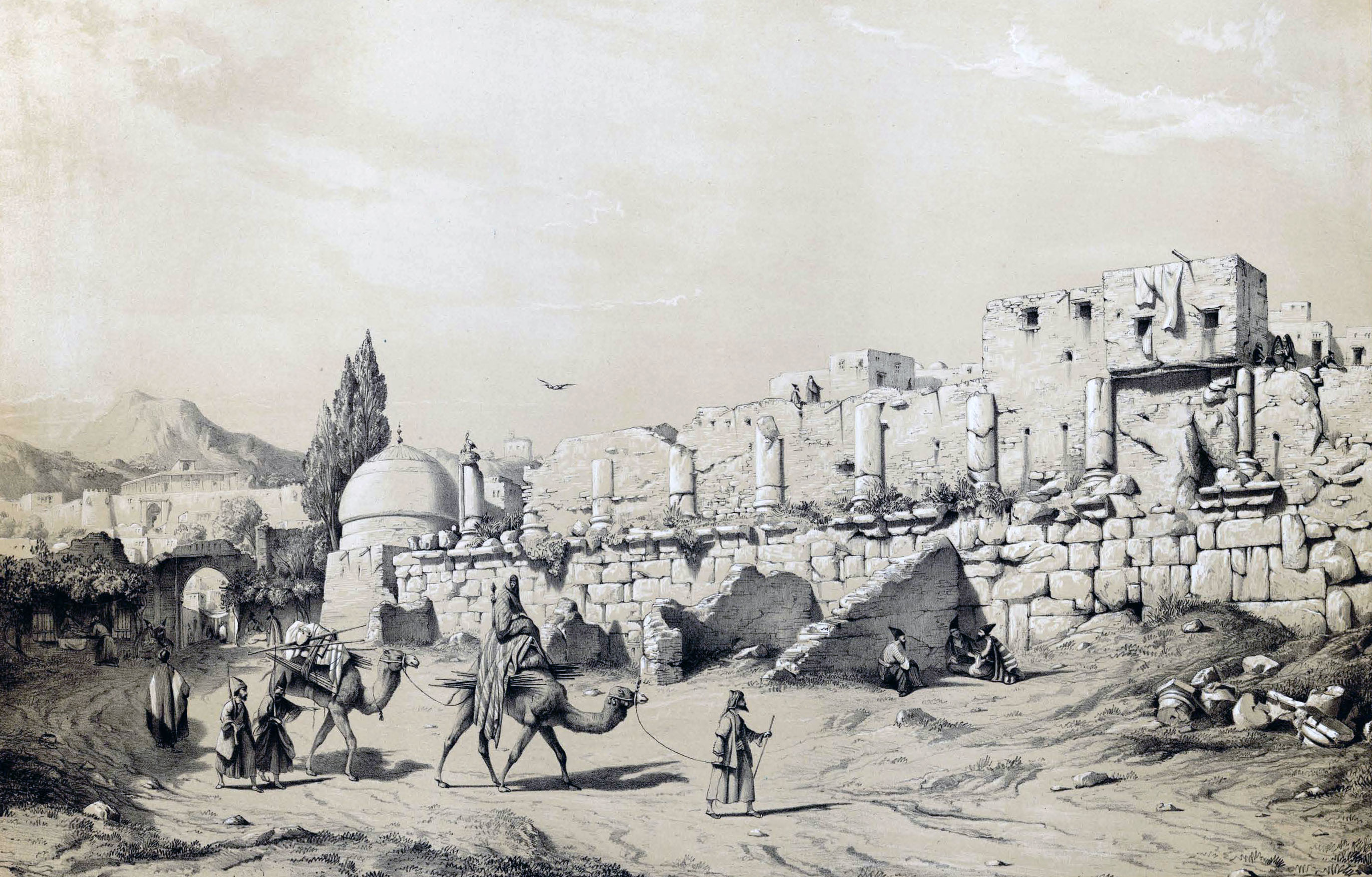
Temple of Anahita, Kangavar
In the 1840s, the French artist Eugene Flandin sketched the ruins at Kangavar and labeled them simply: the Greek temple. He was wrong about the Greek part, but he captured something essential. The massive stone platform, measuring just over 200 meters on each side, with its Ionic columns and twin lateral stairways, looks like it belongs in the Mediterranean world. Yet it stands in the Zagros Mountains of western Iran, and the question of what it actually is has consumed scholars for more than a century.
A Goddess of Waters
The popular identification ties this site to Anahita, the ancient Iranian deity associated with water, fertility, and warfare. The connection comes from Isidore of Charax, a 1st-century geographer who recorded a temple of Artemis along the Parthian royal road in his work Parthian Stations. In the Iranian context, references to Artemis are generally understood as references to Anahita, and Kangavar sits squarely on the ancient route. When excavations began in 1968, the identification seemed settled: this was a columnar temple dedicated to the goddess. The great Ionic columns set on their high stone platform, the sacred precinct defined by its temenos wall, the sheer scale of the construction all pointed toward a place of worship built to honor a deity who commanded reverence across the Persian world.
Echoes of Persepolis
Whatever its purpose, the architecture speaks a Persian vocabulary. The plinth's megalithic foundations echo the stone platforms of the Achaemenid kings. The two lateral stairways ascending the massive platform recall the grand approach to the Apadana at Persepolis, where Darius I received tribute from the nations of his empire. Warwick Ball, a leading authority on the region's archaeology, called the structure one of the greatest works of Parthian architecture, noting its eastern Roman temple form while agreeing that it architecturally recalls Achaemenid traditions. Arthur Upham Pope reached similar conclusions decades earlier. The building exists at a crossroads of influences: Persian foundations, Hellenistic columns, Parthian ambition, and possibly Sasanian renovation.
Palace, Temple, or Both?
In 1981, excavator Massoud Azarnoush upended the consensus. His report contended that the construction did not have the necessary characteristics to identify it as a temple. Ali Akbar Sarfaraz, former head of the Tehran University archaeology team, agreed. Their alternative: the ruins are those of a late Sasanian palace. A third camp, led by archaeologist Seifollah Kambakhshfard, proposed a longer timeline entirely, arguing that the site was originally constructed in the Achaemenid era and underwent several phases of building and rebuilding over centuries. The dating question compounds the identity problem. Originally assigned to around 200 BCE, the construction was later re-examined and potentially pushed forward into the Sasanian period. The scholarly debate continues because the evidence permits multiple readings.
Two Hundred Meters of Ambiguity
Stand on the platform at Kangavar and the scale is undeniable. This was not a modest construction. The plinth alone covers an area equivalent to four football fields, built with stones large enough to suggest an organized labor force of significant size. The twin stairways that ascend each side were designed for procession, whether of worshippers approaching a goddess or courtiers approaching a king. Karim Pirnia argued that the Parthian-style construction underwent Sasanian-era renovations, which would explain the layered architectural signatures. The temenos, the sacred boundary wall that defined the precinct, suggests a religious function. But palaces also had defined boundaries, and power in the ancient Near East rarely distinguished sharply between the sacred and the royal.
A Sister in the South
Kangavar is not the only site in Iran associated with Anahita. At Bishapur, far to the south in Fars Province, another temple bears her name. That structure was probably built by Roman prisoners, its walls constructed of well-cut ashlar blocks with distinctive trapezoid-shaped doorways. The contrast between the two sites is instructive. Bishapur's temple is clearly a building constructed by foreign hands using foreign techniques. Kangavar's monument is something more ambiguous, more layered, more authentically at the intersection of empires. It may have begun as one thing and become another, its stones repurposed across centuries by rulers who each left their mark. Whether Anahita was ever worshipped here may never be settled. What remains is a platform massive enough to anchor a temple or a palace, built by people who understood that scale itself communicates power.
From the Air
The Temple of Anahita at Kangavar lies at approximately 34.50N, 47.96E in Kermanshah Province, western Iran. The massive stone platform is visible from altitude as a large rectangular feature in the town of Kangavar. The Zagros Mountains provide dramatic terrain in all directions. Nearest airports include Kermanshah (OICC) and Hamadan (OIHH). Recommended viewing altitude: 3,000-6,000 feet AGL to appreciate the platform's scale against the town.