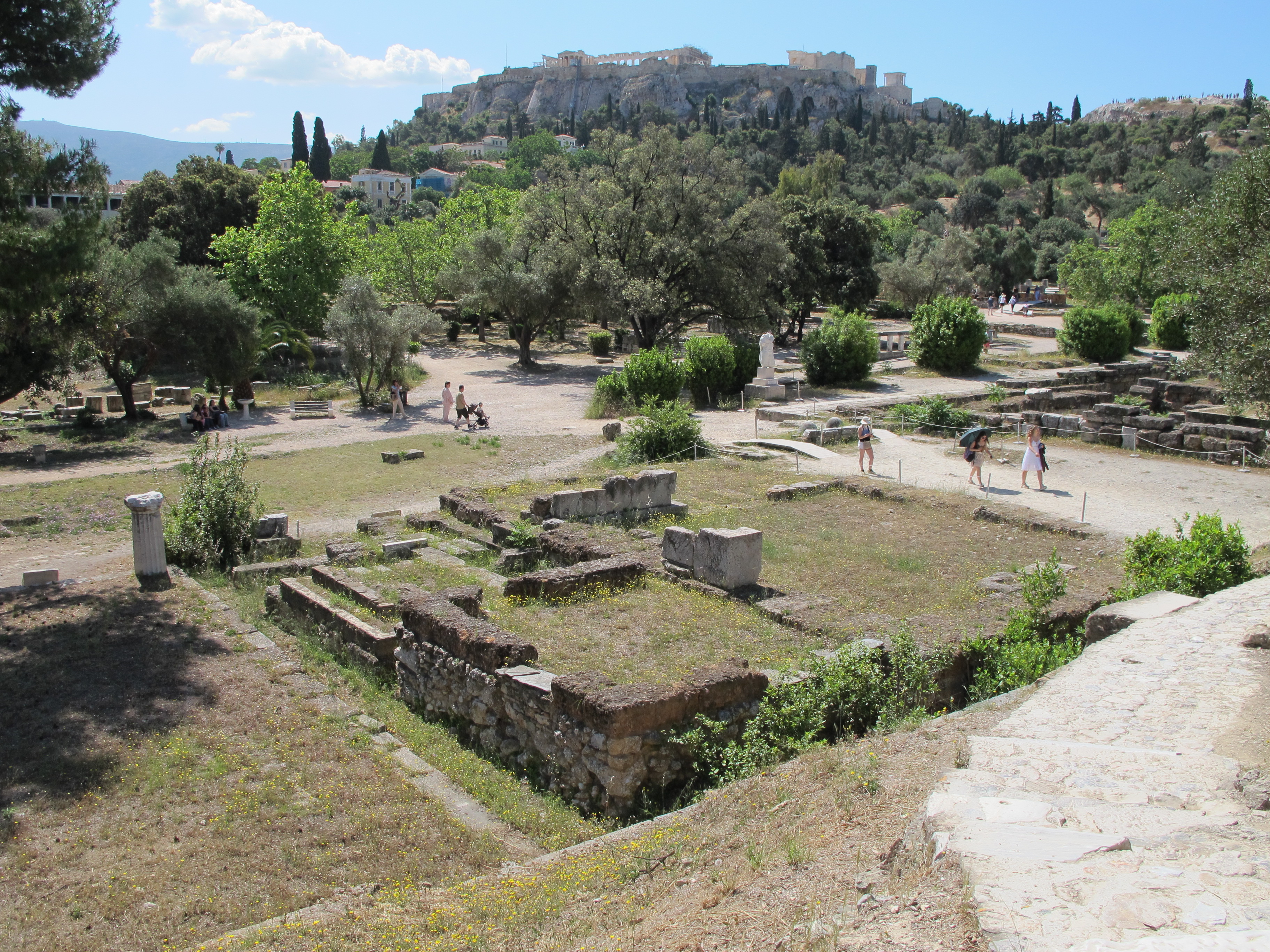
Temple of Apollo Patroos
Before any Athenian could take office as archon, he had to answer one question: where is your family's shrine to Apollo Patroos? Apollo of the Fathers. The god from whom, according to Athenian belief, every citizen could trace descent. If you could not name the location of the cult of Apollo Patroos belonging to your phratry - your kinship group - you could not serve. The civic test was paternity through divinity. The temple at the heart of this cult was small. It still is, what remains of it, on the west side of the Agora beneath the Hephaisteion hill. Foundations, mostly. A truncated wall. But the colossal marble statue that stood inside has been reassembled, and standing before it in the Agora Museum you understand why the cult mattered: this Apollo was the ancestor every Athenian needed.
The First Temple, Burned by Persians
The earliest building on this site appeared in the mid-6th century BC. It was apsidal - rounded at one end - with foundations of fieldstones bedded in clay. Not a grand structure, perhaps not even what an Athenian of the Classical period would have called a temple. A pit beside it contained fragments of the mold for a bronze statue, hinting that the building once held a cast nude male figure as its cult image. In 480 BC the Persian army of Xerxes burned Athens to the ground, including this small shrine. Foundations charred. Walls collapsed. After that, for nearly two centuries, the area remained sacred but unbuilt - just a horos boundary stone marking it as Apollo's, with benches behind looking out across the Agora. The Athenians sat on those benches and did business at the foot of an empty sanctuary.
Why Athenians Needed an Ancestor God
Apollo Patroos held a specific genealogical claim. In Athenian tradition, Apollo had fathered Ion, who in turn fathered the Ionian Greeks - of whom the Athenians were the senior branch. Worshipping Apollo Patroos was a way of asserting that the Ionian cities of the eastern Aegean coast were Athenian colonies, kin obligated to honor the mother city. When Athens lost direct control of those cities in the late 4th century BC and entered the orbit of Antigonus Monophthalmus and Demetrius Poliorcetes' Macedonian realm based in Asia Minor, the cult took on new urgency. Around 306-300 BC, Athens built the new hexastyle Ionic temple whose foundations are visible today. The art historian Andrew Stewart argues this was a deliberate diplomatic gesture: Athens reasserting, in stone, that Apollo's Ionian children all traced back to her.
Euphranor's Apollo
Inside the temple stood a colossal cult statue carved by Euphranor, one of the most respected Athenian sculptors of the 4th century BC. The statue depicted Apollo standing in a long chiton and himation, his long hair falling on his left shoulder, holding a kithara - a lyre - tucked under his left arm. The original marble block weighed about 6.5 tonnes. Standing 2.8 meters tall, the figure was meant to be seen against the back wall of the temple, not in the round; its rear surface was only roughly worked. The statue survived for nearly six centuries. Then in 267 AD a Germanic tribe called the Heruli sacked Athens. The Apollo was damaged, dragged out, and split vertically down the middle in preparation for being fed to a lime kiln - the standard fate of unwanted marble in the late ancient and Byzantine world. The kiln never came. The two halves lay buried until 1907, when Greek archaeologists found them and reassembled the figure that stands today in the Agora Museum.
Niobids on the Roof
The temple's roof acroteria - the corner sculptures - depicted a horror story. Apollo and his sister Artemis murdering the children of Niobe. Niobe had boasted that her fourteen children made her superior to Leto, who had only two. The two were Apollo and Artemis. They killed every one of Niobe's children with arrows. The right corner of the temple roof showed a running Niobid girl in a Doric peplos, modeled on a sculptural type known from many Roman copies; the left corner showed another fleeing daughter; the central acroterion was probably Artemis herself, accompanied by Apollo, hunting them down. To enter the temple of Apollo of the Fathers, in other words, was to walk under a sculptural reminder of what happened to mortals who insulted the divine maternity. The message was civic: respect ancestry, divine and human alike.
Small Footprint, Long Memory
The temple was excavated by Wilhelm Dorpfeld in 1895-96 - he initially mistook it for the Stoa Basileios - and then by the Greek Archaeological Society in 1907-08, when the Apollo statue was recovered. The American School of Classical Studies completed the work between 1931 and 1935 and made the definitive identification. The footprint is small enough that visitors to the Athenian Agora often walk past it without noticing. North of the foundations runs the Stoa of Zeus; south lies the Metroon; east of the Apollo Patroos site, the Romans later built the Temple of Ares - which was itself, remarkably, an older building moved here from the countryside. The agora was always a chess game of sacred buildings. Apollo Patroos was a small piece on that board. But for an Athenian gentleman about to take office, walking past on his way to swear his oath, this was the building that confirmed he was qualified to serve.
From the Air
Temple of Apollo Patroos sits at 37.9756 N, 23.7222 E in the western part of the Ancient Agora of Athens, just north of the modern Athens-Piraeus electric railway and east of the Hephaisteion. Best viewed at 2,000-3,000 feet on overflights of central Athens; the Acropolis is 400 meters southeast of the site. Closely controlled airspace - Athens TMA. Nearest airfields: Athens International (LGAV/ATH) 25 km southeast, Athens Eleusis (LGEL) 25 km northwest. The Agora archaeological park is open to view from above when ATC permits low transit; otherwise visible from the south on flights into Athens via the Saronic Gulf approach.