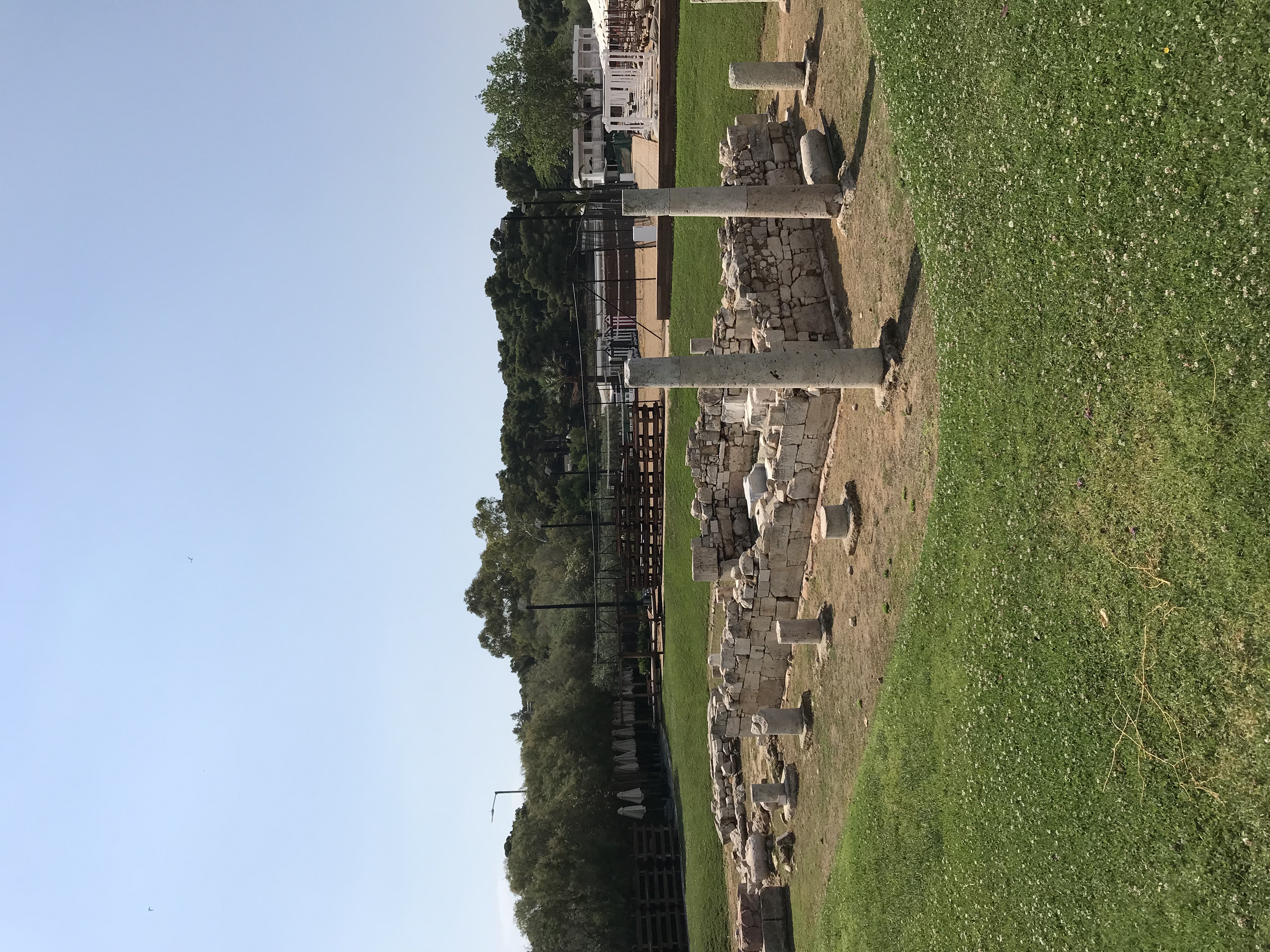
Temple of Apollo Zoster
Children found it. In 1926, kids from an orphanage in the seaside village of Vouliagmeni were playing in the sand at what is now Astir Beach, south of Athens. They began to dig. They hit marble. The archaeologists who came afterward, K. Kourouniotes and M. Pittidis, spent the next two seasons excavating one of the most charmingly located ancient temples in Attica - a small Archaic-period sanctuary that lies, even now, almost at sea level, surrounded by manicured lawn and resort hedges. The story it commemorated was older than the temple itself. Leto, pregnant by Zeus and pursued by a jealous Hera, had stopped here on her way to give birth. She had loosened her gilt belt - in Greek, her zoster - because she thought the labor was beginning. Apollo and Artemis came into the world that day, but not at this site. This was just where their mother adjusted her clothing.
The Goddess and the Belt
The Greeks were fond of preserving small mythological pauses in real geography. Leto did not give birth here - the standard tradition placed that on the floating island of Delos - but she paused. Pausanias, the 2nd-century AD travel writer, recorded the local belief: at this precise headland Leto, hounded across the world by Hera's wrath, had loosened her belt thinking the moment had come. The headland and the temple took the name Zoster, "the belt." Worship at the site centered on three deities: Apollo, his twin sister Artemis, and their mother Leto. Three bases inside the temple's sekos held statues of all three. Two of those bases still bear an inscription: HALAIES ANETHESAN - "the citizens of Halai dedicated." The deme of Halai Aixonides covered the modern coastal districts of Voula and Vouliagmeni, the salt-fields of the Aegean coast south of Athens. These were the people who built and maintained this temple. Their names are gone. Their dedication endures in carved marble.
Persians at the Headland
Herodotus tells a strange military anecdote about this place. After the Battle of Salamis in 480 BC, the retreating Persian fleet sailed past the headland of Zoster at night and saw, in the moonlight, what they took to be Greek warships drawn up on the shore. They turned and fled. The rocks they had mistaken for ships were the same rock formations that gave the headland its dramatic profile. The temple - then standing only a couple of meters above the waterline - would have been silhouetted against the sky. There is no record of whether the Persians ever realized their mistake or whether they continued home convinced that the Greek navy was infinitely larger than it was. The story is the kind Herodotus loved: comic, instructive, faintly miraculous, with a temple at the center.
A Building Almost Underwater
The temple was founded in the 6th century BC. It is a modest rectangular structure, 10.8 by 6 meters, with a sekos and an adyton - the holy of holies - separated by a wall added in the 4th century BC. Its floor is unusual: large rectangular slabs of marble fitted with care, described by archaeologists as "a unique and fine construction." A peristyle was added in the 4th century, four columns along the short sides and six along the long. A marble altar in front of the temple bears an inscription naming the priest Polystratos who oversaw repairs. A marble throne, where the priest of Apollo Zoster sat during ceremonies, also survives. The site sits at sea level. Outside the dry summer months, the floor floods. Archaeologists have done drainage work. It floods anyway. The marble has weathered two and a half millennia of salt and seawater and surf, and it is still here.
Resort and Ruin
Walk into Astir Beach today and you walk through a luxury resort: cabanas, umbrellas, a five-star hotel. The temple sits behind a low hedge at the back of the beach, sunken into a green lawn. Most beachgoers walk past without seeing it. Those who pause to read the sign discover that the foundations they are looking at predate every other thing on the beach by twenty-five centuries. There is a quiet absurdity to the juxtaposition - cocktails being served fifty meters from the spot where a goddess was said to have loosened her belt. The Greek archaeological service has preserved the temple in place rather than moving it; the resort had to build around it. In its modesty, in its persistence, in its refusal to be more dramatic than it is, the Temple of Apollo Zoster expresses something true about Greek religion: not every sanctuary needs to be on a hilltop or guarded by a thousand priests. Some are small, near the water, in a place where a tired pregnant goddess once paused to fix her clothes.
Christian Reuse, Modern Discovery
After Theodosius closed the pagan temples in the late 4th century AD, the building was modified. Walls were extended, repairs made, and the temple was converted to a Christian church. A separate building uncovered in 1936 nearby has been identified as either the priest's house or a hostel for pilgrims who came to the sanctuary. Excavation continued in fits and starts through the 20th century. The Greek state finally completed major drainage and landscaping work, hedging it into the grounds of the resort that grew up around it. There are no tourists in togas, no dramatic columns reaching to the sky. Just a foundation, a floor of carefully cut marble slabs, three bases for three statues that vanished long ago, and the inscription HALAIES ANETHESAN telling you who paid for it. The citizens of the salt-fields. They remembered Leto's pause. They built her a small house by the sea.
From the Air
Temple of Apollo Zoster sits at 37.8100 N, 23.7737 E at near sea level on Astir Beach, on the headland just south of Vouliagmeni in Attica. The site is roughly 20 km south of central Athens along the coast. Best viewed at 1,500-3,000 feet on coastal flights between Athens (LGAV) and the Saronic Gulf islands. Athens International (LGAV/ATH) is 18 km east; the Vouliagmeni peninsula creates a distinctive double-bay profile easily identified from the air. Cape Sounion and the Temple of Poseidon lie 35 km southeast along the same coast - both visible together on clear afternoons.