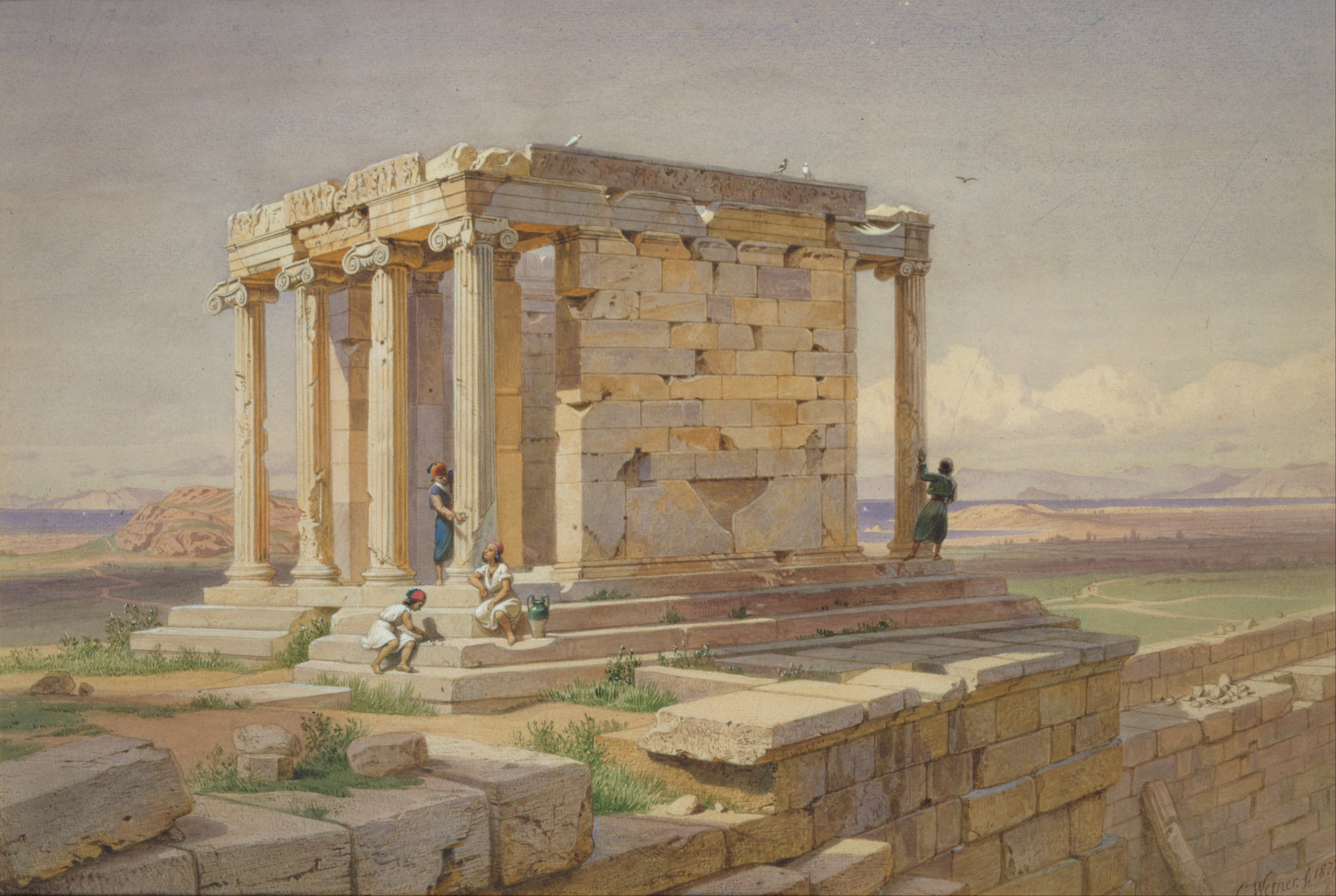
Temple of Athena Nike
She had no wings. The cult statue inside this small Ionic temple - a marble Nike held in the cella - was the goddess of victory rendered without her usual feathered limbs. Athenians visiting in later centuries gave her a name to explain it: Apteros Nike, the wingless victory. They invented a story to fit the absence. The statue had been deprived of wings, they said, so that she could never fly away. Athens, having captured victory, did not intend to let her escape. The temple housing this immobilized goddess sits on a small bastion at the southwestern corner of the Acropolis, the first thing visitors saw as they climbed the Sacred Way and the last thing they saw as they descended. It is barely 8 meters long. It is also one of the most exquisite buildings of 5th-century Athens.
A Small Temple in a Long War
Construction began around 449 BC, during a brief lull in Athens' fight against Persia. Then the Peloponnesian War began in 431 BC, and the city's resources turned to actual fighting. Work on the temple stopped, then started, then stopped again. The architect was Kallikrates, who had also worked on the Parthenon. He chose the Ionic order for this building - the earliest fully Ionic temple on the Acropolis - and designed it tetrastyle and amphiprostyle, with four columns at the front and four at the back, both ends matching. The temple was finally completed around 420 BC during the Peace of Nicias, the brief truce that paused the war. The Athenians dedicated it to Athena and Nike together, hoping the war goddess and the victory goddess fused in a single shrine might give them what they could not otherwise win. Eight years later the war restarted. They lost it. The wingless Nike could not save them, but the temple endured.
The Frieze and the Battles It Records
Around the temple's exterior ran a continuous Pentelic marble frieze, only 0.45 meters tall but extraordinarily detailed. The east frieze showed Athena, Zeus, and Poseidon in divine assembly. The north frieze depicted Greek cavalry in battle. The south frieze showed the climactic Battle of Plataea in 479 BC, when the Greeks finally defeated Persia on land. The west frieze - the most damaged but the most vivid - appeared to show the massacre of Corinthians by Athenians, with multiple corpses and a figure about to be killed in the moment before death. These were not abstract victories. They were specific historical battles, naming Athens' enemies and Athens' wins, carved in marble and elevated to the level of myth. To stand in front of the temple was to be reminded that the small war goddess inside the cella had earned her place by overseeing real human carnage at recognizable locations.
The Sandal Binder
Around 410 BC, after the temple was complete, a parapet was added around the steep edges of the bastion to keep visitors from falling. The outside of this parapet bore a frieze of Nikai - winged victories, plural - in various activities, leading bulls to sacrifice, raising trophies, attending Athena. The most famous panel from this parapet shows a single Nike paused in the act of unfastening her sandal. Her right hand reaches down. Her clothing has slipped off her left shoulder. The drapery is wet drapery: marble carved so that fabric clings to the body in flowing folds, simultaneously revealing and concealing. The panel survives in the Acropolis Museum. It is one of the great masterpieces of Classical Greek sculpture. The act of removing a sandal is itself meaningful - worshippers entering certain Greek shrines were expected to remove their footwear, a practice the Nike on the parapet was performing as a model for those climbing toward the temple. Take off your shoes. Approach barefoot. Honor the goddess.
Demolished, Rebuilt, Demolished Again
Athens fell to the Ottoman Empire in 1456. For nearly two centuries the temple stood undisturbed. In 1686, during a siege of Athens by the Venetians, the Ottomans demolished it for raw material - the marble blocks were used to build defensive walls around the Acropolis. The temple disappeared. After Greek independence in 1834, the German archaeologist Christian Hansen and his colleague Eduard Schaubert dismantled the Ottoman walls, recovered the original temple stones from inside them, and reassembled the building - one of the earliest examples of anastylosis, a method of reconstructing ancient buildings from their original surviving fragments. They did the work with primitive tools and limited information. In 1998 the temple was dismantled again, this time by Greek archaeologists, to replace a deteriorating concrete floor and conserve the marble. A third restoration was completed in summer 2010. The current building is mostly original 5th-century stone, restacked four times across two and a half millennia, still standing.
The Last Sight
Visitors descending from the Acropolis after seeing the Parthenon often miss the Temple of Athena Nike. It is small. It is to the right of the gate as you walk out. Most tourists are looking back at the larger building they have just toured. But for an ancient Athenian leaving the Sacred precinct, this was the temple seen last - the wingless goddess of victory holding her own in her tiny perfect Ionic shrine. Today the friezes hang in the Acropolis Museum, with copies cemented in their places on the building. The cella is empty; the Nike statue with her absent wings has been gone for sixteen centuries. But the bastion still juts out over the city, the columns still rise from their stylobate, and the Athenians who built this in the depths of a long war still managed to make something so beautiful that fifteen hundred years of demolitions could not destroy it. The Nike kept her sandal. She did not fly away.
From the Air
Temple of Athena Nike sits at 37.9715 N, 23.7249 E on the southwestern bastion of the Acropolis of Athens, 156 meters above sea level. Best viewed at 2,000-3,000 feet on permitted overflights of central Athens; the Acropolis itself is unmistakable, with the Parthenon dominant and the smaller Propylaea and Athena Nike to the western entrance. Athens TMA is heavily controlled. Nearest airfields: Athens International (LGAV/ATH) 25 km southeast and Athens Eleusis (LGEL) 25 km northwest. The Acropolis is visible on most approaches into LGAV from the south or west, particularly from the Saronic Gulf side.