Temple of Confucius, Qufu
Ten pillars carved with coiling dragons guard the front of Dacheng Hall, the architectural heart of the Temple of Confucius in Qufu. According to local tradition, these pillars were covered with silk whenever the emperor came to visit -- not out of modesty, but out of concern that he might grow envious of their beauty. Whether the story is true or apocryphal, it captures something real about this temple: for much of Chinese history, the shrine to Confucius in his hometown commanded a reverence that rivaled even the imperial court.
From House to Holy Ground
The temple began as something deeply personal. Within two years of Confucius's death around 479 BC, his former house in Qufu -- three rooms -- was consecrated as a shrine by the Duke of Lu. In 205 BC, Emperor Gao of the Han dynasty became the first emperor to offer sacrifices here, setting a precedent that would last for two millennia. Twelve different emperors made 20 personal pilgrimages to Qufu; roughly 100 others dispatched deputies for 196 official visits. The original house was removed during a rebuilding in 611 AD, but the temple continued to grow. Song dynasty expansions in 1012 and 1094 created a design with three sections and four courtyards containing over 400 rooms. Fire destroyed the complex in 1214 during the Jin dynasty. It was rebuilt by 1302, walled in 1331, devastated again by fire in 1499, and restored to its present scale.
A Forbidden City in Miniature
The temple's current form dates from after the 1499 fire, when its reconstruction coincided with the recent completion of the Forbidden City in Beijing. The architectural parallels are deliberate: yellow roof-tiles otherwise reserved for the emperor, red-painted walls, dark-green pine trees planted to create contrast with complementary colors. The complex covers 16,000 square meters with 460 rooms arranged across nine courtyards on a central north-south axis stretching 1.3 kilometers. The first gate, the Lingxing Gate, takes its name from a star in the Great Bear constellation -- the implication being that Confucius is a star descended from heaven. A 72-meter brass statue of Confucius, reinforced with steel, stands near Nishan outside the city.
The Hall of Great Perfection
Dacheng Hall -- the Hall of Great Perfection -- dominates the complex. Covering 54 by 34 meters and standing nearly 32 meters tall, it is supported by 28 pillars each carved from a single piece of local stone, six meters high and nearly a meter in diameter. The ten front columns bear those famous coiled dragon carvings. Inside, the hall served as the principal site for sacrificial offerings to Confucius's memory. The hall was largely destroyed by yet another fire in 1724 and restored by 1730, but many of its replacement sculptures were damaged during the Cultural Revolution in 1966. In the courtyard before it stands the Apricot Platform, a pavilion commemorating Confucius teaching his students beneath an apricot tree. Each September 28, a ceremony is held here to mark his birthday.
Five Hundred Stones That Speak
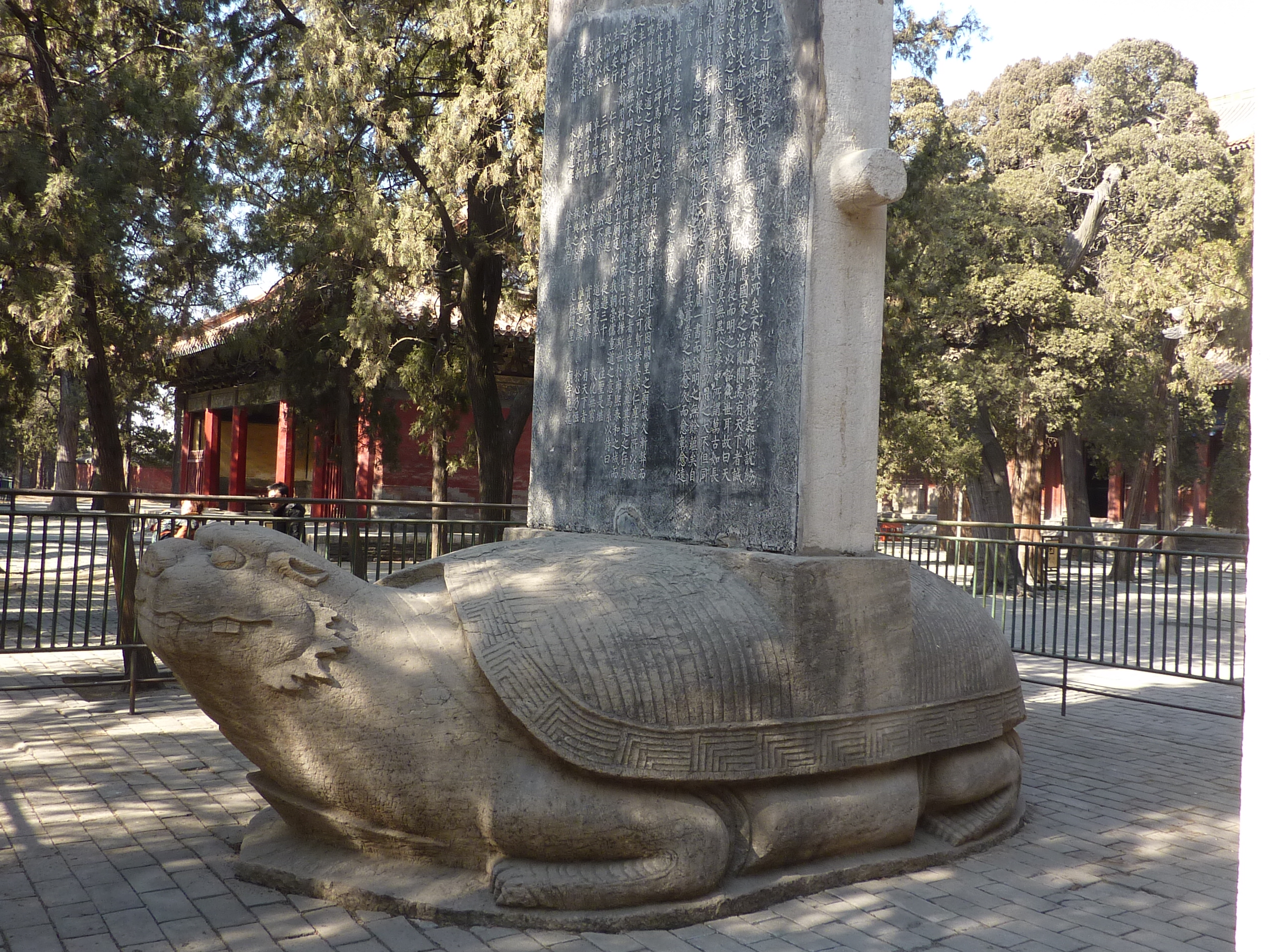
Scattered across the temple grounds are approximately 500 stone stelae, though the actual count is likely higher. These inscribed monuments document every phase of the temple's long history: rebuildings, renovations, honorary titles bestowed on Confucius by successive emperors. Most inscriptions are in Chinese, but Yuan dynasty stelae carry text in Middle Mongolian using the Phags-pa script, and Qing dynasty stelae include Manchu inscriptions -- evidence of how diverse rulers adopted Confucius as their own. The thirteen most important imperial stelae are concentrated in the Thirteen Stele Pavilions, arranged in two rows. In the northern row, five stelae from the Kangxi, Yongzheng, and Qianlong eras of the Qing dynasty each stand nearly four meters tall on giant stone turtles up to 4.8 meters long, weighing as much as 65 tons.
Fifteen Renovations and Counting
The Temple of Confucius has undergone 15 major renovations, 31 large repairs, and innumerable smaller interventions. Fire has been its most persistent enemy -- major blazes struck in 1214, 1499, and 1724. Vandalism during the Cultural Revolution caused damage that has been only partially repaired. Yet the temple endures, as it has endured every dynasty that built it, burned it, and rebuilt it again. Since 1994, it has been part of the UNESCO World Heritage Site encompassing the three Confucian sites in Qufu. For all its imperial grandeur, the temple's most powerful moment may be its simplest: the Apricot Platform, marking the spot where a teacher sat with his students and talked about how to live a good life.
From the Air
Located at 35.60N, 116.98E in central Qufu, Shandong Province. The temple complex is identifiable by its large footprint and yellow-tiled roofs within the historic walled city. Nearest airport is Jining Qufu Airport (ZLJN). The 1.3 km north-south axis of the complex is oriented for easy aerial identification. The Kong Family Mansion sits immediately to the east.