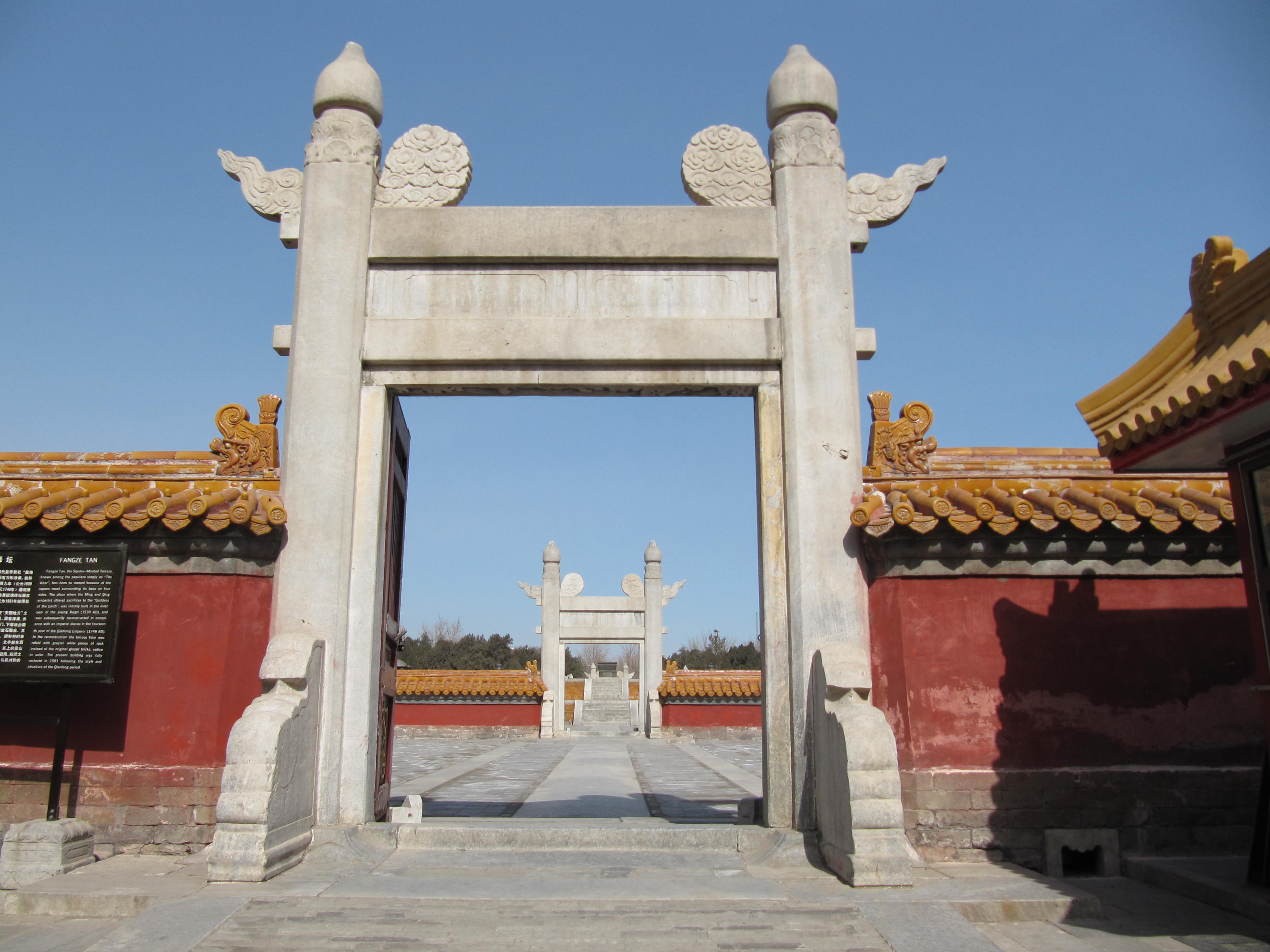
Temple of Earth
Everything about the Temple of Earth is square. The altar is square. The walls are square. The footprint of the complex itself is square. This is not architectural laziness -- it is cosmology rendered in stone. For thousands of years, Chinese tradition held that the earth was square and the heavens round, and Beijing's imperial temple system made this belief physical. The Temple of Heaven in the south is circular. The Temple of Earth in the north is rectilinear. Between them, the Temple of the Sun rises in the east and the Temple of the Moon in the west. Together, the four temples form a cosmic compass inscribed on the city itself.
The Jiajing Emperor's Design
The Temple of Earth was constructed in 1530 by the Jiajing Emperor during the Ming dynasty, part of his broader reorganization of imperial ritual spaces. At 42.7 hectares, it is the second largest of Beijing's five great temples, trailing only the Temple of Heaven. The complex sits just north of the city's second ring road, near the Andingmen area and a few hundred yards from the Yonghe Temple. Its location in the north of Beijing is deliberate: north is the direction associated with the earth element in Chinese cosmological thinking. The Jiajing Emperor, who took a passionate interest in ritual and ceremony, separated the worship of earth from the combined rites that had previously taken place at the Temple of Heaven, giving the earth its own dedicated altar for the first time.
The Square Water Altar
At the center of the complex stands the Fangze Tan, the "square water altar," a raised platform covering nearly 18,000 square meters. The altar was once surrounded by a moat, though the water has long since been drained. Here, on each summer solstice, Ming and later Qing dynasty emperors performed sacrificial rites to appease the Earth God, seeking good harvests, stable governance, and favorable weather. The temple's north-south axis organizes five main structures: the Fangze Altar, the Imperial Respecting House, the Sacrifice Pavilion, the Fast Palace, and the Divine Warehouse. Each building served a specific function in the elaborate choreography of imperial sacrifice, from the emperor's ritual fasting to the preparation of offerings.
Revolution and Renewal
The Cultural Revolution brought damage to the temple, as it did to countless sacred sites across China. But unlike many, the Temple of Earth was restored and renovated in the decades that followed, and the Chinese government designated it as one of the nation's most important historical monuments under special preservation. Since the 1980s, the grounds -- known popularly as Ditan Park -- have hosted traditional temple fairs during the Chinese New Year, when thousands of red lanterns hang from the park's trees and crowds fill the paths. The fairs reconnect the space with its ceremonial origins, even if the specific rites have changed.
A Living Park
On any given morning, the Temple of Earth belongs less to tourists than to the residents of surrounding neighborhoods. Joggers circle the tree-lined paths. Groups practice tai chi on the open plazas. Water calligraphers purchase oversized brushes and paint characters on the pavement in strokes that evaporate as they dry, a form of art that exists only in the moment of its making. The temple itself is surprisingly small within the larger park, a reminder that in Chinese imperial architecture, the relationship between structures mattered more than the structures themselves. It is the positioning -- square to the north, round to the south, sun and moon flanking east and west -- that carries the meaning. The buildings are instruments. The city is the composition.
From the Air
Located at 39.95°N, 116.41°E in northern central Beijing, near Andingmen and just outside the second ring road. The park's rectangular shape is visible from medium altitude. The Yonghe Temple (Lama Temple) lies just to the south. Beijing Capital International Airport (ZBAA/PEK) is 22 km northeast. Best viewed at 3,000-5,000 feet.