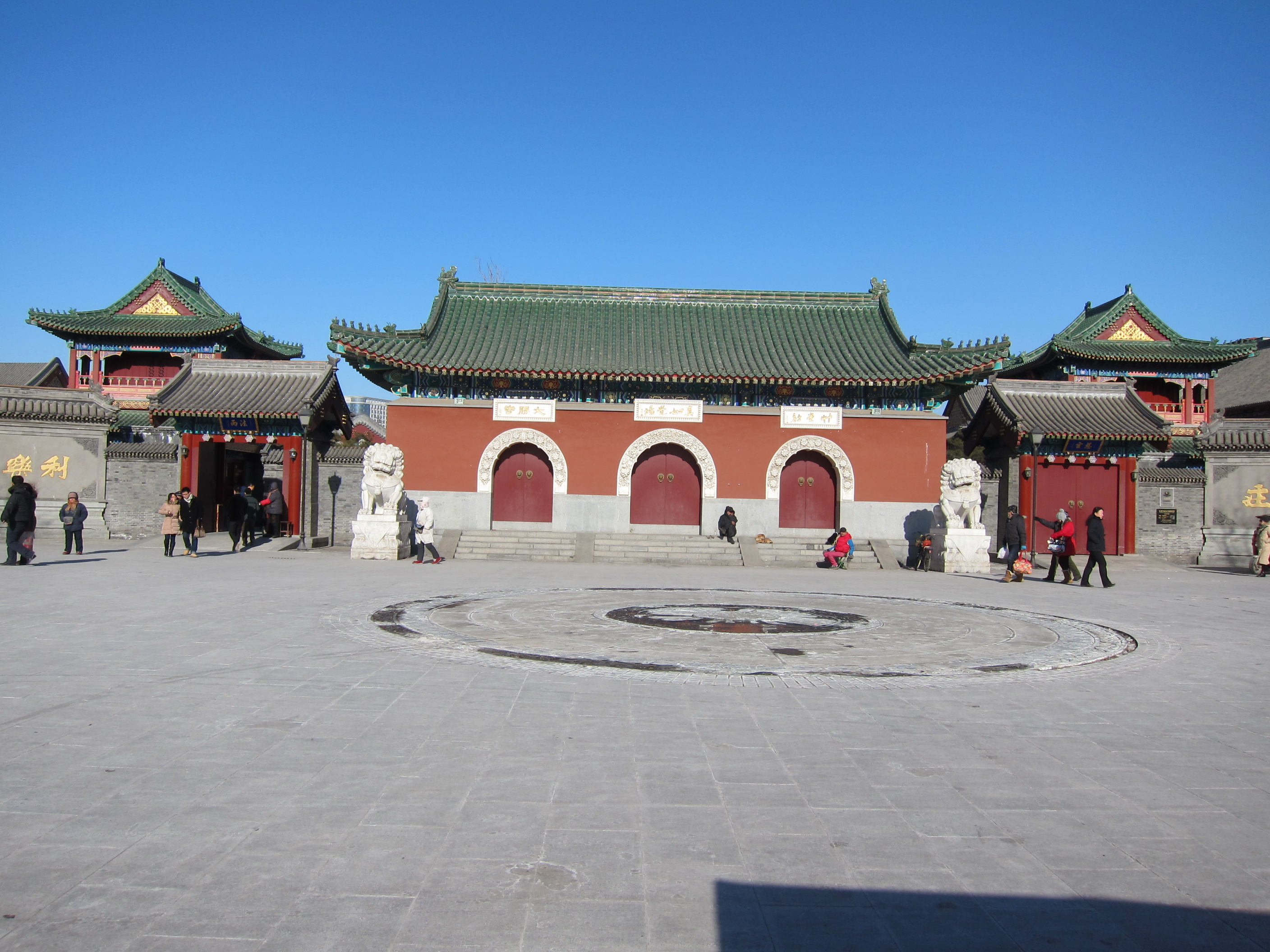
Temple of Great Compassion
For nearly three centuries, the bones traveled a strange path. A fragment believed to be a relic of Xuanzang -- the seventh-century monk whose epic journey to India to retrieve Buddhist scriptures became one of the most celebrated stories in Chinese literature -- was kept at the Temple of Great Compassion in Tianjin. Then, in 1956, the relic was taken to Nalanda, India, and presented as a gift. Since that day, the Dabei Yuan has used an image of Xuanzang for worship instead of his spirit bones. The reliquary is gone, but the monastery's reverence for the pilgrim monk endures.
Two Monasteries, One Temple
The Temple of Great Compassion -- Dabei Yuan in Chinese -- is not a single building but a compound that has grown and changed over centuries. First built during the Qing dynasty, the monastery has been so heavily rebuilt and renovated that its current form bears limited resemblance to the original. The complex now consists of a West Monastery dating from 1669 and an East Yard with later additions. The division is functional as well as architectural: the east yard contains memorials for the Buddhist monks Xuanzang and Hong Yi, while the west yard houses the Cultural Relic Palace, the Abbot Palace, and the offices of the Chinese Buddhism Association's Tianjin Branch.
A Treasury in Bronze, Iron, and Stone
The Cultural Relic Palace in the west yard holds one of Tianjin's most significant collections of Buddhist art. Hundreds of Buddha statues fill the exhibition space, crafted from bronze, iron, stone, and wood. The collection spans an extraordinary chronological range, with pieces dating back to the Wei and Jin dynasties -- periods that saw Buddhism transform from a foreign import into a central pillar of Chinese culture. The variety of materials reflects the varied circumstances of their creation: wealthy patrons commissioned bronze, humble workshops carved wood, and monastic communities worked in stone. Together, they document over a millennium of devotional art in northern China.
The Monk and the Master
Two monks anchor the temple's spiritual identity. Xuanzang, who died in 664 CE, is the more famous -- his sixteen-year journey from China to India and back, undertaken to obtain authentic Buddhist scriptures, was fictionalized in the sixteenth-century novel Journey to the West and has been retold in countless adaptations since. Hong Yi, the other monk memorialized at the temple, represents a different kind of Buddhist commitment. Born Li Shutong in 1880, Hong Yi was a renowned painter, musician, and calligrapher who abandoned a brilliant secular career to become a Buddhist monk, eventually becoming one of the most respected Chan masters of the twentieth century.
Murals and the Living Tradition
The temple's cultural significance extends beyond its collections to its walls. The mural art at Dabei Yuan is considered one of its most important features, and the temple has long served as a center of local Buddhist culture in Tianjin. As a Chan Buddhist monastery, the Temple of Great Compassion belongs to the meditation-focused tradition that emphasizes direct experience over textual study -- a tradition that traces its lineage back to Bodhidharma and the earliest transmission of Buddhism from India to China. Today, the monastery continues to function as an active religious site, its incense and chanting marking a practice that has persisted on this spot since the Qing dynasty, through wars, revolutions, and the radical cultural disruptions of the twentieth century.
From the Air
Located at 39.16°N, 117.18°E in central Tianjin, north of the Hai River. The temple compound features traditional Chinese Buddhist architecture including a pagoda that may be visible from lower altitudes. Nearest airport: Tianjin Binhai International (ZBTJ), approximately 16 km east. Beijing Capital International (ZBAA) is about 120 km northwest. Look for traditional Chinese roof forms and the temple's pagoda amid the dense urban grid of central Tianjin.