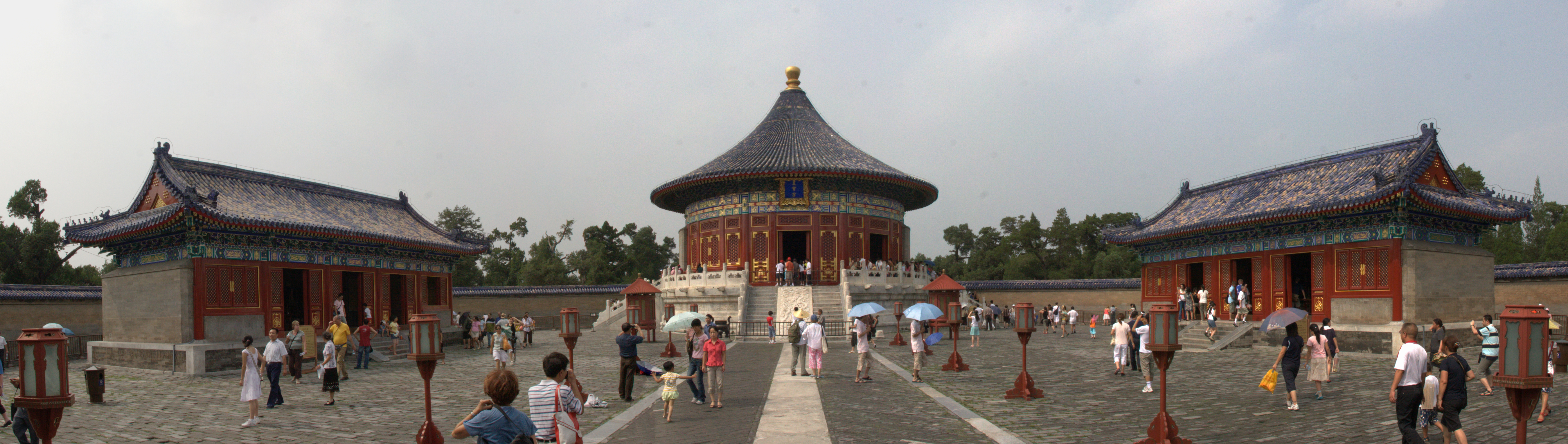
Temple of Heaven
The Hall of Prayer for Good Harvests contains not a single nail. Built entirely of interlocking wooden joints on three tiers of marble, this circular temple rises from a park in southeastern Beijing like a proof of concept for an entire civilization's understanding of heaven. The Temple of Heaven complex, constructed between 1406 and 1420 by the Yongle Emperor -- the same ruler who built the Forbidden City -- was where China's emperors performed their most solemn duty: asking the sky for a good harvest.
Architecture as Cosmology
Everything here encodes meaning. The circular forms represent heaven; the square bases represent earth. The number nine, sacred in Chinese numerology, governs the altar's balusters, steps, and stone rings. At the center of the Circular Mound Altar lies the Heart of Heaven stone, where the emperor stood to pray for favorable weather. The altar's design creates a remarkable acoustic effect: a prayer spoken at its center reflects off the surrounding guardrails, producing a resonance that was believed to carry the emperor's words to heaven itself. The Imperial Vault of Heaven echoes this design on a smaller scale, a single-gabled circular building whose famous Echo Wall can carry a whisper from one end to the other. UNESCO inscribed the complex in 1998, calling it 'a masterpiece of architecture and landscape design which simply and graphically illustrates a cosmogony of great importance.'
Six Centuries of Imperial Prayer
The Yongle Emperor began construction in 1406 as part of the same building campaign that produced the Forbidden City. His successor, the Jiajing Emperor, expanded the complex in the 16th century and renamed it the Temple of Heaven. Jiajing also built three companion temples: the Temple of the Sun to the east, the Temple of Earth to the north, and the Temple of Moon to the west -- together mapping the cardinal directions onto Beijing's sacred geography. The Qianlong Emperor renovated the complex in the 18th century, but dwindling state finances meant this was the last major imperial restoration. Lightning struck the Hall of Prayer for Good Harvests in 1889, burning it to the ground. The current structure is a reconstruction built several years later, faithful to the original design.
Occupation, Destruction, and Survival
The temple complex has weathered more than storms. Anglo-French forces occupied it during the Second Opium War. During the Boxer Rebellion of 1900, the Eight-Nation Alliance turned the sacred grounds into a military command post that lasted a full year. The Cultural Revolution brought another wave of destruction: rioters vandalized the buildings, and the main central altar was smashed, its fragments thrown into the surrounding park along with miscellaneous rubble. That an imperial religious complex survived these successive assaults -- foreign occupation, revolutionary iconoclasm, and simple neglect -- speaks to its deep hold on the Chinese imagination.
The Park Today
Modern Beijing has enveloped the temple complex, but the park's 273 hectares remain a breathing space in one of the world's densest cities. Each morning, retirees practice tai chi beneath ancient cypress trees. Music groups gather near the Echo Wall. The Circular Mound Altar draws visitors who stand on the Heart of Heaven stone and clap, testing the acoustic resonance for themselves. Four gates open to the surrounding neighborhoods, each accessible by public transit. The temple that once belonged exclusively to the emperor now belongs to everyone -- though the cosmology it embodies, the belief that heaven listens and the harvest responds, is written into every column, every stone, every carefully counted step.
From the Air
Located at 39.88N, 116.41E in Dongcheng District, southeastern central Beijing. The complex is one of the largest green spaces visible from altitude in central Beijing, identifiable by its circular structures. Nearest airports are Beijing Daxing International (ZBAD) to the south and Beijing Capital International (ZBAA) to the northeast.