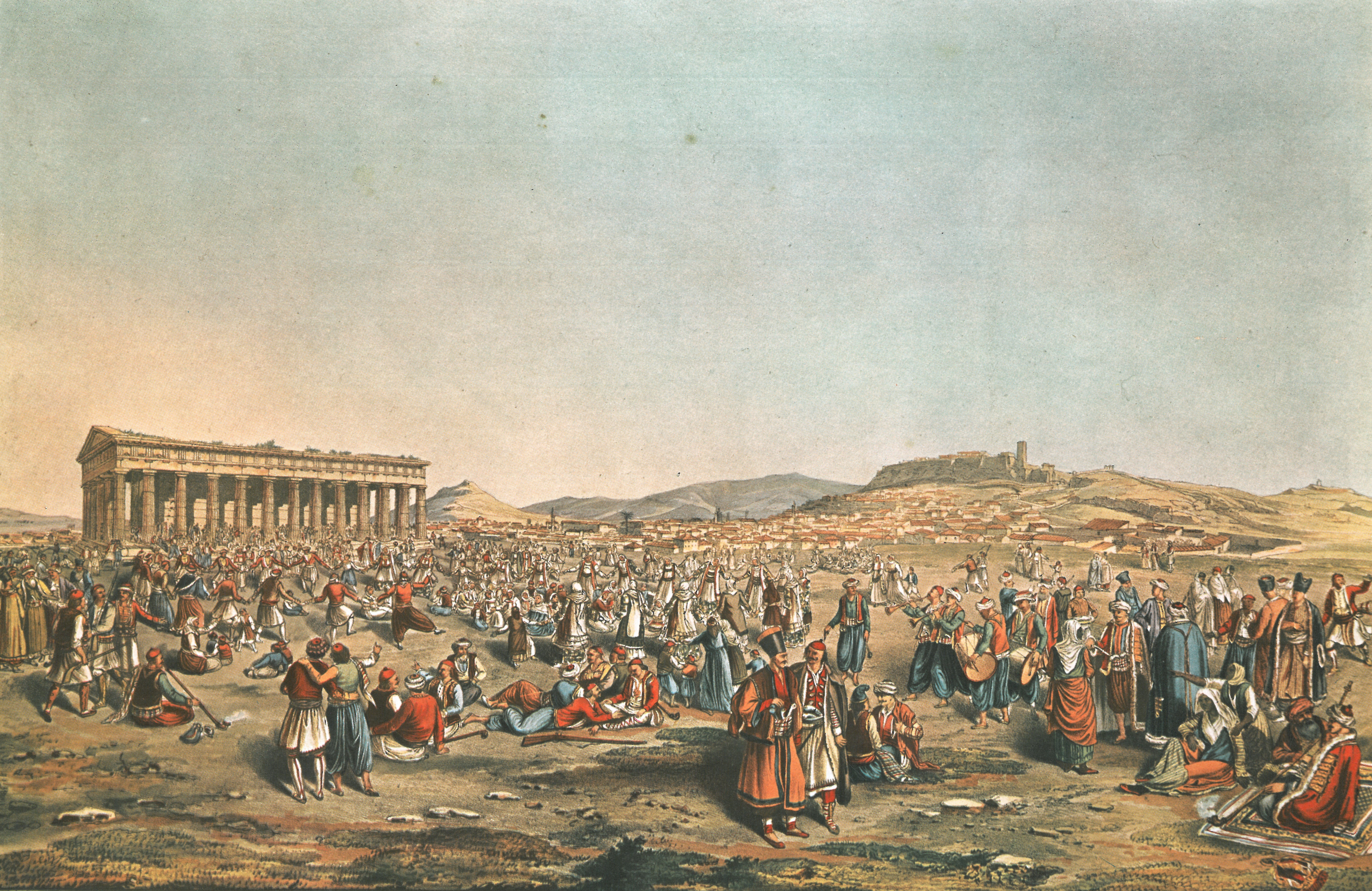
Temple of Hephaestus
Almost every other classical Greek temple is a ruin. This one still has its roof. The Temple of Hephaestus stands on a low hill called Agoraios Kolonos, on the northwest edge of the Athenian Agora, and it has stood there essentially complete for nearly twenty-five hundred years. Its columns, its pediments, its architrave, its inner walls, its sculpted metopes are all where the builders left them. The reason is unromantic but decisive: from around AD 700 until 1834, the building was a Greek Orthodox church dedicated to Saint George Akamates. Roofs get repaired when a community uses a building. Roofs collapse when no one does. Hephaestus survived because he was rebranded.
The God of the Forge, in the Right Neighborhood
Hephaestus was the patron of metalworkers, of fire, of the rough physical craft that produced everything from cooking pots to swords. The Athenians built his temple in exactly the right neighborhood. Pottery shops and metal-working forges crowded the streets around the hill. Archaeologists have found waste from blade smiths and bronze casters in the soil nearby. When Athenians worshipped Hephaestus, they worshipped the work that fed their city. There had been a small earlier shrine on this site, but it was burned in the Second Persian invasion of 480 BC, when Xerxes' army sacked Athens. The Greeks swore an oath after the Battle of Plataea: never rebuild what the Persians destroyed, leave the ruins as a reminder. The new temple, started later, was a different thing entirely.
The Pericles Plan
Construction began in 449 BC, just as Pericles was launching the building program that would also produce the Parthenon. The Hephaisteion went up first, but it took longer than expected. Funds and skilled workers were diverted to the more glamorous project on the Acropolis. The western frieze was finished by 440 BC. The eastern frieze, the western pediment, and several interior changes drag on until the 430s. Only during the brief Peace of Nicias from 421 to 415 BC was the roof finally put on and the cult statues installed. The architect's name has been lost. Scholars call him simply The Hephaisteion Master. He, or whoever directed the work, used Pentelic marble from Mount Penteli, the same quarry the Parthenon drew on, and added Parian marble for the sculptures. The dimensions are 13.71 by 31.78 meters, six columns wide and thirteen long, a small temple by the standards of the city's grandest projects but exceptionally refined.
Heracles, Theseus, and Civic Pride
Of the sixty-eight metopes around the exterior, only eighteen were ever sculpted. The rest may have been painted. The carved ones tell two stories: ten metopes on the east end show the Labors of Heracles, and the four corner metopes on the long sides show the Deeds of Theseus. Theseus was the legendary founder-hero of Athens. Putting his deeds beside the labors of the most famous Greek hero placed Athens at the center of myth itself. This is also why the building was called the Theseion for centuries. Modern travelers assumed it must be Theseus's temple, since the hero's bones had been brought back from Skyros by Kimon in 475 BC. Inscriptions found in the building eventually proved otherwise. It belonged to Hephaestus and Athena, twin patrons of craft.
Saint George of the Loafers
The conversion to a church happened around AD 700, though the exact date is unrecorded. The new dedication was to Saint George with the unusual epithet Akamates. Three competing explanations have been offered. One traces it to Akamantas, son of Theseus and Phaedra, the name drifting through Greek into Akamates over the centuries. Another points to the literal meaning of akamates, which is something close to loafer or idler, because under Ottoman rule the church was used only one day a year, on Saint George's feast day. A third suggests it derives from the medieval archbishop Michael Akominatos, who may have celebrated the first liturgy there. The last Divine Liturgy held in the temple took place on 21 February 1833, during ceremonies welcoming Otto, Greece's first king after independence.
Byron's Friend and the Modern Museum
When Athens became the capital of Greece in 1834, the royal edict announcing it was published from the temple steps. The building briefly became a burial ground for non-Orthodox Europeans. Among those buried inside was John Tweddel, a friend of Lord Elgin, and excavators later found a slab from George Watson's grave inscribed with a Latin epitaph composed by Lord Byron. Otto turned the building into a museum, and it kept that role until 1934. Today it is once again an ancient monument, the most complete classical temple anywhere, viewable from the agora paths below. Architects have copied it for two centuries. Penshaw Monument near Sunderland, Arlington House in Virginia, the Vermont State House, the Old Royal High School in Edinburgh, all carry pieces of its proportions. The original still stands above its olive trees, almost exactly as the Hephaisteion Master left it.
From the Air
Located at 37.98 N, 23.72 E in central Athens, on the western edge of the Ancient Agora archaeological site at about 75 meters elevation. The temple is roughly 600 meters northwest of the Acropolis and clearly visible from low-altitude approaches over the city. Nearest airport: Athens-Eleftherios Venizelos (LGAV) 30 km east. Best viewed from the southwest below 1,500 meters AGL. Look for the rectangular peripteral form on the green hill of Agoraios Kolonos, immediately west of Monastiraki and the Stoa of Attalos.