Temple of Isis (Pompeii)
A thirteen-year-old boy stood in the ruins of a freshly unearthed temple in 1769, staring at walls painted with Egyptian gods. Wolfgang Amadeus Mozart had arrived in Pompeii just five years after excavators uncovered the Temple of Isis -- one of the first major buildings pulled from beneath the volcanic ash. Twenty years later, the memories of those painted walls and mysterious rites found their way into his opera The Magic Flute. The temple that inspired one of Western music's great works had itself been built for reasons no less personal: a freedman father's ambition for his six-year-old son.
A Father's Gambit in Stone
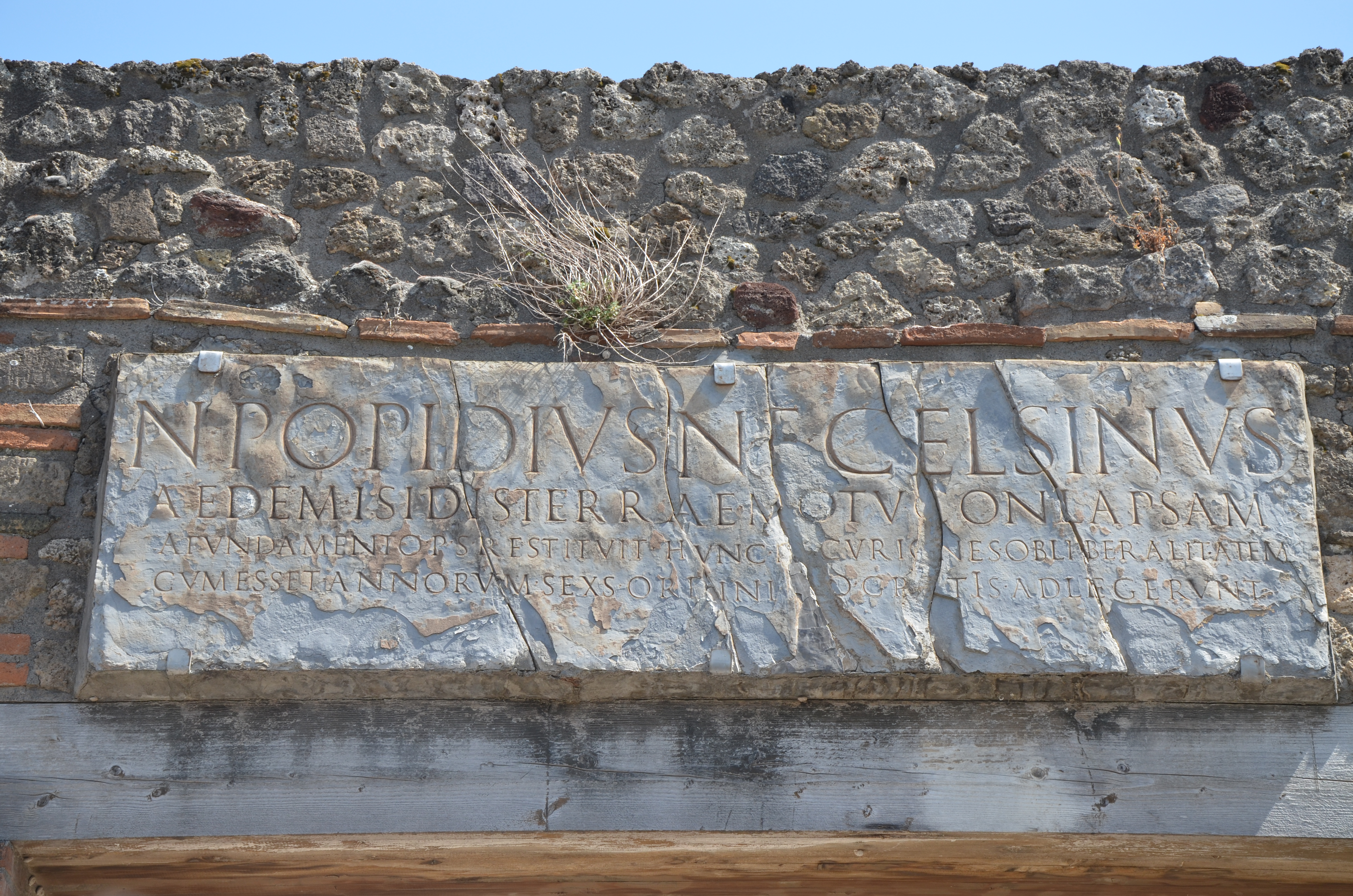
The temple standing in Pompeii today is actually the second structure on this site. The original, built during the reign of Augustus, was damaged in a powerful earthquake in 62 AD. What makes the reconstruction remarkable is who paid for it. Numerius Popidius Ampliatus, a freedman -- a former enslaved person who had gained his freedom -- could not hold political office himself under Roman law. So he rebuilt the Temple of Isis in the name of his six-year-old son, Numerius Popidius Celsinus, and his wife Corelia Celsa. The strategy worked: the grateful city council admitted the boy to their ranks, making him one of the youngest members of Pompeii's elite. An inscription confirmed the dedication. In a single act of construction, a former enslaved person purchased his child's entry into the ruling class -- using an Egyptian goddess as the vehicle.
An Egyptian Goddess in Roman Dress
How did an Egyptian deity end up with a temple in a provincial Roman town? Isis had been traveling the Mediterranean for centuries. After Alexander the Great conquered Egypt in the fourth century BC, Greek settlers began merging her with their own goddess Demeter -- both presided over agriculture, motherhood, and the mysteries of death. By the time her worship reached Rome, Isis had accumulated new roles: patron of sailors, promise-keeper to the dead, and a deity who offered women a spiritual authority that Roman state religion denied them. The Roman Senate tried twice to shut the cult down, issuing decrees demanding the demolition of her temples in both 54 and 30 BC. No one volunteered for the job. The cult only grew. For women, participation offered something Roman state religion could not -- the role of priestess, genuine spiritual agency, and the promise of salvation through initiation. When the earthquake struck Pompeii in 62 AD, the Temple of Isis was among the very first buildings the city chose to restore.
Twenty-Nine Columns and a Crypt
The temple sits on a raised platform, entered by way of stairs and oriented on a northeast-southwest axis. Twenty-nine columns surround the structure in total. Inside, the building divides into two spaces: the pronaos, an outer columned area, and the naos, the inner sanctum where statues of Isis and Osiris once stood. Ornate niches mark the transitions between rooms. Beyond the inner chamber, altars line the walls and recesses hold ritual objects. Outside, a subterranean crypt served as the initiation chamber for new devotees of the cult. The walls throughout were elaborately painted in what scholars identify as the First and Second Styles of Pompeian fresco -- though the original paintings and sculptures were removed to the Museo Archeologico in Naples, where they remain today. Isis herself was depicted in Roman rather than Egyptian form, a deliberate act of cultural assimilation, though Egyptian-style art was woven into the decorative program alongside.
Unearthed Before the World Was Ready
When excavators reached the Temple of Isis in 1764, they encountered something astonishing: while nearly every other building in the Forum lay in shambles, the temple was essentially intact. It had been fully rebuilt sometime between the earthquake of 62 AD and Vesuvius's eruption in 79 AD -- a speed of restoration that reveals just how important Isis worship was to Pompeii's daily life. The Swiss military engineer Karl Weber supervised the dig, navigating tons of volcanic material and the political complications of working above farmers' arable land. His workers dug haphazardly, hunting for sculptures and backfilling immediately to prevent collapse, though Weber himself insisted on producing accurate maps. Francisco la Vega confirmed the temple's identity through an inscription on July 20, 1765. Artists and illustrators swarmed to the site in the decades that followed, producing romanticized views that fed Europe's growing fascination with Egypt. The temple became a touchstone of the exotic -- an Egyptian mystery cult preserved under Italian volcanic ash, unearthed for an Enlightenment audience hungry for the ancient and the strange.
From the Air
Located at 40.75N, 14.49E within the archaeological site of Pompeii, at the foot of Mount Vesuvius. From altitude, the excavated ruins of Pompeii are clearly visible as a grid of ancient streets and structures against the modern landscape. The Temple of Isis sits in the southeastern part of the excavated area, near the Teatro Grande. Vesuvius dominates the skyline to the north. Nearest major airport is Naples International (LIRN), approximately 25 km to the northwest. The Bay of Naples and the Sorrentine Peninsula are visible to the south and west.