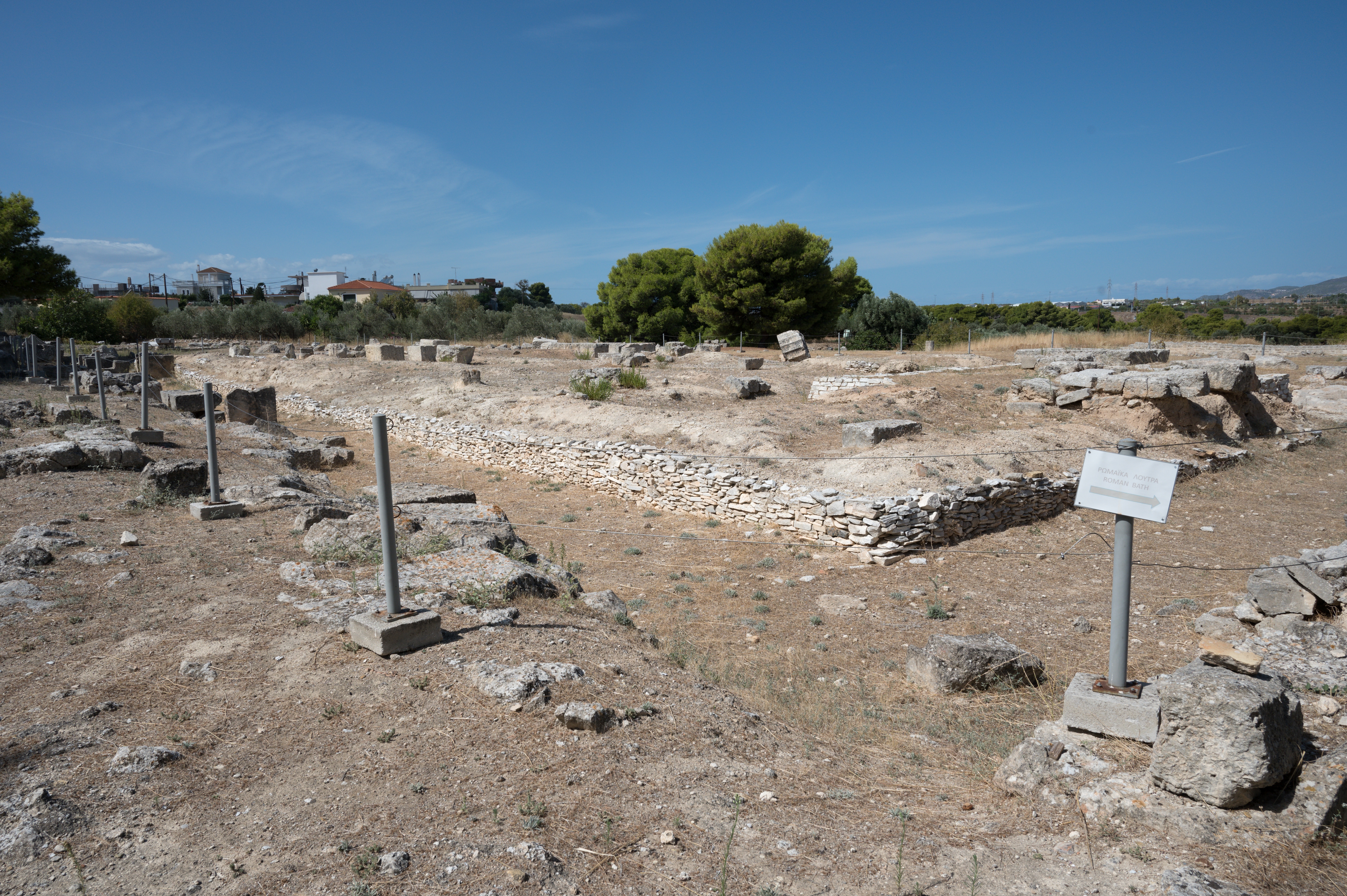
Temple of Isthmia
Every two years, athletes from across the Greek world converged on a stretch of pine-covered land between two seas. They came to compete in the Isthmian Games, one of the four great Panhellenic festivals alongside the Olympics at Olympia, the Pythian Games at Delphi, and the Nemean Games at Nemea. The prize was a wreath of dried celery, or in later periods pine, and the chance to dedicate a victory statue inside the Temple of Poseidon at Isthmia. The temple itself, on the narrow Isthmus of Corinth where the Peloponnese hangs from mainland Greece by a thread of stone, was the heart of all of it. Two temples actually, one built on top of the other, both burned down across a thousand years of activity.
The Birthplace of Greek Architecture
Around the turn of the 8th to 7th century BC, something new was happening in Greek building. Corinth, sitting astride the only land bridge between southern and central Greece, was at the center of it. The city was inventing the Doric order, that signature Greek architectural language of fluted columns and triglyph-and-metope friezes that became synonymous with the classical world. The first Temple of Isthmia, built somewhere between 690 and 650 BC, may have been one of the earliest large stone temples in mainland Greece. Its ground plan, recovered through painstaking trench work in 1989, was unprecedented for its time, larger and more refined than anything previously known. Whether it was strictly Doric or something stranger remains an open question. The Archaic temple burned to the ground in 470 BC.
The Classical Replacement
The Greeks rebuilt around 440 BC, directly on top of the burned foundations. The new temple, also dedicated to Poseidon, became the focal point of the sanctuary that hosted the Isthmian Games starting around 581 BC. The festival ran every two years for nearly a millennium. Athletes wrestled, ran, raced chariots, threw the discus and javelin, and competed in events specific to a sanctuary that worshipped the god of horses and the sea. Pausanias, walking through in the 2nd century AD, described what he saw. Inside the colonnaded fore-temple stood images of Poseidon, his wife Amphitrite, and Thalassa, the personified Sea. A massive bronze and ivory chariot group dedicated by Herodes Atticus filled the central space: gilded horses with ivory hooves, Poseidon and Amphitrite mounted, the boy Palaimon balanced on a dolphin. Around them, statues of Galene, the Calm, and Pegasos with Bellerophon. The Classical temple burned again in 390 BC and was rebuilt one more time.
The Sanctuary Around the Temple
The temple did not stand alone. The sanctuary at Isthmia was a small city of devotion, with a stadium, a theater, Roman baths, and what Pausanias called the Holy of Holies of Palaimon, an underground shrine reached by a descending passage. Anyone, Corinthian or stranger, who swore an oath there and broke it could not escape, the Greeks believed. There was an ancient altar to the Cyclopes, where they sacrificed to the one-eyed giants of myth. Tradition held that the graves of Sisyphus, the legendary king of Corinth, and Neleus, son of Poseidon, lay near the Isthmos. The temple of Poseidon was the largest building, but it sat in a forest of memory, every stone tied to a story. The sanctuary was finally sacked by the Visigoths under Alaric during their invasion of the Peloponnese in AD 396. By then, the Roman Empire was Christian and the games had been suppressed.
Lower Status, Honest Work
Olympia was always more prestigious, and the Isthmian Games never quite escaped second-tier reputation among the four. But the games were closer to the major Greek cities, the journey shorter for athletes from Athens or Corinth or Megara. The location made them more accessible, and the prize wreath of pine, sacred to Poseidon, carried its own honor. The Romans loved the games. After Rome destroyed Corinth in 146 BC, the games temporarily moved to Sikyon, but they returned to the Isthmus when Julius Caesar refounded Corinth a century later. Saint Paul knew the festival; his metaphors about athletes running for an imperishable crown in his letter to the Corinthians grew directly out of the local culture. The Isthmus was a place where Greek and Roman religion met Christian preaching, all in the same generation.
Excavations and What Remains
Almost nothing of the temple's superstructure survived. Oscar Broneer of the American School of Classical Studies began excavations in 1952 and published his findings in three volumes starting in 1971. He proposed a wooden Doric peristyle and dated the temple to about 700 BC. Both claims drew dispute. A second campaign in 1989 by the University of Chicago, led by Elizabeth Gebhard, refined the date to 690-650 BC and reconstructed the floor plan in detail. What you see today is mostly that floor plan: stone foundations, scorched pottery from the fires of 470 BC and 390 BC, low rectangles of stylobate where the columns once stood. The pines around the site echo the wreath the games once awarded. The Corinth Canal cuts through the isthmus a few kilometers to the west, slicing what was once a unified strip of land into two.
From the Air
Located at 37.92 N, 22.99 E on the Isthmus of Corinth, about 16 km east of ancient Corinth and 80 km west of Athens. Elevation is roughly 60 meters. The Corinth Canal lies 2 km west, slicing through the isthmus, and the Saronic Gulf is 1 km east. Nearest airport: Athens-Eleftherios Venizelos (LGAV) 80 km east. Best viewed from the south below 1,500 meters AGL. The site is an open archaeological zone with low foundation walls; look for the rectangular outline among the pine trees, with the canal as a primary visual reference.