Temple of Jupiter, Baalbek
Six columns stand on the south side of a stone platform in Lebanon's Beqaa Valley. They are 19.9 meters tall, nearly 2.5 meters in diameter, and they are the largest surviving columns from the classical world. Everything else -- the walls, the roof, the cult statue, the oracle that Roman emperors once consulted -- is gone. What remains is enough to stop you mid-stride. The Temple of Jupiter at Baalbek was the biggest temple dedicated to Jupiter Optimus Maximus Heliopolitanus in the Roman Empire, and three centuries of continuous construction went into making it so.
Foundations Beyond Lifting
The temple sits at the western end of a ceremonial complex the Romans called Heliopolis -- City of the Sun -- perched at 1,145 meters of altitude on the empire's remote eastern border. Beneath the temple platform lie three foundation stones known as the Trilithon, each weighing an estimated 800 tonnes, making them among the heaviest construction blocks in human history. Individual Roman cranes could not lift stones in the 60-to-100-tonne range, let alone these monsters. How the Romans moved them remains debated: temporary earthen ramps from the slightly elevated quarry nearby, teams of multiple cranes working in concert, or some alternating-side technique that inched the blocks into position. The quarry sat higher than the building site, so no vertical lifting was required -- but the horizontal distance and precision placement remain engineering feats that modern builders respect.
Three Centuries of Building
Construction likely began around 16 BC, when Baalbek became a Roman colony known as Colonia Julia Augusta Felix Heliopolitana. A graffito scratched on one of the topmost column drums suggests the structure was largely complete by AD 60, though the sixth-century historian John Malalas attributed the temple to the reign of Antoninus Pius (AD 138-161). The confusion is understandable: this was not a single building campaign but an evolving project spanning generations of masons, architects, and emperors. It served as an important religious site throughout the Roman period. Emperors consulted its oracle -- Emperor Trajan reportedly learned of his approaching death from its priests. Cultic activity had taken place at the site long before Rome arrived; the temple presumably replaced an earlier one, perhaps using the same foundation.
What the Wind Has Done
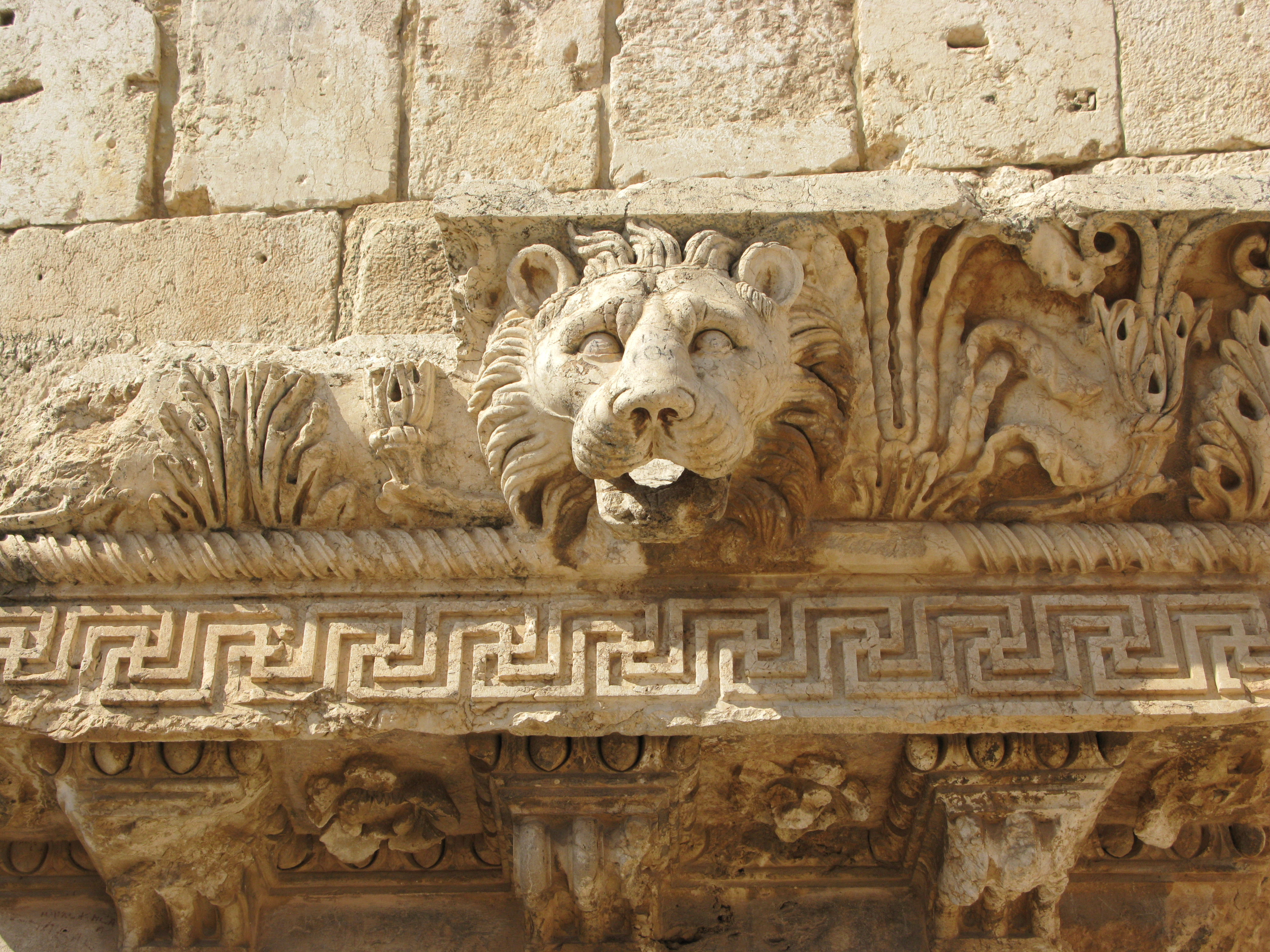
The six surviving columns still carry their entablature -- the horizontal stone beams and carved frieze blocks that once ran around the entire building. Some of those remaining architrave and frieze blocks weigh 60 tonnes, with one corner block exceeding 100 tonnes, all of them sitting 19 meters above the ground. On the south side, the capitals retain their Corinthian detail in near-perfect condition. Walk around to the north face and you find them worn almost bare -- centuries of the Beqaa Valley's winter winds have sandblasted the stone smooth. It is a quiet demonstration of the power of weather and time, carved into the very material that was meant to last forever. The asymmetry tells a story no inscription could: the same columns, the same stone, the same age, but one side sheltered and one side exposed.
Oracle Silenced, Columns Speaking
After Rome fell and Christianity became the dominant faith, the temple complex was repurposed and partially dismantled. Earthquakes, military campaigns, and centuries of quarrying reduced Jupiter's temple to its six iconic columns. Archaeological investigation began in earnest only in the late 19th century but has been repeatedly interrupted by regional instability. The Lebanese Civil War halted work in the 1970s and 1980s. UNESCO designated Baalbek a World Heritage Site in 1984, recognizing what those six columns represent: not just Roman engineering at its most ambitious, but also the fragility of monuments that depend on human attention for survival. The oracle is silent. The cult statue is gone. But the columns still stand at their full height, visible from across the valley, carrying stone beams that have not shifted in two thousand years.
From the Air
Located at 34.007N, 36.204E in Lebanon's Beqaa Valley at approximately 1,145 meters elevation. The six standing columns of the Temple of Jupiter are the most prominent feature of the Baalbek archaeological complex, visible from altitude as a stone platform at the edge of the modern town. Nearest major airport is Beirut-Rafic Hariri International (OLBA), roughly 85 km to the southwest. The valley corridor between the Lebanon and Anti-Lebanon ranges provides clear visual navigation.