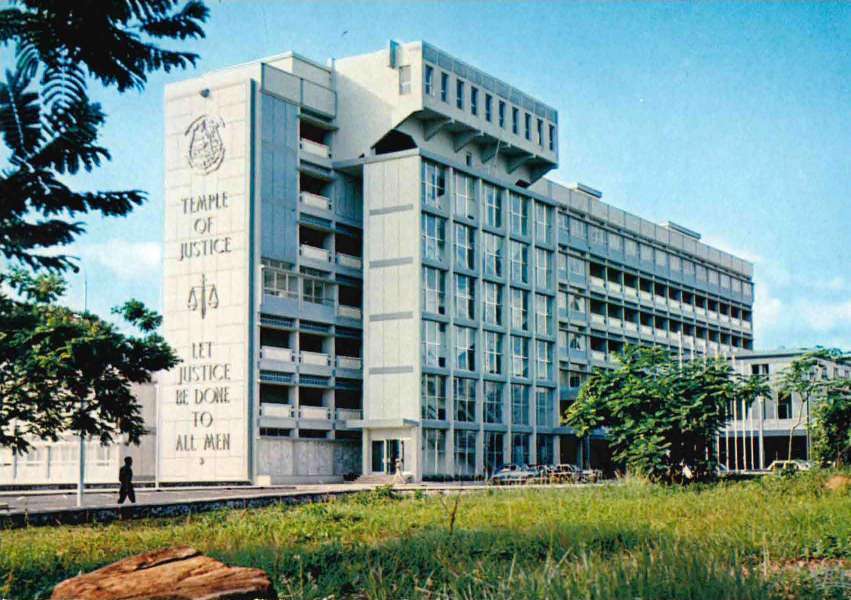
Temple of Justice (Liberia)
The words carved into the building used to read 'LET JUSTICE BE DONE TO ALL MEN.' After a renovation in 2008, the last word was removed. Now it reads simply 'LET JUSTICE BE DONE TO ALL.' It is a small edit to a large building, one word dropped from a slogan on a courthouse. But in Liberia, where fourteen years of civil war tested every institution to the point of collapse, even the revision of a motto carries weight. The Temple of Justice on Capitol Hill in Monrovia survived those wars. That it emerged intact enough to be renovated, let alone revised, sets it apart from much of the city around it.
An Italian Architect on Capitol Hill
The Temple of Justice was designed by Tommaso Valle, a Rome-based architect, during the 1960s, a period when Liberia was building the infrastructure of a modern state under President William Tubman. Capitol Hill in Monrovia was the centerpiece of that ambition. The Executive Mansion, an eight-story semicircular structure of reinforced concrete, went up across the street. The Capitol Building, modeled after its American counterpart, had opened in 1957. Valle's courthouse completed the triad: legislative, executive, and judicial power concentrated on a single hill, each housed in monumental architecture meant to project permanence and authority. The Temple was dedicated in 1965, a modern structure with clean lines that stood in deliberate contrast to the colonial-era buildings elsewhere in the capital.
Surviving What Others Did Not
When the First Liberian Civil War erupted in 1989, Monrovia's buildings became targets, shelters, and casualties. The Executive Mansion across from the Temple was the site of President William Tolbert's assassination during the 1980 coup, and later suffered a devastating fire in 2006. The Capitol Building endured its own damage. But the Temple of Justice emerged from both the First and Second Civil Wars with relatively little structural harm. 'Relatively' is doing heavy work in that sentence. The building survived, but poor maintenance and the complete absence of electricity during the war years made it a miserable place to practice law. Courtrooms sat dark and hot. Offices went without power. The institution the building housed, Liberia's Supreme Court, continued to function in whatever diminished capacity the circumstances allowed.
The Renovation and the Revision
The renovation project that began in 2008 addressed the practical damage of neglect: electrical systems, structural repairs, the accumulated wear of a building that had gone years without upkeep. But the most symbolically charged change was the smallest. The original slogan, 'LET JUSTICE BE DONE TO ALL MEN,' had been carved into the building at a time when Liberia's legal and political systems were dominated by Americo-Liberian men. Removing the word 'MEN' was a deliberate act of inclusion, reflecting a country that had just elected Ellen Johnson Sirleaf as Africa's first female head of state in 2005. The revised slogan now addresses everyone who might stand before the court, a broader promise from a building that had outlasted the narrower one.
Law on a Hill
Capitol Hill today remains the seat of Liberian government. The Temple of Justice houses the Supreme Court, auxiliary courtrooms, and legal offices. The building sits within sight of both the Executive Mansion and the Capitol Building, the three structures forming a compact triangle of state power that would be familiar to anyone who has visited a national capital but carries particular meaning in a country where those institutions were tested by war, coup, and prolonged dysfunction. Monrovia has rebuilt much of what was destroyed. The Temple of Justice, which needed rebuilding of a different kind, stands as evidence that a courthouse can outlast the conflicts it is meant to adjudicate. The slogan on its facade is a statement of aspiration rather than accomplishment. In a country still working through the legacy of its civil wars, that distinction matters.
From the Air
Located at 6.303N, 10.797W on Capitol Hill in central Monrovia. The Temple of Justice is part of a cluster of government buildings including the Executive Mansion and Capitol Building, visible as a concentration of large structures on the hill above the city center. Nearest airport is Spriggs Payne Airport (GLSP), approximately 2 km east along the coast. Roberts International Airport (GLRB) is 56 km southeast. Recommended viewing altitude: 2,000-3,000 feet for the Capitol Hill government district. The Atlantic coastline and Mesurado River provide navigation references. Tropical climate with heavy rainfall June through October.