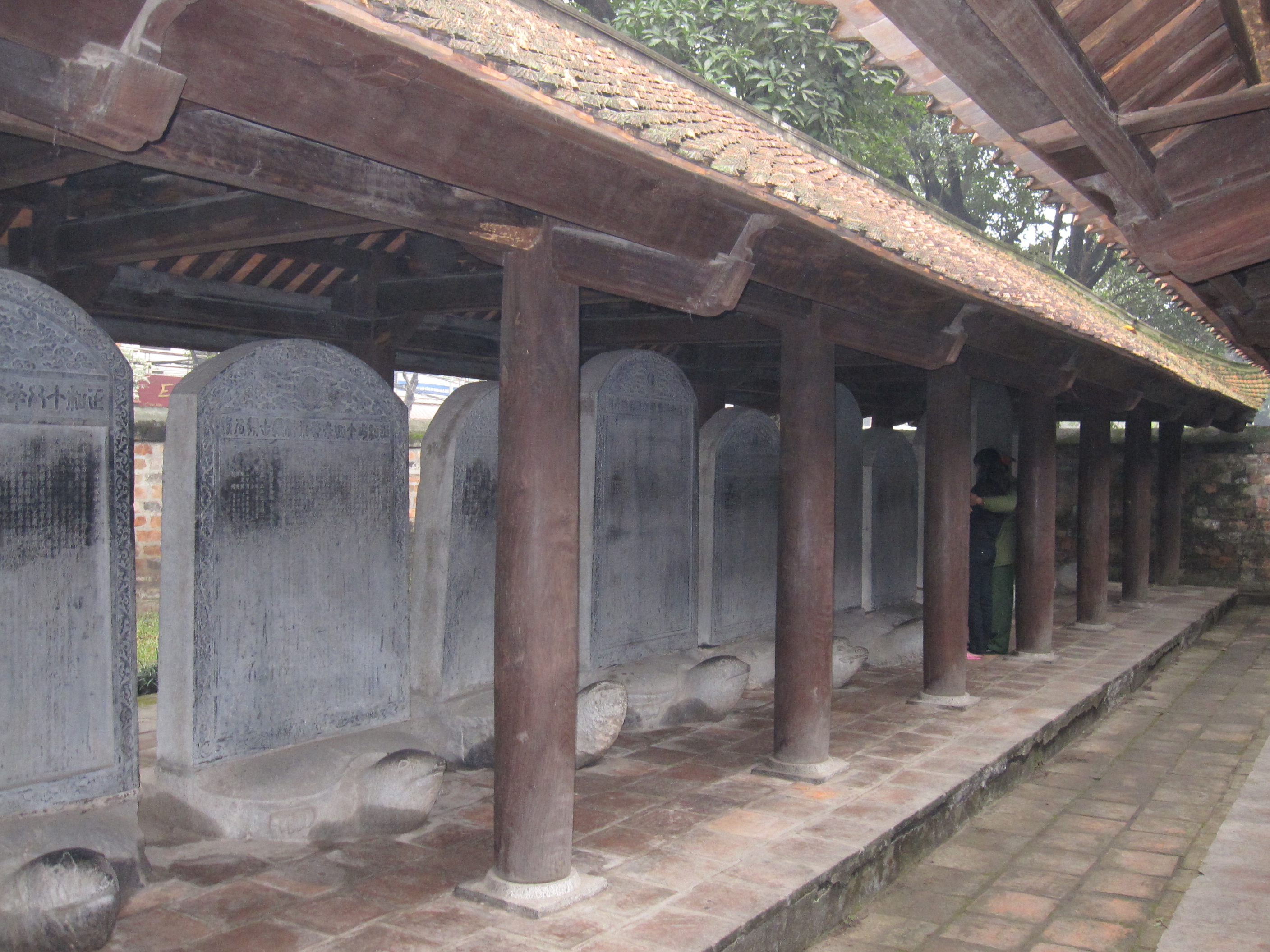
Temple of Literature, Hanoi
Eighty-two stone turtles stand in rows beneath the frangipani trees, each one bearing a stele on its back inscribed with names -- 1,307 names of scholars who passed Vietnam's most grueling examinations between 1442 and 1779. The turtles have outlasted the dynasties that erected them, the colonial regime that nearly demolished the temple around them, and the wars that leveled the city beyond its walls. This is Van Mieu, Hanoi's Temple of Literature, and it has been in the business of honoring learning for nearly a thousand years. Founded in 1070 as a temple dedicated to Confucius, it became the seat of Vietnam's first national university just six years later. Today it appears on the back of the 100,000 dong banknote -- a country putting a school on its money.
A Thousand Years of Scholarship
Emperor Ly Thanh Tong founded the Văn Miếu in 1070, commissioning statues of Confucius and his four greatest disciples -- Yan Hui, Zengzi, Zisi, and Mencius -- along with the Duke of Zhou and seventy-two painted figures of Confucian scholars. In 1076, his successor Ly Nhan Tong established the Quoc Tu Giam, the Imperial Academy, within the temple walls. It was Vietnam's first university, created to educate the bureaucrats, nobles, and royalty who would administer a young kingdom. The academy operated continuously for over seven hundred years, from 1076 to 1779, making it one of the longest-running educational institutions in Asian history. Students enrolled for three to seven years, studying the Four Books and Five Classics of Confucianism, Chinese philosophy and history, and classical poetry. Monthly tests and quarterly examinations measured their progress, each round more demanding than the last.
The Examination Gauntlet
The path from student to mandarin ran through a series of examinations so difficult that success transformed a family's standing for generations. Students first passed the regional Huong Examination, then the national Hoi Examination certified by the Ministry of Rites, and finally -- for those who survived -- the royal Dinh Examination held at court, where the monarch himself posed the questions. The emperor personally ranked those who passed into different grades of doctoral achievement. Beginning in 1484, Emperor Le Thanh Tong ordered the creation of stone stelae to record the names and birthplaces of every successful candidate. Originally 116 steles sat atop carved blue stone turtles, each chosen because the turtle represents longevity and wisdom in Vietnamese culture -- one of the nation's four holy creatures alongside the dragon, the unicorn, and the phoenix. Eighty-two of these stelae survive, and in 2011, UNESCO inscribed them on its Memory of the World Register.
Five Courtyards, Five Worlds
The temple's layout mirrors the Confucian temple at Qufu in Shandong, the birthplace of Confucius himself. Covering over 54,000 square meters, the complex unfolds through five courtyards, each with its own character. The first two are contemplative spaces shaded by ancient trees, where scholars once retreated from the clamor of the city. The third courtyard holds the Thien Quang well, flanked by the halls that shelter the famous stone turtles. The fourth is the ceremonial heart -- the House of Ceremonies and the sanctuary where Confucius and his disciples are still worshipped, their altars tended as they have been for centuries. The Khue Van pavilion, built in 1805 at the entrance to the third courtyard, has become a symbol of Hanoi itself: a red structure perched on four white-washed stone stilts, its circular windows framing the sky. Three pathways run through the entire complex -- the center reserved for the monarch, the left for administrative mandarins, the right for military mandarins.
Survival Against the Odds
The temple has absorbed the shocks of nearly every upheaval in Vietnamese history. Reconstructed during the Tran dynasty in the thirteenth and fourteenth centuries, it endured the transition to Nguyen rule in 1802, when the imperial academy was relocated to Hue and the Hanoi temple was reduced to a district school. Under the French protectorate, it was registered as a Monument historique in 1906 -- a designation that did not prevent the French from demolishing parts of it between 1945 and 1954 to expand the adjacent Saint Paul Hospital during wartime. The fifth courtyard was destroyed entirely during the First Indochina War in 1946. Major restorations followed in 1920, 1954, and most extensively in 2000, when the fifth courtyard was rebuilt to honor the three monarchs who shaped the temple's history: Ly Thanh Tong, who founded it; Ly Nhan Tong, who added the academy; and Le Thanh Tong, who commissioned the stone turtles.
Living Tradition
Before each Tet New Year celebration, calligraphers gather outside the temple to write wishes in classical Chinese characters, their brushstrokes a living thread connecting modern Hanoi to the scholars who studied within these walls a millennium ago. Visitors once rubbed the stone turtles' heads for good luck, a practice so popular that fences now protect the ancient carvings. Inside the fourth courtyard, a small museum displays inkwells, pens, books, and personal artifacts belonging to former students. The drum in the fifth courtyard stands over two meters wide and weighs 700 kilograms. When it sounds, it echoes across grounds where generations of Vietnam's brightest minds once debated philosophy and composed poetry, preparing for examinations that would determine whether they served the kingdom or returned to the provinces. The temple endures because it represents something Vietnam has valued through every dynasty, occupation, and revolution: the belief that learning is sacred.
From the Air
Located at 21.029N, 105.836E in central Hanoi, south of the Imperial Citadel of Thang Long. The temple complex covers over 54,000 square meters and is identifiable by its traditional Vietnamese roof structures and courtyard layout amid the dense urban fabric. Nearest airport is Noi Bai International Airport (VVNB), approximately 25 km north. The complex sits west of Hoan Kiem Lake. Best viewed at 2,000-4,000 feet for appreciation of the five-courtyard layout.