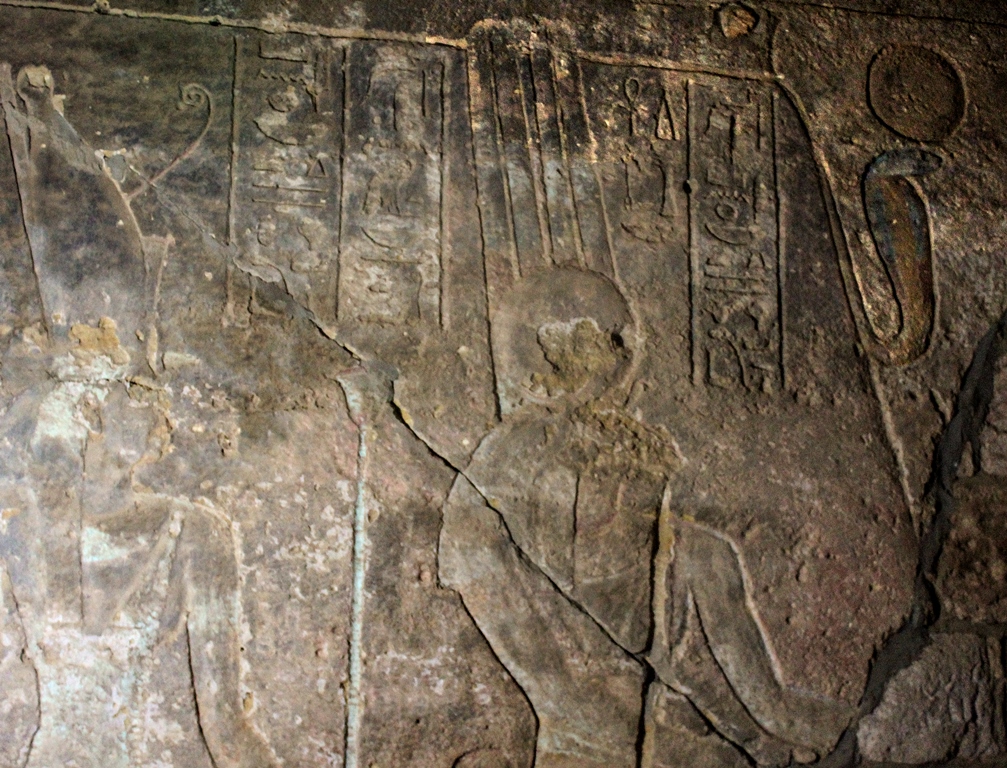
Temple of Mut, Jebel Barkal
If you stood at the right spot at the foot of Jebel Barkal and looked up, the free-standing sandstone pinnacle at the mountain's southwest corner took on the shape of an Uraeus - the rearing cobra that Egyptian pharaohs wore as a crown - and the pinnacle appeared to be wearing the White Crown of Upper Egypt. It was a coincidence of erosion, or a message from the gods, depending on your theology. In the 680s BCE, the Kushite pharaoh Taharqa decided it was a message, and he built his Temple of Mut directly beneath it.
A Temple Carved Into the Rock
The Temple of Mut - also labeled Temple B300 - sits at the western base of Jebel Barkal, directly beneath the pinnacle. It is only partly built. The outer structure, a sequence of entrance kiosk, pylon, Bes pillars, and columns topped with sistrum-headed Hathor capitals, was erected from cut stone. The inner sanctuary is something else: five painted chambers carved directly into the sandstone base of the mountain itself. When Taharqa came to renovate a ruined structure abandoned by New Kingdom pharaohs (the "ancestors," in his own words, whose work he declared to be "humble"), he chose to sink the heart of his new temple into the mountain rather than build on top of it. The building says something explicit: the goddess lives inside the rock. You don't house her. You cut into her house.
Mut, Wife of Amun
The temple is dedicated to Mut, the goddess who was Amun's wife. In Egyptian theology, Amun lived inside Jebel Barkal in the form the Kushites revered most deeply - the state-god of both their kingdom and the Egypt they had recently conquered. Mut lived there with him. Taharqa built this temple so that the couple had their proper accommodations at their Nubian home. The ram-headed Amun appears throughout the wall paintings, frequently with Taharqa himself, in scenes of offering and devotion. Queen Takahatenamun, Taharqa's wife, appears in one scene shaking a sistrum - a sacred rattle used in Egyptian religious ritual. The goddesses represented in the temple played important roles in the myth of the divine origin of the king, and in coronation ceremonies - meaning this temple was not just a place of worship but a theological engine for Kushite kingship, establishing that the pharaoh of Kush was born of Nubian gods in a Nubian holy mountain.
Colors That Survived
The rock-cut chambers preserved what the outer structure did not. Of Taharqa's cut-stone temple, only two Hathor columns still stand. But the paintings inside the chambers are remarkable - figures rendered in ochre and white kaolin on a background of Egyptian blue, accompanied by hieroglyphic inscriptions. Mut appears in multiple forms: human-headed, lion-headed, and in aspects connected to the Double Crown. The iconography ties her to the myth of the Eye of Ra, a solar goddess who could be either nurturing or destructive depending on her mood. Between 2013 and 2020, a team from the Italian Central Institute of Restoration, working with Sudan's National Corporation for Antiquities and Museums, cleaned and restored the paintings. Laurenti Maria Concetta and Osman El-Mailk Eglal Mohamed directed the painting restoration; Claudio Prosperi Porta handled structural safety; Francesca Iannarilli ran the archaeology. The colors came back. The blue, especially, came back - a blue mixed by Egyptian chemists almost three millennia ago, still holding.
Frédéric Cailliaud's First Glimpse
The first Western visitor to document the Temple of Mut was Frédéric Cailliaud, a French naturalist and Egyptologist who arrived at Jebel Barkal in 1821. His drawings of the rock-cut chambers - of the paintings inside the first chamber, of the ruined temple at the foot of the mountain - preserved the condition of the site two centuries ago, before further decay and before modern restoration. Cailliaud was working at a moment when European knowledge of Nubia was close to nonexistent, when the Kushite dynasty that built this temple was barely known to European scholarship at all. What he drew helped introduce the Nubian pharaohs to a wider world that had long since decided Egypt was the only civilization to flower on the Nile. It wasn't. Taharqa's temple, with its cobra-crowned mountain above it, had always known better.
From the Air
Located at 18.54N, 31.83E at the western base of Jebel Barkal in Sudan's Northern State, near the modern town of Karima. Recommended viewing altitude: 2,000-4,000 feet AGL to see both the temple and the distinctive free-standing pinnacle at the mountain's southwest corner. The pinnacle is the key visual feature - a separate sandstone tower roughly 75 meters tall that appears to stand apart from the main cliff. Nearest major airport is Merowe (HSMN) about 30 km to the northeast; Dongola (HSSW) is roughly 180 km downstream. The site is a short walk from the Temple of Amun on the mountain's eastern side - both part of the Jebel Barkal UNESCO complex. Best light for photographing the pinnacle's cobra resemblance is late afternoon.