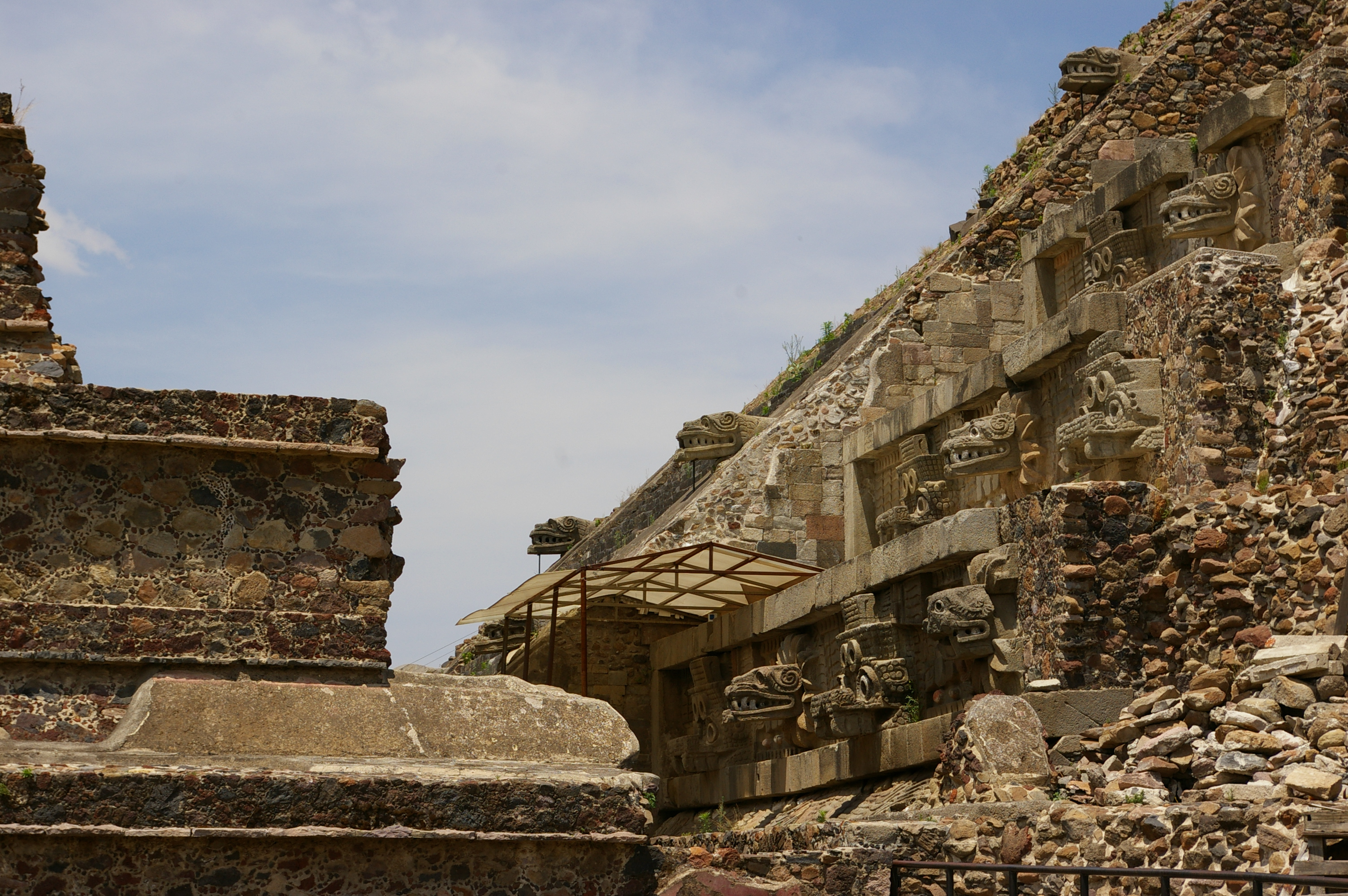
Temple of the Feathered Serpent, Teotihuacan
In 2015, archaeologist Sergio Gomez reached the end of a tunnel that had been sealed for 1,800 years beneath the Temple of the Feathered Serpent at Teotihuacan. What he found there included jade statues, jaguar remains, carved shells, rubber balls, pyrite mirrors, and shimmering pools of liquid mercury - the largest quantity of mercury ever discovered at a Mesoamerican site. The tunnel had been deliberately closed around 250 CE, its contents entombed in darkness beneath a pyramid whose carved facades depicted hundreds of feathered serpent heads and whose foundations held the remains of over 200 people sacrificed during its construction. Teotihuacan's rulers built the temple to embody creation itself, then may have destroyed its authority in what archaeologists interpret as a political revolt.
260 Serpent Heads
The Temple of the Feathered Serpent is a six-level step pyramid at the southern end of Teotihuacan's Avenue of the Dead, enclosed within the vast Ciudadela complex. Its facades were once covered with sculpted representations of the feathered serpent deity - the being later known to the Aztecs as Quetzalcoatl. Researchers estimate that across all four faces, the pyramid originally displayed approximately 260 feathered serpent heads, one for each day of the Mesoamerican ritual calendar. The carvings are dense and fantastical: serpent heads alternate with other deity figures, framed by panels of seashells, on either side of a central staircase. The pyramid dates to between 150 and 200 CE, a period when Teotihuacan was one of the largest cities in the world, its population likely exceeding 100,000.
The Mountain from the Sea
The Ciudadela complex surrounding the temple is not merely a courtyard. Archaeologists have found evidence that its immense plaza was periodically flooded in rituals that transformed it into a simulacrum of the primordial sea from Mesoamerican creation narratives. The pyramid rising from this artificial lake became the sacred mountain that, in those stories, emerged from the waters to begin time itself. The temple's meaning was cosmological: it was not just a building but a re-enactment of the origin of the world. Below it, the sealed tunnel that Gomez explored in 2015 descended into what the builders apparently conceived as an underworld. The liquid mercury found at its end may have been intended to represent water or a supernatural river, its reflective surface serving as a mirror into realms beneath the earth.
Warriors Buried at the Foundations
More than 200 sacrificial burials have been found at the pyramid, interred during its construction as part of its dedication. The dead were predominantly male, though women were among them. Many of the men were buried with weapons and with necklaces made from human teeth, leading researchers to conclude they were warriors - likely soldiers who served Teotihuacan rather than captives from rival armies. The richness of burial goods increases toward the pyramid's center, suggesting at least three degrees of status among the sacrificed, though no single burial stands out as a royal tomb or obvious focal point. The scale of the sacrifice was extraordinary even by Mesoamerican standards, and it raises uncomfortable questions about the nature of loyalty and power in a city that left behind no written language to explain its own actions.
The Revolt Against the Monument
At some point after its completion, the Temple of the Feathered Serpent was deliberately burned in a hot fire. Excavations led by archaeologist George Cowgill in 1988-1989 found that large fragments of clay walls and debris from this destruction were incorporated into the construction of the Adosada Platform, a later structure built partly in front of the original pyramid. Crucially, the damaged temple was left exposed rather than covered by a new pyramid - an unusual choice that Cowgill interprets as intentional, a visible reminder to future rulers against the temptation to overstep. The destruction coincided with a broader shift at Teotihuacan: from around the mid-200s onward, the city redirected its energy away from monumental construction and toward apartment compounds that housed residents of all social levels. The burning of the Feathered Serpent Pyramid has been read as a revolt - a collective statement that the era of building temples to individual glory was over.
From the Air
Located at 19.6818°N, 98.8461°W in the Teotihuacan archaeological zone, approximately 40 km northeast of Mexico City center, at about 7,500 feet elevation. From altitude, the Avenue of the Dead is unmistakable - a broad straight corridor running roughly north-south with the massive Pyramid of the Sun on its east side and the Pyramid of the Moon at its northern terminus. The Temple of the Feathered Serpent sits at the southern end within the rectangular Ciudadela enclosure. The site is surrounded by modern agricultural land and the town of San Juan Teotihuacan. Nearest major airport is Mexico City International (MMMX/MEX), approximately 45 km southwest.