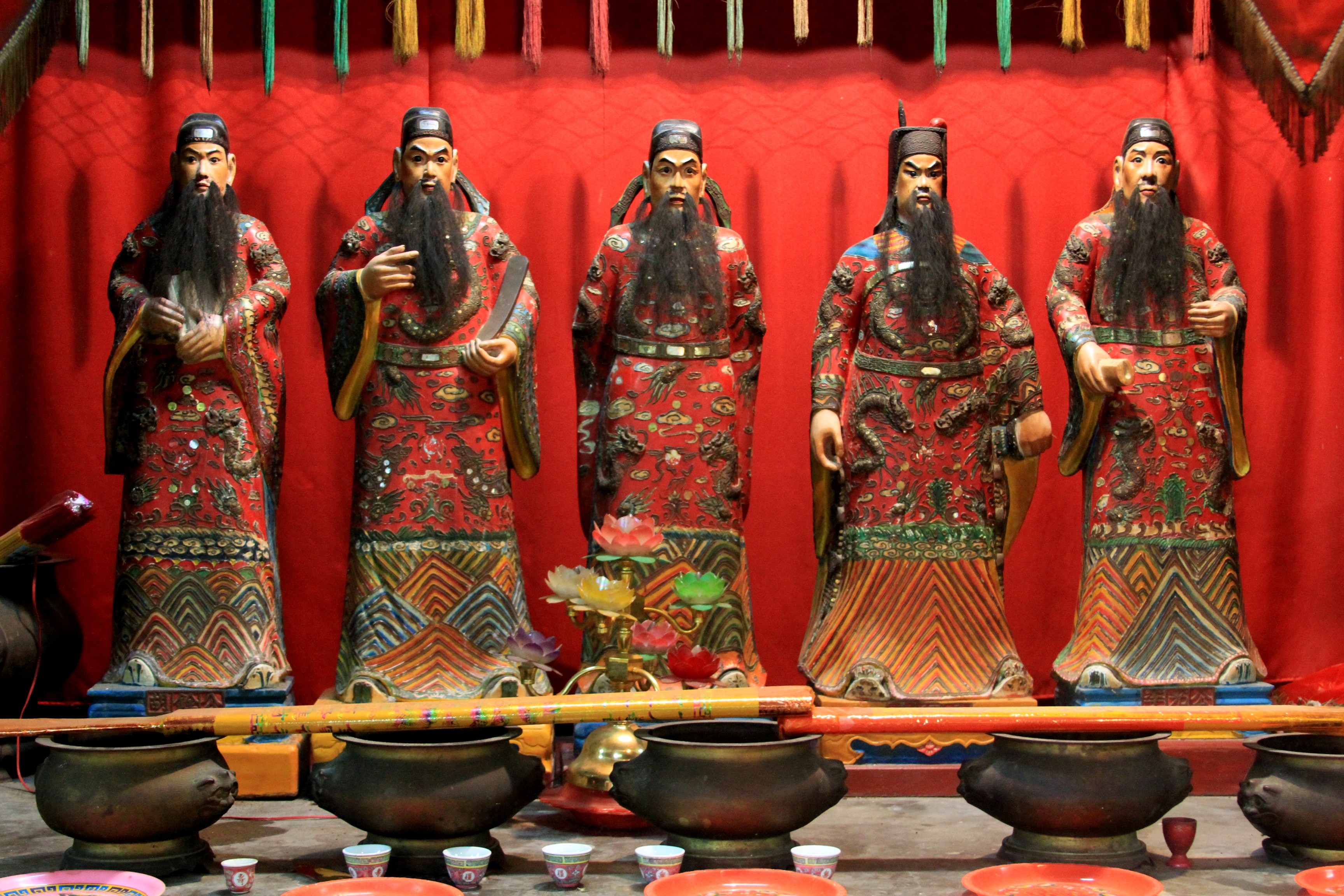
Temple of the Five Lords
Five stone figures stand in a temple on Hainan Island, each representing a man who was sent here to be forgotten. The irony is that China remembers them precisely because of where they were sent. The Temple of the Five Lords, about five kilometers southeast of downtown Haikou, commemorates officials from the Tang and Song dynasties who lost factional battles at court and were exiled to what was then considered the edge of the civilized world. Hainan in their era was not the tropical resort island of today. It was a punishment, a place where disgraced ministers were sent to languish and, in some cases, to die. That these men are now honored here says something about how history eventually sorts its verdicts.
The First Building in Hainan
The temple complex covers 2,800 square meters, centered on a red two-story wooden hall that rises more than nine meters above its grounds. An inscription above the second-floor entrance declares it the "first building in Hainan," a claim that speaks less to chronological fact than to cultural significance. The earliest structures on this site date to the reign of the Wanli Emperor, between 1572 and 1620, during the Ming dynasty. A major restoration followed in 1889 under the Qing emperor Guangxu, with smaller repairs since. Beyond the main hall, the complex includes the Guanjia Hall, the Xuepu Hall, paired East and West halls, the Sugong Ancestral Hall, the Ancestral Hall of the Two Fubo Generals, and several pavilions whose names evoke contemplation: the Suquan Pavilion, the Xixin Hall, the Youxian Cave. Each structure serves a different memorial function, but together they form a single argument: that exile does not erase a person's worth.
Fallen from Favor
The five lords span nearly three centuries of imperial politics. Li Deyu, a Tang dynasty chancellor who lived from 787 to 850, led one side of the Niu-Li Factional Struggles, a decades-long conflict between officials of aristocratic and humble origins. When Emperor Xuanzong crushed his faction, Li Deyu was demoted to census officer at Yai Prefecture, modern-day Haikou, and never returned to the mainland. Four Song dynasty ministers followed him into Hainan exile across the next three centuries. Li Gang served as chancellor for just 75 days before being removed; he had been tasked with defending against the invading Jin dynasty, then cast aside when the emperor chose appeasement over resistance. The Northern Song fell in 1127, vindicating Li Gang's warnings. Zhao Ding, a statesman and poet, advocated recovering territory lost to the Jin and eventually died by hunger strike in exile. Hu Quan was banished in 1148 under the rule of the powerful minister Qin Hui, only to be rehabilitated after Qin Hui's death in 1155.
Generals, Poets, and the Shape of Memory
The temple complex extends beyond its five namesakes. The Ancestral Hall of the Two Fubo Generals honors Lu Bode, who captured Hainan for the Western Han dynasty in 110 BC, and Ma Yuan of the Eastern Han, who lived from 14 BC to 49 AD. Both received the honorary title "Fubo General" for establishing Chinese authority over the island. Their memorial sits within the same grounds, linking the officials' stories to Hainan's deeper history of incorporation into the Chinese imperial system. Southeast of the main complex stands the Sugong Temple, dedicated to Su Shi, arguably the most famous exile ever sent to Hainan. A towering poet, essayist, calligrapher, and statesman of the Song dynasty, Su Shi was banished here in 1097 after repeated clashes with political rivals. During his three years on Hainan, he continued writing and teaching, leaving a cultural imprint that outlasted his punishment. His inclusion in the temple grounds reinforces the complex's central theme: that the empire's rejects became the island's treasures.
The Edge of the World, Reconsidered
To understand what exile to Hainan meant, consider the geography. The island sits across the Qiongzhou Strait from the mainland, a narrow but symbolically vast gap during the Tang and Song periods. No railroads, no airports, no bridges. Passage was by boat, and the tropical climate brought diseases that could kill a northerner accustomed to temperate seasons. For court officials who had spent their lives in the refined world of imperial palaces, Hainan represented not just political death but physical danger. Today the temple stands near the border between Haikou proper and Qiongshan District, surrounded by a city that has grown into a modern capital of nearly three million people. Tourists photograph the stone statues of the five lords, walk through gardens planted around the pavilions, and read the inscriptions that record centuries of factional warfare. The punishment that was meant to silence these men has, over time, given them a stage they would never have had at court.
From the Air
Located at 20.01N, 110.36E in southeastern Haikou, Hainan Island, China. The temple complex is approximately 5km southeast of Haikou city center, near the border with Qiongshan District. Nearest airport is Haikou Meilan International Airport (ZJHK), about 15km to the east. From altitude, Hainan Island is the large tropical island south of mainland Guangdong, separated by the Qiongzhou Strait. The temple is within the urban fabric of Haikou and not individually visible from cruising altitude, but the city's coastal layout along the northern shore of the island is distinctive.