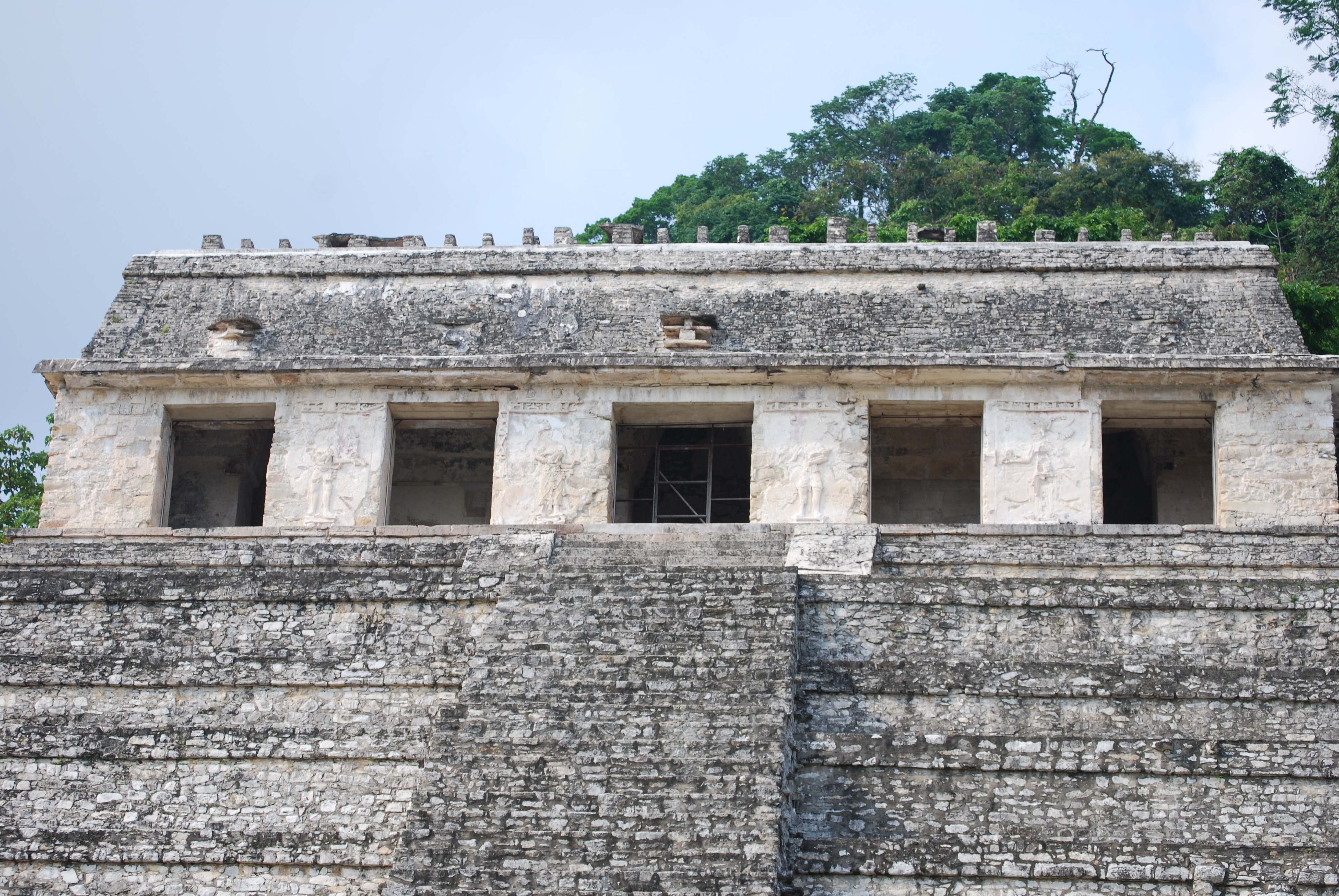
Temple of the Inscriptions
For more than a thousand years, the secret was a stone slab in the floor. Explorers, artists, and archaeologists had visited the Temple of the Inscriptions at Palenque for over two centuries without realizing that the largest stepped pyramid at the site was not merely a temple but a tomb. In 1952, Mexican archaeologist Alberto Ruz Lhuillier noticed something odd about a floor slab in the temple's back room: it had holes that could accommodate lifting ropes. He pried it up and found a rubble-filled stairway descending into the heart of the pyramid. Two years of excavation later, he became the first person in over a millennium to gaze upon the burial of Kinich Janaab Pakal, the seventh-century king who had ruled Palenque for nearly seventy years. The Maya called this building Bolon Yej Te Naah -- the House of the Nine Sharpened Spears.
A Monument Built to Last
Pakal himself initiated construction of the temple in the last decade of his life, probably around 675, and his son Kinich Kan Bahlam II completed the structure and its decoration after Pakal's death in 683. The pyramid rises in eight steps to a total of nine levels, with a temple structure on top that contains five entrances flanked by six piers -- vertical panels bearing carved images and hieroglyphic text in Maya script. The building's name comes from three great stone tablets on the temple's inner walls: the East, Central, and West tablets, which together contain 617 glyphs and constitute one of the longest known Maya inscriptions. These tablets record roughly 180 years of Palenque's history, linking past events to future calendar dates in a pattern also found in the Books of Chilam Balam. The final two columns announce Pakal's death and name Kan Bahlam II as his successor -- the only portion of the text completed after the king's passing.
Figures on the Threshold
The six piers that frame the temple's entrance were once brilliantly colored in red, yellow, and blue, with the stucco still wet when pigment was applied so the color bonded to the building. Piers B through E each depict a standing figure holding an infant-like form of God K, a Maya deity shown with one human leg and one serpent leg. The human leg ends in a six-toed foot, almost certainly a reference to Pakal's son Kan Bahlam II, who appears in portraits with six fingers on one hand and six toes on one foot. The figure on Pier C is thought to be a woman, possibly Pakal's mother Lady Zac-Kuk, connected to the tomb below by a hollow stone duct called a psychoduct -- a physical structure that scholars have compared to an umbilical cord linking mother to son, the living world to the dead. Blue pigment signified the heavens and the gods. Yellow related to Xibalba, the Maya underworld, and was applied to the jaguar-skin skirts worn by the carved figures. The temple was repainted multiple times, and archaeologists can read the layers of pigment between layers of stucco like geological strata.
The Descent
The stairway that Ruz Lhuillier uncovered descends from the temple floor deep into the pyramid's core. At the entrance to the burial crypt, five skeletons were found -- sacrificial victims, both male and female, intended to accompany Pakal into the underworld. The tomb chamber itself was designed with extraordinary engineering to bear the immense weight of the pyramid above: the architects used cross vaulting and recessed buttresses to create a hut-shaped space that has endured for over thirteen centuries. Inside lay the great carved sarcophagus. Its lid depicts Pakal reclining on the earth monster, with the open jaws of a jaguar below him symbolizing Xibalba and the Celestial Bird perched atop the Cosmic Tree above, a serpent twined in its branches. Pakal hovers between worlds -- the heavens and the underworld -- surrounded by his ancestors arranged in a line going back six generations. Only one person has ever photographed the sarcophagus lid in place: Merle Greene Robertson, who was suspended from the ceiling of the chamber to capture the image. The tomb was then resealed and has not been reopened since.
A Face of Jade
Pakal's death mask is made entirely of jade, its eyes fashioned from shell, mother of pearl, and obsidian. Smaller jade heads were packed into the sarcophagus alongside him, and a stucco portrait of the king was found beneath the base. The psychoduct -- that hollow stone channel running from the tomb up through the stairway and out through a hole in the temple floor -- is unique among Maya structures. Archaeologists interpret it as a physical manifestation of the soul's departure at death, corresponding to the Maya inscription phrase ochbihaj sak ikil, meaning 'the white breath road entered.' It has also been suggested that the duct aligns with the winter solstice, allowing sunlight to reach down toward the burial chamber. Before Ruz Lhuillier's discovery, Mesoamerican pyramids had been understood primarily as temple platforms. Pakal's tomb demonstrated for the first time that these structures could serve a dual purpose -- as both temples and royal tombs, monuments to both the gods and the kings who claimed descent from them.
From the Air
Located at 17.484N, 92.047W within the Palenque archaeological zone in northern Chiapas, at approximately 150 meters elevation. The Temple of the Inscriptions is the tallest pyramid at the site, standing 27.2 meters high with a 60-meter-wide base, and is visible from moderate altitude above the jungle canopy. Nearest airports include Palenque (MMPQ) adjacent to the modern town and Villahermosa (MMVA) roughly 150 km north. Expect humid tropical conditions with frequent morning mist and approximately 2,160 mm annual rainfall.