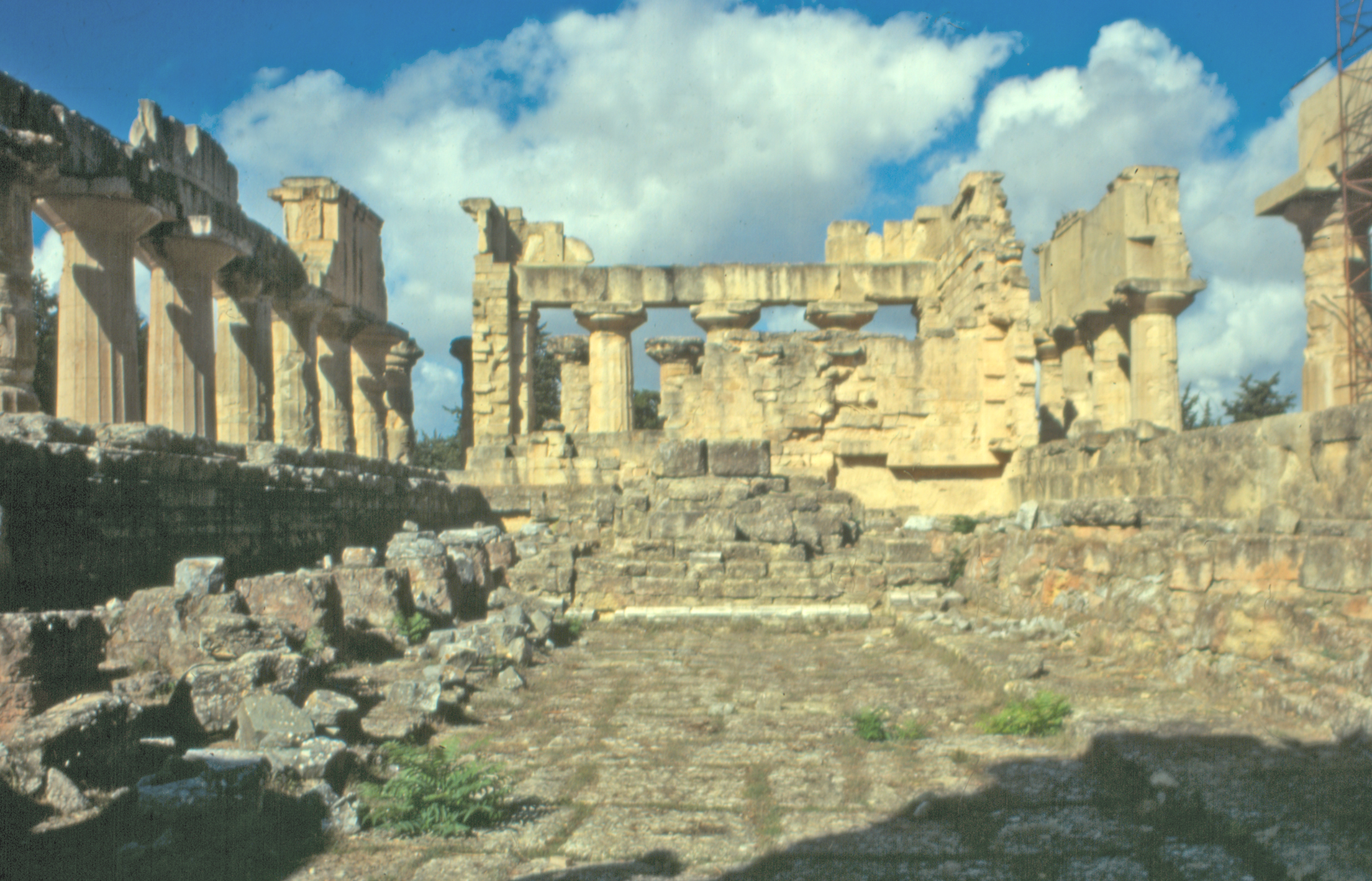
Temple of Zeus, Cyrene
Each of the column capitals weighs 17 tonnes. There are eight columns across the front, seventeen down each side, and the whole structure stretches 68.3 meters long and 30.4 meters wide -- roughly the same footprint as the Parthenon in Athens or the Temple of Zeus at Olympia. Yet this temple stands not in Greece but in Cyrene, in modern-day Libya, on the edge of the North African desert. Built around 500 to 480 BCE by Greek colonists, the Temple of Zeus at Cyrene was one of the largest temples in the ancient Greek world. It was also one of the most abused: sacked, rebuilt, enlarged, shattered by earthquake, purged by Christians, quarried by an Italian army, and finally reconstructed over four decades of modern archaeological work.
Limestone and Ambition
The temple was built as a Doric octastyle peripteral structure -- eight fluted columns at the front and rear, surrounded by a colonnade of seventeen columns on each long side. The stone was local: a shelly, low-quality limestone quarried directly east of the building site. The hollow left by that quarry later became the south end of Cyrene's hippodrome. Each column was assembled from nine drums, each drum 1.9 meters in diameter. The foundations of the outer colonnade are independent of those of the inner sanctuary, or cella, suggesting the colonnade may have been added after the original structure was complete -- a pattern seen also in the nearby Temple of Apollo. A Latin inscription indicates that extensive renovations were carried out late in the reign of Augustus, around 5 to 14 AD, when an unnamed proconsul rededicated the building to Jupiter Augustus.
Undermined, Column by Column
In 115 AD, during the Kitos War, Jewish fighters sacked Cyrene and systematically destroyed the temple. The method was deliberate and labor-intensive: at least 46 of the outer colonnade's columns were undermined by cutting away the crepidoma beneath them, inserting temporary wooden struts, and then setting the struts on fire. As the wood burned through, the columns collapsed outward. The scale of demolition -- each column assembled from nine massive drums, each capital weighing 17 tonnes -- speaks to both the intensity of the conflict and the symbolic importance of what the temple represented. It would be more than fifty years before anyone attempted to put it back together.
A Colossal Replica of Zeus
Restoration came under the proconsul Claudius Attalus between 172 and 175 AD, during the reign of Marcus Aurelius. The cella was rebuilt with its floor lowered by over a meter, a descending staircase added inside the entrance, and the interior walls sheathed in marble. The original internal columns were replaced with engaged columns of green cipollino marble, topped with Corinthian capitals carved from Proconnesian marble. An attempt to re-erect the external colonnade was almost immediately abandoned. Then, between 185 and 192 AD under Emperor Commodus, a platform was constructed in the cella to support an acrolithic replica of the legendary Statue of Zeus at Olympia. The throne base alone measured 8 meters by 10 meters. Marble fragments of the statue's fingers, toes, torso, and arms survive today, along with cedar and nails from the throne and plaster fragments of the drapery -- remnants now kept in the Cyrene Archaeological Museum.
Smashed Beyond Recognition
The 365 Crete earthquake toppled the temple for the second time. Afterward, Christians purged the structure with thorough violence, smashing the internal columns and statues and burning the ruins. The head of a life-size statue of Zeus from the sanctuary was broken into more than a hundred pieces. The site lay in ruins for centuries, its massive blocks too conspicuous to be ignored by nineteenth-century travelers but too heavy to be easily carted away. Robert Murdoch Smith and E. A. Porcher conducted the first excavations in 1861. In 1915, the Italian army used the ruins as a quarry for constructing a barracks. Giacomo Guidi excavated the cella completely in 1926, and full excavation continued from 1939 until 1942, when the Allied conquest of Libya halted the work.
Reassembly Across Eras
In 1954, the Department of Antiquities of Cyrenaica resumed clearance work, and in 1957 the British Army re-erected one and a half columns. A long process of anastylosis -- the archaeological practice of reconstructing a building from its original scattered elements -- led to the re-erection of most of the temple between 1967 and 2008. The resulting structure is frankly anachronistic: it combines the Classical-era peristyle with the Imperial-period cella, merging elements separated by six centuries of architectural history into a single standing building. The goal was partly practical, since re-erecting the columns protected the individual blocks from further erosion. Around the temple, other structures from the sanctuary survive: three banqueting halls with mosaic floors dating to the third or second century BCE, a small fourth-century BCE Doric shrine identified as a treasury, and a Hellenistic precinct that may have served as a temporary temple for Zeus during the decades between the main temple's destruction and its restoration.
From the Air
Located at 32.82N, 21.86E at the ancient Greek city of Cyrene in northeastern Libya, on the edge of the Jabal al Akhdar (Green Mountain) plateau. The archaeological site is visible from altitude as a complex of ruins on the plateau overlooking the coastal plain. Nearest airport is Benina International Airport (HLLB) near Benghazi, approximately 200 km to the west. The reconstructed columns of the temple are among the most prominent features visible from the air at the Cyrene site.