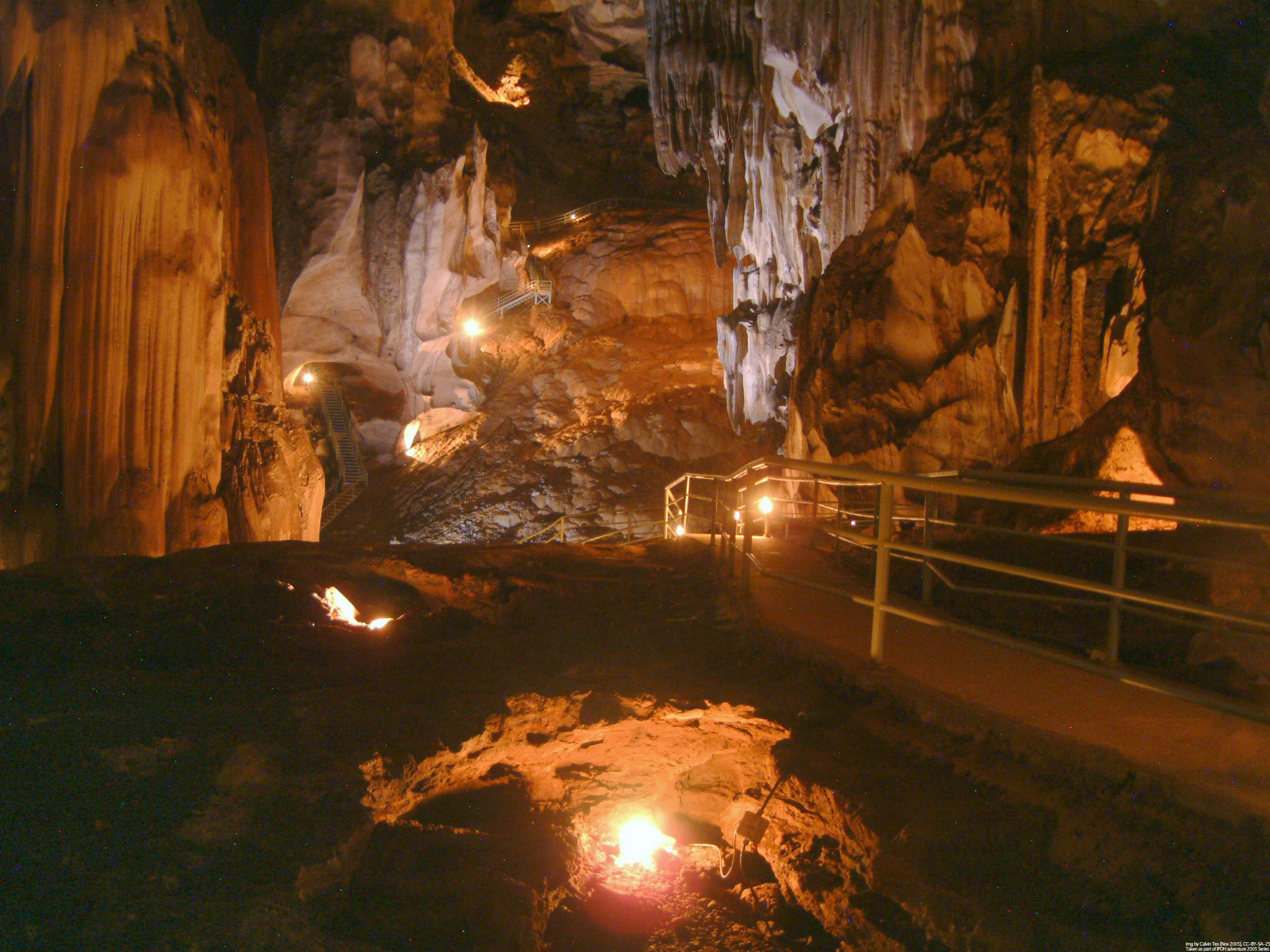
Tempurung Cave
The name gives it away. Tempurung means coconut shell in Malay, and when you stand beneath the cave's five great domes and look up, the resemblance is uncanny -- smooth, curving limestone overhead, pale and ribbed, arching into darkness like the inside of something organic. Gua Tempurung, tucked into the limestone karst country 24 kilometers south of Ipoh in Perak, is one of the longest caves in Peninsular Malaysia. Its passages extend 4.5 kilometers through the earth, though only 1.9 kilometers are open to visitors. What those visitors encounter is a geological record stretching back an estimated 400 million years, a space that has served as shelter, sanctuary, mine, and hideout across the centuries.
Five Domes, Five Worlds
The cave's defining feature is its sequence of five massive domed chambers, each different in character. The ceilings rise into coconut-shell curves overhead, but beneath those similar shapes, the details diverge. Each dome has its own formation of stalagmites and stalactites -- some thick and columnar, others thin as drinking straws. The temperature shifts as you move deeper. Water levels vary from chamber to chamber. Even the mineral composition changes: some sections are pure limestone, others shot through with veins of marble. In the middle of the cave, a stalagmite rises from the floor in a shape that locals say resembles a giant. A 1.6-kilometer underground river flows through the cave system, its current audible long before you reach it. For visitors choosing the more adventurous routes, wading through that river in chest-deep water -- headlamp cutting through the blackness -- is the kind of experience that recalibrates your sense of what a cave can be.
Shelter Across the Ages
Human presence at Tempurung stretches back millennia. The cave is believed to have been used as shelter since around 8000 BC, placing it among the oldest sites of human habitation in Peninsular Malaysia. For most of that long history, the cave's story is written only in the geological record -- drip by drip, layer by layer. But the twentieth century left more legible marks. During the Malayan Emergency, the communist insurgency that convulsed Malaya from 1948 to 1960, guerrilla fighters used Tempurung's deep passages as a hideout. The cave's scale and darkness made it an ideal refuge -- pursuers would need to follow narrow passages through water and absolute blackness to root anyone out. Remnants of the insurgents' presence are reportedly still visible on some cave walls. Then, beginning in the 1970s, the cave found a new use: tin mining. Perak's Kinta Valley was one of the world's great tin-producing regions, and miners followed the ore even underground.
Into the Dark
Today, Tempurung is one of Perak's most popular natural attractions, and the state government has invested in making it accessible without stripping away its wildness. Walkways with handrails, electric lighting, stairs, and bridges guide visitors through the main passages. Four different tour routes are offered, ranging from a dry, well-lit walk suitable for families to a full wet adventure that involves wading and swimming through the underground river. The most extreme route takes roughly three and a half hours and requires a willingness to get thoroughly soaked in the dark. Above ground, the cave sits in the same karst landscape that defines much of the Kinta District -- weathered limestone hills bristling with vegetation, riddled with smaller caves and overhangs. The Kampar River is a 15-minute drive away, popular with kayakers and rafters running its rapids. Gopeng, the nearest town, has positioned itself as Perak's adventure tourism hub, and Tempurung is its anchor attraction.
The Weight of Deep Time
What makes Tempurung remarkable is not any single feature but the sheer accumulation of time it represents. Four hundred million years of geological process produced these chambers -- an age that predates the dinosaurs, predates the flowering plants, predates nearly everything familiar about the modern world. Ten thousand years of human use left traces in the darkness. A mid-century guerrilla war drove fighters into these passages. Tin miners followed. And now tourists wade through the same underground river, headlamps wobbling on the water's surface, gawking at formations that were already ancient when the first humans arrived. The cave does not care about any of this. It continues its slow work of deposition and erosion, building and dissolving, indifferent to whoever happens to be passing through. That indifference is, in its own way, the most striking thing about the place.
From the Air
Tempurung Cave is located at 4.416N, 101.188E in the limestone karst country south of Ipoh, Perak. From the air, the karst hills are distinctive -- steep-sided limestone towers covered in vegetation, scattered across the Kinta Valley floodplain. The cave entrance is at the base of one such hill near Gopeng. Sultan Azlan Shah Airport in Ipoh (WMKI) is approximately 24 km to the north. The North-South Expressway (E1) runs nearby and provides a good visual reference. Best viewed at 3,000-5,000 ft; the karst topography is dramatic from above, with the green towers rising sharply from flat agricultural land.