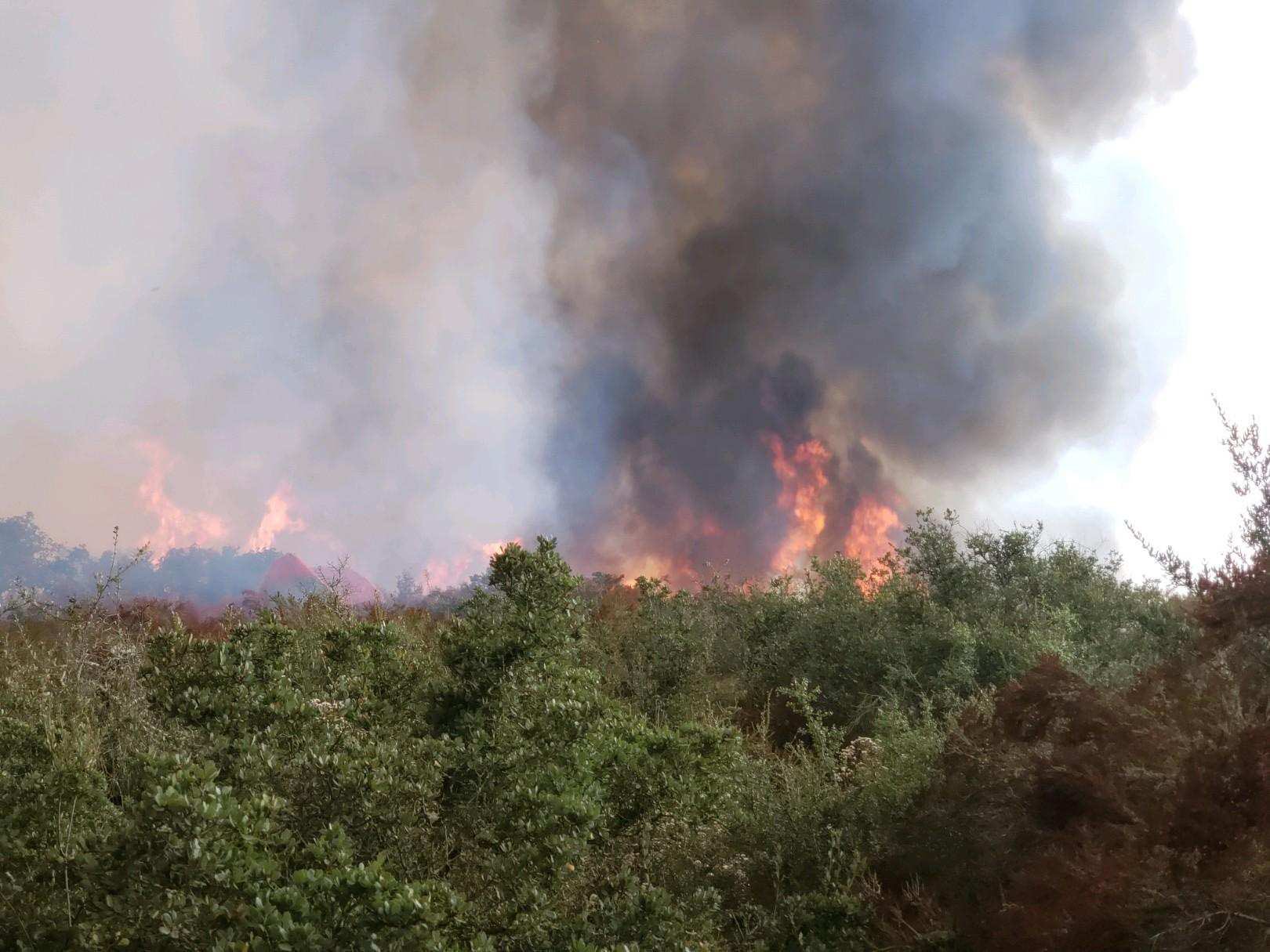
Tenaja Fire
When the Murrieta Valley Unified School District announced it would close all schools on Thursday and Friday, families faced a question that has become grimly familiar in Southern California: where do you go to breathe? The Tenaja Fire had erupted on Wednesday, September 4, 2019, along Tenaja Road and Clinton Keith Road in the rural community of La Cresta, southwest of Murrieta. Within two days, the blaze had ballooned across the landscape, forcing the evacuation of over 1,200 people and filling the skies with smoke dense enough to close the Romoland and Lake Elsinore school districts as well. More than 500 firefighters converged on Riverside County as the fire burned northeast toward Murrieta.
Power Lines in the Wind
The cause of the Tenaja Fire was determined to be power line conductor slap. Southern California Edison conductors arced when they swung and touched in the wind, ejecting hot material that ignited vegetation below. The rural terrain around La Cresta, 80 miles from Los Angeles, provides the conditions California wildfires need: dry brush, steep terrain, and limited access for firefighting equipment. The fire ignited on a Wednesday afternoon and grew with alarming speed. By Thursday evening, evacuations had expanded to include homes on The Trails Circle in La Cresta and the Santa Rosa Plateau Visitor Center. One firefighter suffered minor injuries battling the blaze, and two structures received minor damage.
Smoke Across Three Districts
The immediate danger from flames threatened homes, but the broader impact came from what the fire put into the air. Poor air quality forced the closure of multiple school districts in the Murrieta, Perris, and Lake Elsinore areas. Murrieta Valley Unified shut down Thursday, September 5, and Friday, September 6. Both the Romoland School District and Lake Elsinore Unified School District canceled classes on Friday. Families with children suddenly at home searched for indoor spaces with clean air while smoke hung over the region. The mass amount of smoke became a story unto itself, affecting daily life for thousands beyond the evacuation zones.
Five Hundred Against the Flames
By Thursday, more than 500 firefighters were actively engaging the fire as it burned to the northeast, toward Murrieta. Cal Fire reported the blaze at 10 percent containment on the day after ignition. By 2:30 PM that afternoon, fire activity had subsided considerably. At 8 PM Friday evening, all evacuation orders and warnings affecting hundreds of homes in and around the fire area were lifted as containment grew to 35 percent. The acreage had stabilized. On September 9, Cal Fire revised their estimate of the burned area; the fire had consumed less than originally reported. Full containment came on September 14.
Ten Days to Containment
The Tenaja Fire burned for ten days before Cal Fire could announce complete containment. The final tally: over 1,200 people evacuated, two structures with minor damage, one firefighter with minor injuries, and three school districts closed for multiple days. The Santa Rosa Plateau, an ecological preserve southwest of Murrieta, saw its visitor center included in evacuation orders. The fire joined the long list of California wildfires that have become annual events, each one testing the resources of firefighting agencies and the resilience of communities that have chosen to live in the wildland-urban interface where development meets fire-prone landscape.
From the Air
Located at 33.53N, 117.27W in the rural La Cresta area southwest of Murrieta, Riverside County, California. The fire area spans hillsides near the Santa Rosa Plateau. Best viewed at 2,000-3,000 feet AGL. French Valley Airport (F70) lies 10nm to the northeast. March Air Reserve Base (KRIV) is 20nm to the north. The terrain is hilly with limited roads; the area remains fire-prone during dry conditions. Verify TFR status before overflying during active fire seasons.