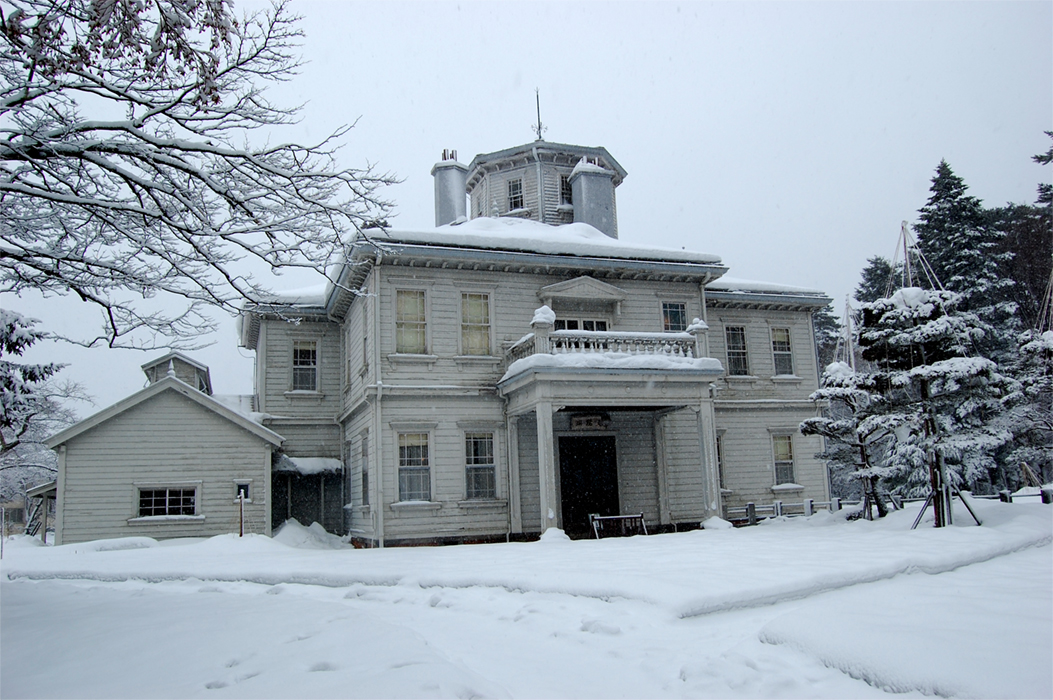
Tenkyokaku
The poet Li Bai, writing during China's Tang dynasty, once compared the surface of a lake to the mirror of heaven. More than a thousand years later, in September 1908, the crown prince who would become Emperor Taisho stood at the windows of a brand-new villa overlooking Lake Inawashiro in Fukushima Prefecture and reached for that same image. He named the building Tenkyokaku -- the Palace of Heaven's Mirror. It was an apt choice. The lake stretched below like polished glass, reflecting the slopes of Mount Bandai, and the villa itself was a kind of mirror too: a Western building on Japanese soil, designed by a Japanese prince who blended French Renaissance architecture with local craftsmanship.
A Prince's Vision
In August 1907, Prince Arisugawa Takehito was touring the Tohoku region of northern Japan when he arrived at the shores of Lake Inawashiro, the country's fourth-largest freshwater lake. The scenic beauty of the highland landscape -- the broad water, the volcanic peak of Mount Bandai rising behind it -- moved him enough to commission a summer villa on the spot. Unusually for a royal residence, the prince designed the building himself, working alongside local architects and carpenters rather than importing a European designer. Construction was completed in just one year, by August 1908. The result was a three-story wooden structure crowned by an octagonal tower, rising 17.9 meters above the lakeshore. White clapboard walls and a wraparound balcony gave it a distinctly Western silhouette, but the construction techniques and certain architectural details were unmistakably Japanese.
Chandeliers and Billiard Tables
Step inside Tenkyokaku and the Meiji era's fascination with Western culture becomes tangible. Marble mantelpieces frame the fireplaces. Chandeliers hang from coffered ceilings. A billiard room occupies one wing -- the game was wildly fashionable among Japan's elite during this period. The floor space spans 927 square meters across three levels, an intimate scale compared to European palaces but generous for a summer retreat. Every detail reflects the era's appetite for blending East and West: Japanese joinery holding together a French-inspired facade, local timber shaped into forms borrowed from continental architecture. The villa was a place where the imperial family could relax in Western comfort while gazing out at one of the most classically Japanese landscapes in the country.
Emperors and Honeymoons
The villa passed through several royal hands over the following decades. In 1922, ownership transferred to Prince Takamatsu Nobuhito, who added a Japanese-style annex for Prince Arisugawa's widow. She lived there until her death in 1923. The young Emperor Showa -- then still crown prince -- visited and chose the villa as the setting for his honeymoon in 1924, lending it a romantic legacy that locals remember to this day. After World War II, the sweeping reforms that dismantled the old aristocratic system brought Tenkyokaku into public ownership. Prince Takamatsu surrendered the villa to Fukushima Prefecture. It served as a conference hall and seminar space for decades, a utilitarian second act for a building designed for imperial leisure.
Heaven's Mirror Restored
Recognition of the villa's historical and architectural significance came in February 1979, when Tenkyokaku was designated one of Japan's Important Cultural Properties. After extensive renovations, the building opened to the public in September 1982. Today visitors can walk through the rooms where princes played billiards and emperors honeymooned, and view exhibits on Meiji-era history displayed in the very rooms that embody it. In 1984, a large bronze statue of Prince Arisugawa was relocated from its former position in front of the Naval Staff College in Tsukiji, Tokyo, to the villa grounds -- bringing the building's creator back, in a sense, to the lakeside he fell in love with. From the upper windows, Lake Inawashiro still spreads out below, and on a clear day Mount Bandai still rises behind it, the same view that stopped a prince in his tracks in 1907.
From the Air
Located at 37.52N, 140.04E on the western shore of Lake Inawashiro in Fukushima Prefecture. The villa sits near the lakeshore and is not easily distinguishable from the air individually, but Lake Inawashiro (104 sq km, Japan's fourth-largest freshwater lake) is an unmistakable landmark. Mount Bandai (1,816m) rises prominently to the north of the lake. The town of Inawashiro is on the lake's northwest shore. Nearest major airport: Fukushima Airport (RJSF), approximately 45km to the south-southeast. The area experiences heavy snowfall in winter months. Best viewed during approaches from the south or east where the lake and mountain create a dramatic backdrop.