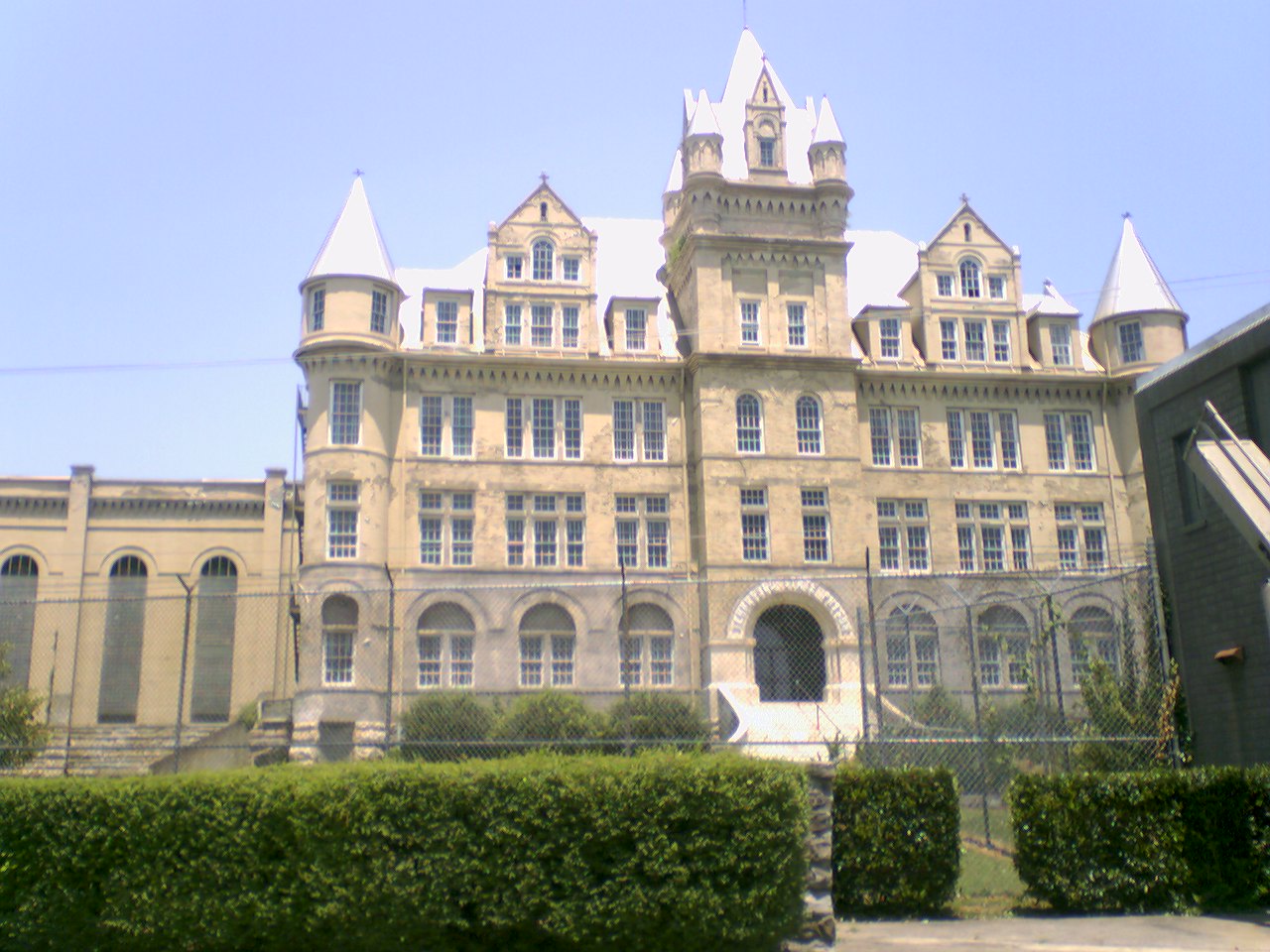
Tennessee State Prison
Six miles west of downtown Nashville, on a bend of the Cumberland River, a castle rises from the Tennessee landscape. Twenty-foot walls, three feet thick, built of stone by the hands of the very convicts they were meant to contain. The Tennessee State Prison opened on February 12, 1898, designed to hold 800 inmates. It received 1,403 that first day. Overcrowding was not a problem that developed over time. It was the prison's founding condition, and it would persist for nearly a century until a federal court declared the place unfit for human habitation and ordered it closed for good.
Before the Castle
Tennessee's first state penitentiary opened on January 1, 1831, on what is now 15th Avenue between Church Street and Charlotte Avenue in Nashville. Modeled after New York's Auburn Penitentiary in both design and discipline, it enforced a regime of silence: prisoners labored together by day with downcast eyes, slept alone in separate cells at night, and were forbidden to communicate with one another under any circumstances. It was the first prison of its kind in Tennessee and in the South. Inmates worked up to 16 hours a day for meager rations in unheated, unventilated quarters. By the 1840s, prison labor had become so profitable that convicts were employed building the Tennessee State Capitol itself. The prison evolved into a revenue-generating system that competed directly with free laborers. In 1870, the state struck a deal with the Tennessee Coal, Iron, and Railroad Company, creating the first convict-leasing program in the country. Free laborers struck back with a walkout in 1871, the first of many revolts against the system.
War Behind the Walls
In 1863, the Union Army seized the penitentiary and converted it into a military prison. Under occupation, the population tripled and conditions worsened dramatically. Convicts were leased to the federal government by the Occupation Government of Tennessee to help repay mounting war debts. Among those imprisoned was Mark R. Cockrill, a Confederate sympathizer whose West Nashville property would later be purchased as the site for the new prison. The Civil War reshaped the prison's population in ways that endured long after the fighting stopped. Before the war, roughly 5 percent of Tennessee's inmates were Black. By 1869, that figure had surged to 62 percent. The disparity was even starker among women: every female prisoner in Tennessee in 1868 was African American.
Stone by Convict Hands
The new prison was built under the direction of Enoch Guy Elliott, appointed chief warden by Governor Peter Turney. Elliott used mostly prison labor to construct the facility on Cockrill Bend, the same property that had belonged to the Confederate sympathizer Mark Cockrill. Construction costs exceeded $500,000, equivalent to roughly $12.3 million in modern terms, not including the price of the land. The fortress-like structure featured twenty-foot stone walls enclosing cell blocks, workshops, an administration building, and factory spaces. When the old penitentiary on Church Street was demolished in 1898, salvageable materials were carried to the new site and used in outbuildings, creating a physical link between the 1831 original and its successor. In 1902, just four years after opening, seventeen prisoners blew out the end of one wing with dynamite, killing one inmate and allowing two others to escape. They were never recaptured. Five years later, inmates commandeered a switch engine and drove it straight through a prison gate.
Hollywood's Favorite Prison
The Tennessee State Prison's brooding, castle-like silhouette caught the attention of Hollywood. The facility served as a filming location for several major productions, including the 1990 comedy Ernest Goes to Jail, the 2005 Johnny Cash biopic Walk the Line, and The Green Mile. The prison's Gothic atmosphere provided a ready-made set that no studio could replicate. But behind the cinematic backdrop, the real institution was deteriorating. Riots broke out in 1975 and 1985. Overcrowding, which had plagued the prison since its first day of operation, never abated. The federal courts intervened with the Grubbs v. Bradley case, which resulted in a permanent injunction prohibiting the Tennessee Department of Correction from ever again housing inmates at the facility. The prison closed in June 1992.
The Castle Endures
After closure, the Tennessee State Prison sat empty on Cockrill Bend, its stone walls slowly weathering, its cell blocks open to the elements. The structure became one of Nashville's most striking ruins, a fortress without purpose standing against the skyline west of downtown. On March 3, 2020, an EF3 tornado from the devastating tornado outbreak of March 2-3 severely damaged the already deteriorating facility. Preservation advocates have long debated the prison's future, with proposals ranging from demolition to adaptive reuse. The building sits on the National Register-worthy site, its twenty-foot walls still standing after more than a century, built by the labor of men who had no choice in the matter. Whether viewed as a monument to punishment or a testament to the human capacity to endure, the castle on the Cumberland remains one of Nashville's most haunting landmarks.
From the Air
Located at 36.1772N, 86.8654W on Cockrill Bend, a prominent curve of the Cumberland River six miles west of downtown Nashville. The fortress-like stone structure with its thick walls and institutional layout is visible from altitude. Best viewed at 2,000-3,000 feet AGL. The prison sits on its own peninsula formed by the river bend. Nearby airports: KJWN (John C. Tune Airport, 3 nm northwest), KBNA (Nashville International Airport, 10 nm east), KMQY (Smyrna Airport, 18 nm southeast). Nashville airspace is Class C centered on KBNA.