Tepe Giyan
Someone placed bronze rings on the jaw of a dead man. Not as ornament, not as currency, but threaded deliberately onto the maxilla and mandible of a 40-year-old skeleton, a burial practice so unusual that the archaeologists who uncovered it in 2011 had never seen anything like it. Grave No. 123 at Tepe Giyan was the latest secret surrendered by a site that has been giving them up for nearly a century, one careful layer at a time.
Where the Dead Keep Records
Tepe Giyan sits in the highland Zagros Mountains of western Iran, a mound of accumulated human presence near the modern city of Nahavand. The site is primarily a necropolis, a city of the dead containing 123 documented graves. But calling it a cemetery understates what it represents. Each burial, each pot shard, each stamp seal records a moment in a continuum that stretches from the 6th millennium BCE into the late Bronze Age. The people who lived and died here left behind one of the most complete ceramic sequences in the ancient Near East, a timeline written in clay rather than words.
Painted Birds and Wavy Bands
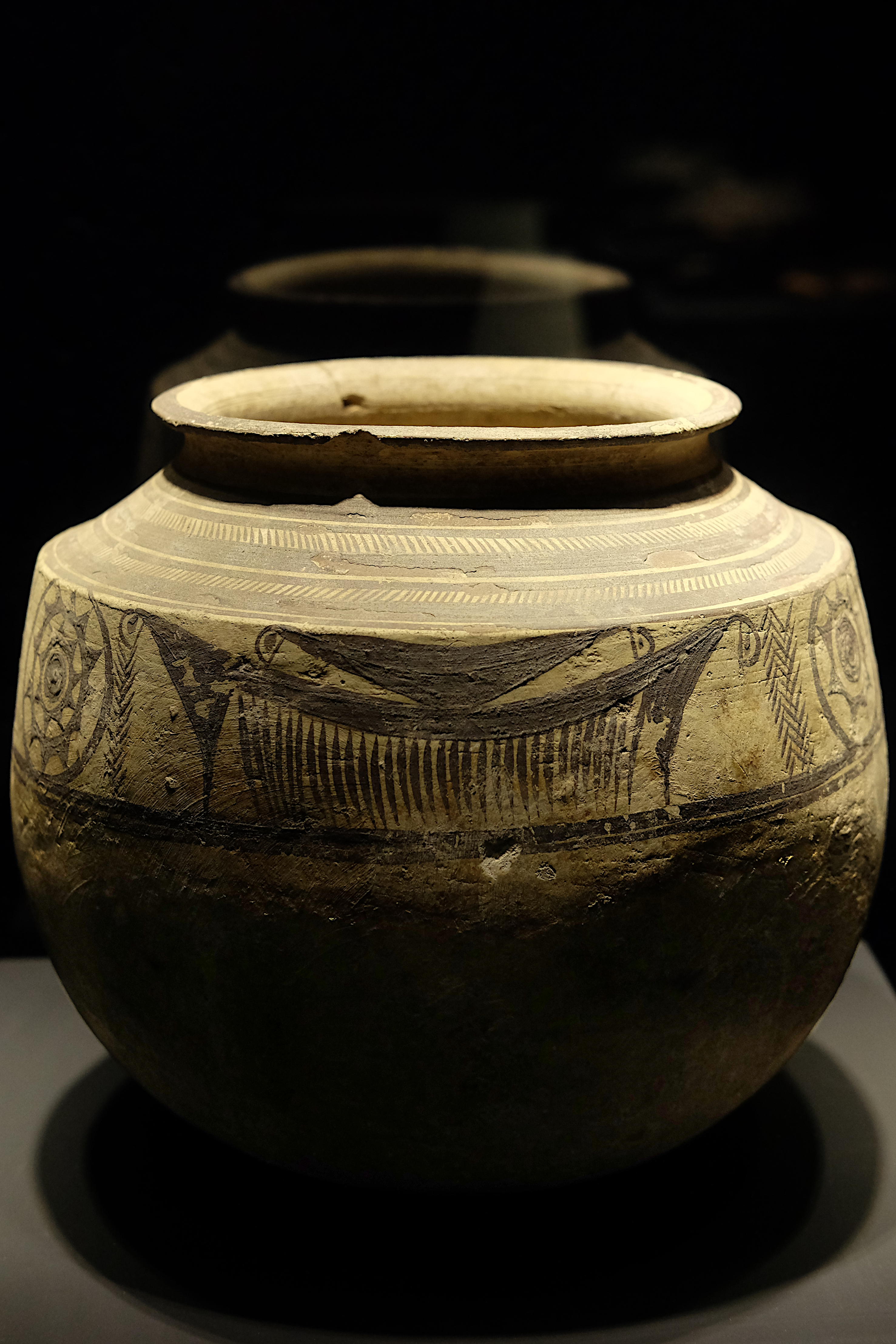
French archaeologists George Contenau and Roman Ghirshman first broke ground here in 1931, backed by the Musees Nationaux and the Ecole du Louvre. What they found was a stratigraphic record divided into distinct phases, each with its own ceramic signature. The earliest, Giyan V, dates to the 6th through 4th millennium BCE and shows styles connected to the great city of Susa far to the south. By Giyan IV, at the transition from the 3rd to the 2nd millennium BCE, potters were producing jars decorated with raised horizontal and wavy bands, painting only the necks while leaving the bodies blank. The motifs grew specific: pairs of birds with wings spread like combs, rows of sawtooth patterns. These were not random decorations. They were a visual language, consistent enough to be read across generations.
Iron Arrives Slowly
The latest phase, Giyan I, spanning roughly 1400 to 1100 BCE, tells a story of technological transition. Iron objects appear, but sparingly: a few daggers, some spear-heads and arrow-heads, rings and bracelets. Iron was still a novelty across Persia during this period, rare enough that possessing an iron blade marked its owner as someone of means. The scarcity at Tepe Giyan mirrors what archaeologists find at sites throughout the region, a slow adoption rather than a sudden revolution. Bronze remained the practical metal. Iron was becoming the future, but it had not yet arrived.
Echoes Across the Plateau
Tepe Giyan does not exist in isolation. Its oldest ceramics bear clear kinship with the Ubaid period pottery of Mesopotamia, linking this mountain community to the lowland civilizations emerging between the Tigris and Euphrates rivers. The site also shares striking similarities with Tepe Sialk, another ancient settlement in the Iranian highlands. Together these sites sketch the outline of a cultural network that crossed mountains and valleys, connecting communities separated by hundreds of kilometers of difficult terrain. Master of Animals stamp seals found at Tepe Giyan, dating from 5000 to 4000 BCE, depict a figure commanding beasts, an image that appears across the ancient world from Mesopotamia to the Indus Valley. Someone carved these seals here, in the highlands, participating in a symbolic tradition that transcended geography.
Still Giving Up Secrets
The 2011 discovery of Grave No. 123 by Ali Khaksar's team proved that Tepe Giyan had not yet finished speaking. The bronze-ringed skeleton of the 40-year-old man raised questions that decades of prior excavation had not anticipated. Was this a medical procedure, a ritual practice, a mark of status? The answers remain elusive. What is clear is that the people buried here lived at a crossroads of the ancient world, in highlands that connected Mesopotamian lowlands to the Iranian plateau, and that their burial customs, their pottery, and their seals carried meaning we are still learning to decode.
From the Air
Tepe Giyan lies at approximately 34.18N, 48.24E in the Zagros Mountains of western Iran, near Nahavand. From altitude, the Zagros range dominates the landscape with its parallel ridgelines running northwest to southeast. The site sits in an intermontane valley. Nearest major airport is Hamadan (OIHH). Recommended viewing altitude: 5,000-8,000 feet AGL for valley context.