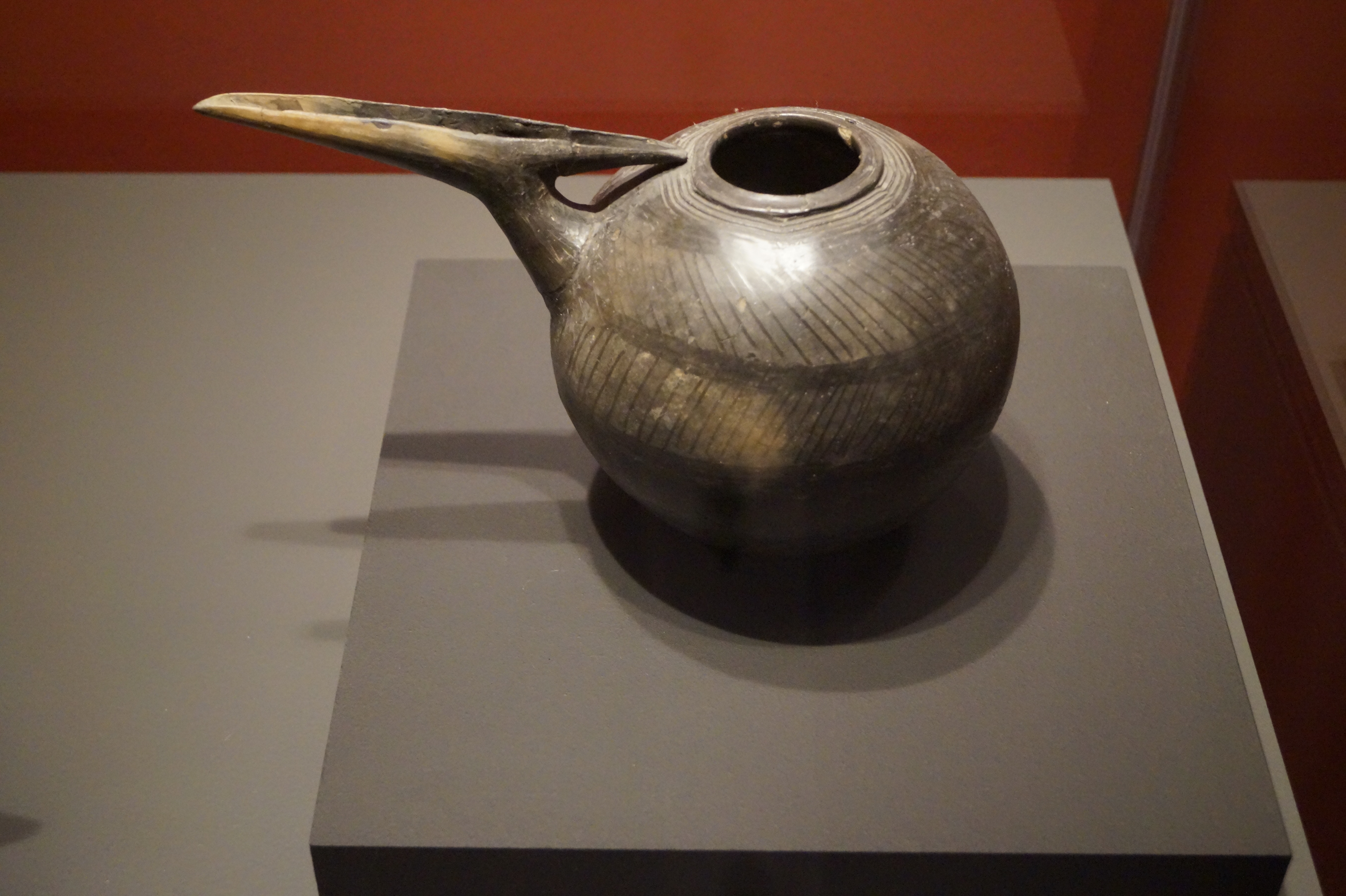
Tepe Hissar
In 1877, a German-born telegraph engineer named Albert Houtum-Schindler noticed locals digging into a mound near Damghan. They were searching for artifacts, and finding them -- pottery, metal objects, beads -- in quantities that suggested something significant lay beneath the surface. Half a century passed before anyone excavated properly. When archaeologist Erich Schmidt arrived in 1931 on behalf of the University of Pennsylvania Museum, he uncovered evidence of continuous human occupation spanning from roughly 3900 BCE to 1900 BCE -- nearly two thousand years of unbroken habitation at a crossroads where Mesopotamia met Central Asia.
Crossroads of the Ancient World
Tepe Hissar sits two kilometers southeast of Damghan in Semnan province, about 360 kilometers east of Tehran. Its position on the Great Khorasan Road -- the ancient highway connecting Mesopotamia to the far reaches of Central Asia -- made it a natural gathering point for trade, migration, and cultural exchange. By the second half of the fourth millennium BCE, roughly 3500 to 3000 BCE, the settlement had become a major center of metalworking and gemstone processing, particularly lapis lazuli. Copper alloys and lead-silver were produced at industrial scale. Semi-precious stones were cut and polished for export to markets as distant as Mesopotamia and Egypt. The city maintained trade relationships with the Bactria-Margiana Archaeological Complex far to the northeast in modern Turkmenistan. Tepe Hissar was not a backwater but a hub.
What the Dead Carried With Them
The site's burials tell the story most vividly. More than 700 graves have been excavated across the site's three main occupation strata. One man from Strata II was buried wearing a copper stamp seal hung from his pelvis, a mace head at his side, copper jewelry and multi-coil bracelets near his head and arms, copper pins with double scroll heads on his chest, a silver headband, and beads of lapis lazuli, carnelian, and turquoise scattered across his body. Archaeologists nicknamed five richly furnished graves from the final period 'the Dancer,' 'Warrior 1,' 'Warrior 2,' 'the Priest,' and 'the Little Girl.' Even the communal graves contained copper ornaments, mattocks, and knives. These were people who valued beautiful objects and took them into death, a practice sustained across two millennia of occupation.
The Burned Building
The most revealing structure at Tepe Hissar was destroyed by fire while still occupied. Archaeologists call it the Burned Building. Unlike other structures that were abandoned before destruction, this one burned with its contents intact, baking its mudbrick walls hard and preserving everything inside. It was the most elaborate building in its layer: six rooms with stairways to the roof, a gateway passage, courtyard, outdoor latrine, and a defensive tower at the entrance. The main room yielded lapis lazuli and chalcedony ornaments, gold and silver jewelry, copper daggers -- one with a grip wrapped in silver bands -- and large copper vessels. A storeroom held lidded storage jars, a copper mattock, and two copper stamp seals. Flint arrowheads lay scattered inside and outside the building, suggesting the fire may have been connected to violence. The excavators concluded this was the residence of the settlement's most prominent individual.
A Writing Tablet Before Writing
Among the more enigmatic finds is a single clay tablet bearing three symbols, discovered in a lapis lazuli workshop area dated by radiocarbon to approximately 3650 to 3370 BCE. This predates Proto-Elamite script, the earliest known writing system of the Iranian plateau. The tablet appears to be what specialists call a 'numerical tablet' or 'impressed tablet,' a type found primarily at Susa and Uruk in Mesopotamia, used for accounting before true writing developed. Its presence at Tepe Hissar suggests the settlement's trade networks were sophisticated enough to require record-keeping, linking this remote Iranian site to the administrative innovations happening simultaneously in the great cities of southern Mesopotamia. After roughly 1900 BCE, Tepe Hissar was abandoned. The sophisticated architecture of the late period gave way to poorly planned structures before habitation ceased entirely, part of a broader collapse of settlement across northeastern Iran.
From the Air
Located at 36.15N, 54.38E, two kilometers southeast of Damghan in Semnan province, northeastern Iran. The archaeological mound is visible from altitude as an elevated feature in otherwise flat terrain near the city. A Sasanian-era palace ruin and an Islamic caravanserai are also visible nearby. The nearest airports include Semnan Airport (OIIS) and Shahroud Airport (OINJ). The modern railway cuts through the center of the site.