Teresa Teng
In the 1980s, there was a saying in mainland China: "Old Deng rules by day, Little Deng rules by night." Old Deng was Deng Xiaoping, the paramount leader. Little Deng was Teresa Teng, whose cassette tapes had been smuggled across the strait by the millions. Her music was technically forbidden -- too sweet, too sentimental, too capitalist -- but it played behind closed doors in apartments from Beijing to Guangzhou. A Taiwanese singer, born to a military family that had fled the mainland after 1949, had become the most listened-to voice in a country that officially pretended she did not exist.
A Daughter of the Garrison
Teng Li-chun was born on 29 January 1953 in Yunlin County, Taiwan, the daughter of a soldier in the Republic of China Armed Forces. She grew up in the martial atmosphere of military dependents' villages, where families who had followed the Nationalist government from the mainland lived in tight-knit communities. Her first mentor introduced her to singing before military audiences, and she would continue performing for soldiers throughout her life. She grew up Roman Catholic, baptized at St. Joseph Catholic Church in Luzhou, where the church distributed rice and flour as part of its missionary work. Her birth name used the character 筠 (yun), but because people consistently mispronounced it as 君 (jun), she eventually adopted the more common character, becoming the Deng Lijun the world would know.
Across Every Border
Teng's career spanned nearly 30 years and more than 1,700 recorded songs in Mandarin, Hokkien, Cantonese, Shanghainese, Japanese, Indonesian, English, and Italian. She is credited as East Asia's first true pop superstar, a pioneer who blended Western pop arrangements with Chinese melodic sensibility at a time when mainland China's airwaves carried little besides revolutionary anthems. In Japan, she won the Grand Prix at the Japan Cable Awards three times in a row -- for "Tsugunai" in 1984, "Aijin" in 1985, and "Toki no Nagare ni Mi o Makase" in 1986. In Taiwan, she won the Golden Bell Award for Best Female Singer in 1980. Her most acclaimed album, Dandan Youqing (Light Exquisite Feeling), released in 1983, set 12 poems from the Tang and Song dynasties to modern music. It was her first album composed entirely of original material, and it remains a touchstone of Chinese pop.
The Voice Behind the Wall
Before the 1980s, foreign music was largely banned in mainland China. Teng's songs arrived anyway, on smuggled cassettes that passed from hand to hand. Her gentle, personal style -- love songs, ballads about longing and memory -- stood in stark contrast to the collective anthems that had dominated Chinese music for decades. The authorities labeled her music decadent. People listened regardless. Faye Wong, Jay Chou, and Cui Jian, the so-called father of Chinese rock, all cite Teng as a formative influence. Nobel laureate Liu Xiaobo and filmmaker Jia Zhangke have spoken of her cultural impact. She became, without ever setting foot on the mainland, a bridge between two Chinas that officially did not speak to each other.
A Life Cut Short
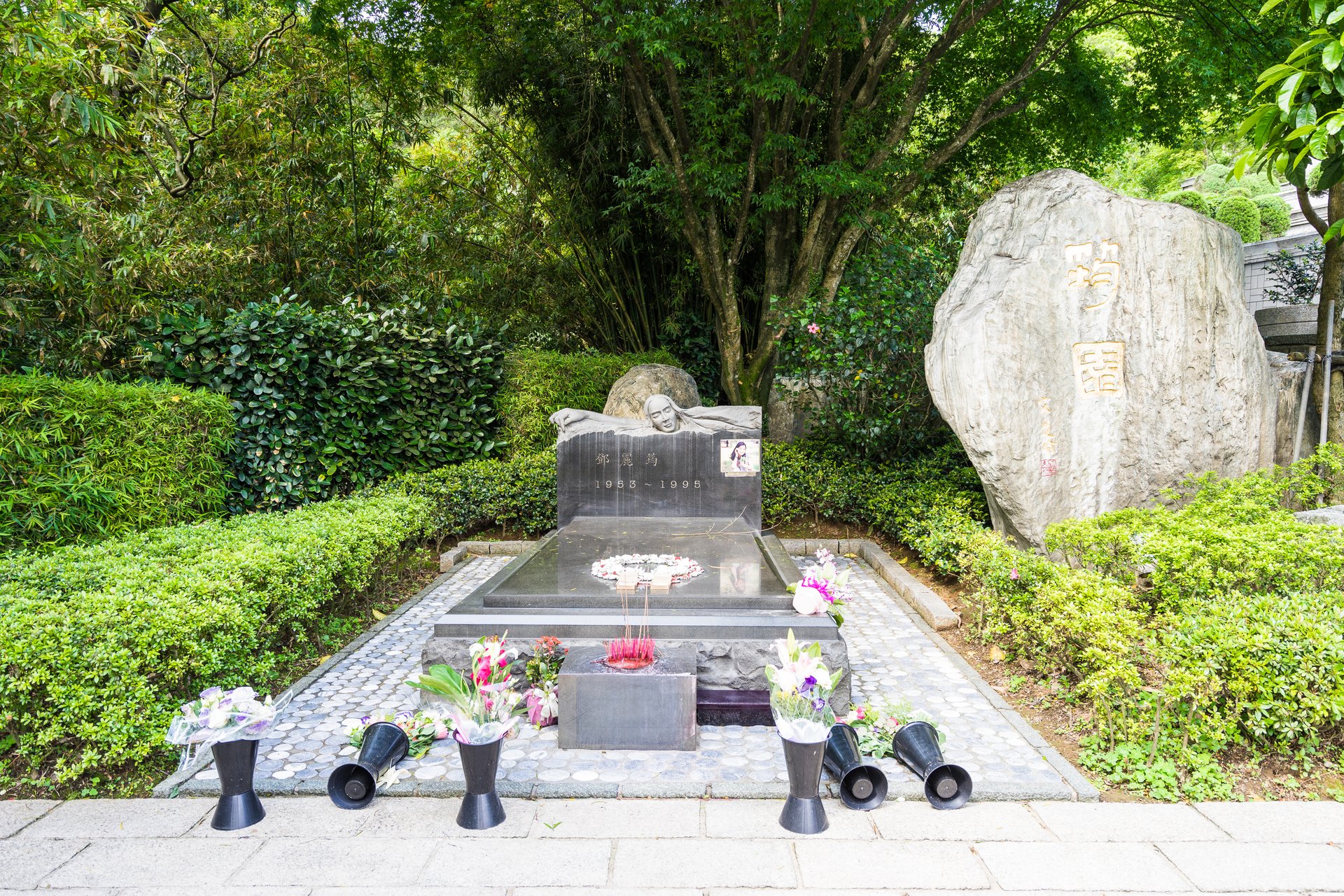
On 8 May 1995, Teresa Teng died in Chiang Mai, Thailand, at the age of 42. She had been on holiday. Reports attributed her death to a severe asthma attack, though Thai doctors cited heart failure. No autopsy was performed -- both her family and that of her fiance, Paul Quilery, declined. She had complained of respiratory difficulties since the start of the year. Her funeral in Taiwan became the largest state-sponsored memorial the island had ever seen, with over 30,000 people lining the route. Billboard wrote that her death "produced a unified sense of loss throughout all of Asia." She was buried at Chin Pao San cemetery in Jinshan, on the northern coast of Taiwan, overlooking the sea.
The Music That Outlasts
Teresa Teng has been dead for three decades, but her cultural presence has not diminished. In 2013, a holographic projection of Teng appeared on stage alongside living performers at a concert in Taipei, her image singing duets with artists who grew up listening to her voice. Her grave at Chin Pao San draws visitors year-round, many of them from mainland China -- the country whose government once tried to suppress her music. The saying endures: wherever there are Chinese-speaking people, there is the music of Teresa Teng. It is not nostalgia. It is the sound of a voice that was too warm, too human, and too persistent to be contained by any border or ideology.
From the Air
Teresa Teng's memorial is located at Chin Pao San cemetery at approximately 25.25°N, 121.60°E in Jinshan District, New Taipei, on the northern coast of Taiwan overlooking the ocean. She was born in Yunlin County (central Taiwan) but is most associated with the Taipei area. Nearest major airport is Taipei Songshan (RCSS), approximately 25 km south. Taiwan Taoyuan International Airport (RCTP) lies roughly 45 km southwest. Best viewed at 3,000-5,000 ft altitude along the northern coastline near Jinshan.