Terminal Island
On February 25, 1942 — ten weeks after Pearl Harbor — the US Navy gave the Japanese American residents of Terminal Island forty-eight hours to leave. Everything. Homes, boats, businesses, the community they had built over three generations. The military police were already in the neighborhood when the announcement came. Families packed what they could carry. The rest was sold for whatever the buyers offered, which was almost nothing, or left behind entirely. The 3,500 people who had lived on Terminal Island and spoken their own dialect of Japanese — kii-shu ben, or 'Terminal Island dialect' — were among the first Japanese Americans removed under Executive Order 9066. Their community was dismantled before the order was even formally signed.
The Island That Was Made
Terminal Island is not entirely natural. The original formation — historically called Isla Raza de Buena Gente, Island of the Friendly People, by Spanish sailors who encountered the Tongva who lived there — was a sandbar and tidal flat in the outer Los Angeles Harbor. Dredging operations beginning in the late nineteenth century and accelerating through the twentieth century filled channels, extended the island's footprint, and created the industrial land mass that exists today. The 1891 renaming to Terminal Island reflected the island's developing role as a terminus for the port's rail and shipping operations. By the time the twentieth century began, it was both a working harbor facility and home to a fishing community that had developed in the island's quieter corners.
Kii-Shu Ben
The Japanese American community on Terminal Island formed in the late nineteenth and early twentieth centuries, drawn by the fishing industry in Los Angeles Harbor. These were primarily families from the Wakayama Prefecture in Japan, and their community on Terminal Island was geographically and socially insular enough that they developed their own dialect — kii-shu ben — a variation of Japanese that linguists have studied as a case of language evolution in an isolated community. The dialect blended influences from the Wakayama original with American English borrowings and the particular idioms of harbor life. By the 1940s, Terminal Island was the largest Japanese American fishing community in the continental United States, a self-sufficient neighborhood with its own schools, churches, and businesses.
Forty-Eight Hours
The forced removal of Terminal Island's Japanese American community preceded the formal machinery of internment. The FBI had been arresting community leaders — fishermen were assumed to have useful knowledge of harbors and coastal waters — since the days immediately after Pearl Harbor. The remaining community lived in escalating fear for two months before the final order came. Forty-eight hours was insufficient time to liquidate a household, negotiate a fair sale, or arrange storage for property that couldn't be carried. Opportunists came to buy at pennies on the dollar. Some families lost everything they couldn't physically transport. The internment camps they were sent to — Manzanar, Poston, Jerome — held them for the duration of the war. Most did not return to Terminal Island.
The Spruce Goose Flies Once
On November 2, 1947, Howard Hughes climbed into the cockpit of the H-4 Hercules — the enormous wooden flying boat he had built under wartime contract to solve the problem of cargo transport across U-boat-infested Atlantic waters — and taxied it out from Terminal Island's waters. The war had ended two years earlier. The plane was obsolete before it flew. Hughes lifted it eight feet off the water and flew it for about a mile at 70 feet of altitude. It never flew again. The Spruce Goose, as the press had named it, spent decades in a climate-controlled dome on Terminal Island before being moved to a museum in Oregon. The single flight it made was the most theatrical proof-of-concept in aviation history.
The Island Now
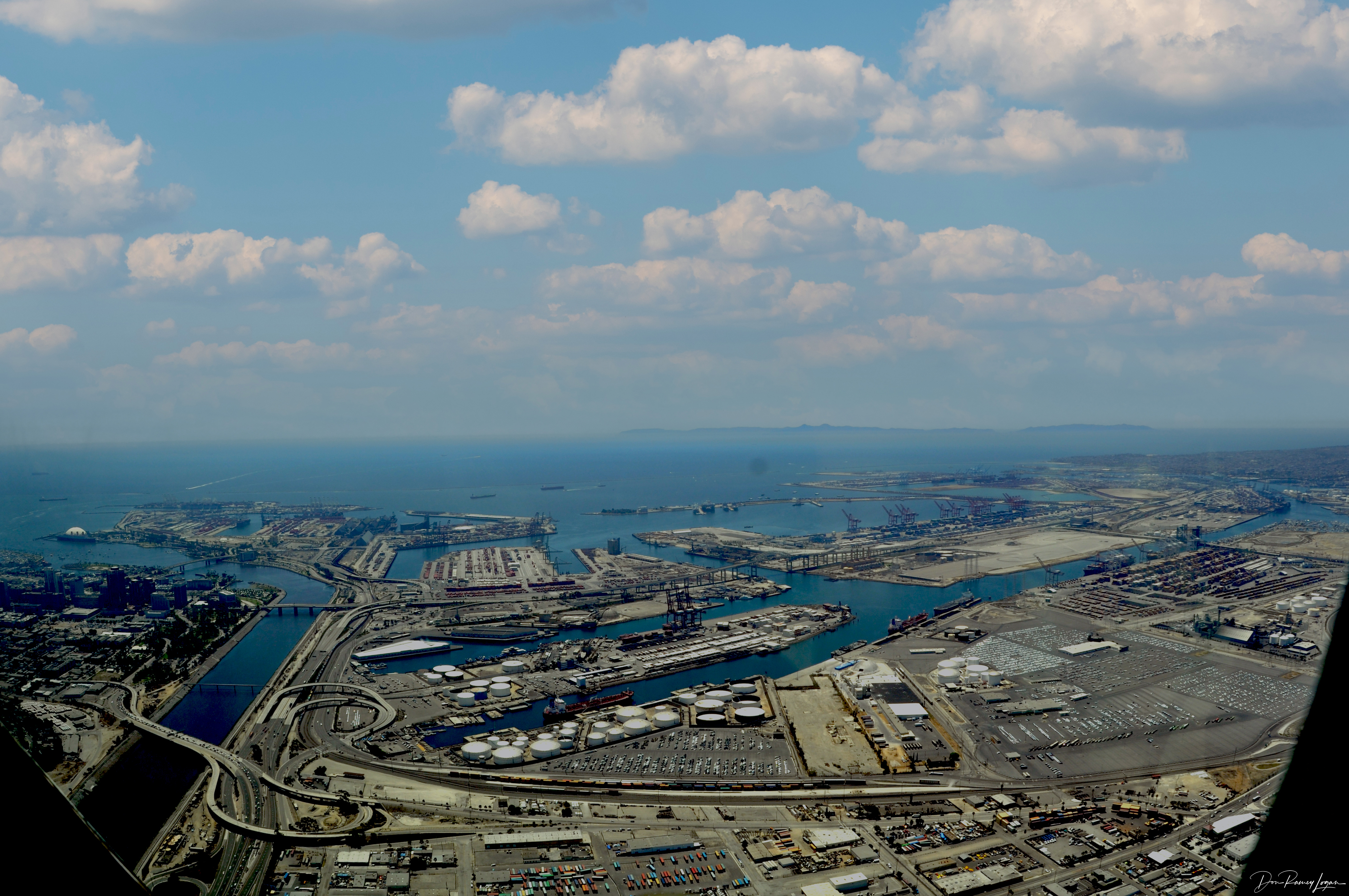
Terminal Island today is almost entirely industrial — port operations, fish processing, the federal correctional institution that occupies its western end. The Ford Motor Company assembly plant that operated on the island from 1930 to 1958, assembling cars from parts shipped from Detroit, is gone. SpaceX leases 12.4 acres for rocket component fabrication, bringing the island's association with large machines and ambitious engineering into the twenty-first century. The Japanese American community that was removed in 1942 is commemorated by a small monument on the island. The kii-shu ben dialect they spoke — isolated, evolved, distinctive — is extinct. The last fluent speakers died decades ago.
From the Air
Located at approximately 33.76°N, 118.25°W, Terminal Island sits between the Port of Los Angeles (San Pedro) and the Port of Long Beach in Los Angeles Harbor. The island is clearly identifiable from altitude by the massive container cranes and port infrastructure. Long Beach Airport (KLGB) is approximately 4 miles northeast. The Queen Mary is moored at the Long Beach side of the harbor. Approach from the south over the harbor entrance for the best view of the island's industrial scale.