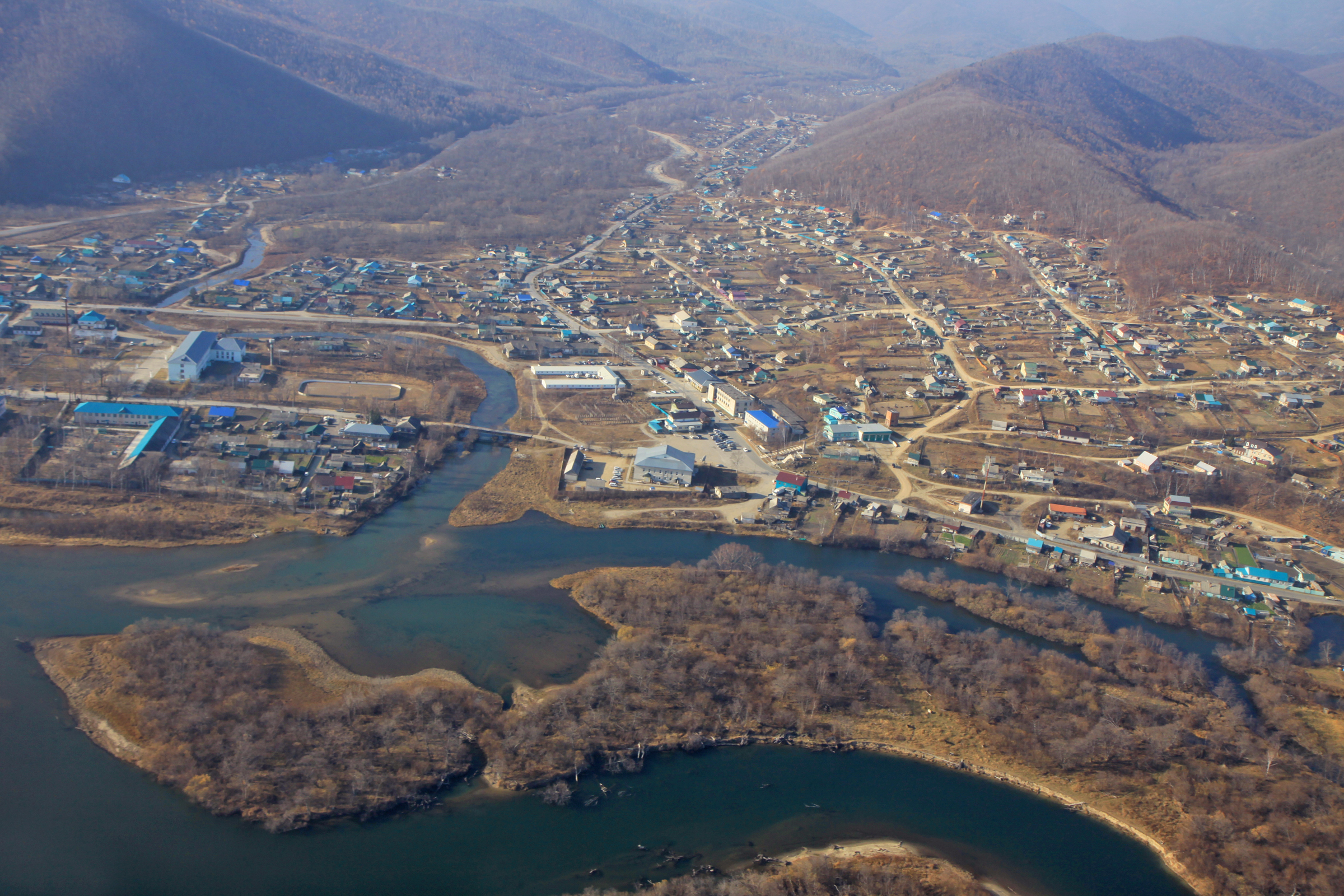
Terney
A French explorer stumbled upon this bay on June 23, 1787, and what he found unsettled him in the best possible way. Jean-François de Galaup, comte de La Pérouse, was sailing north along what he called 'the Tartary of the Manchus' when he anchored in a quiet cove on the Sea of Japan coast. His sailors found no living residents — only a native grave, its occupant dressed in Chinese silk and decorated with Chinese coins, evidence of trade networks reaching deep into the continent. La Pérouse named the bay Baie de Ternay in French. The Russian settlement that eventually grew here, founded in September 1908, would keep a version of that name, and the wildness that impressed the French expedition survives to this day.
Where North Meets South
The Sikhote-Alin Mountains behind Terney are one of the planet's great biological crossroads. Northern species — brown bears, lynx, the enormous Blakiston's fish owl — share habitat with southern species that have no business surviving this far into continental Asia: Amur tigers, Amur leopard cats, wild boar rooting for acorns beneath oak trees. The collision produces an ecosystem of staggering diversity, with 1,076 documented species of vascular plants and 72 species of mammals in the middle Sikhote-Alin alone. The entire area carries UNESCO World Heritage designation, recognizing what took geologists, ecologists, and sheer geological good fortune millions of years to assemble. The cold Oyashio Current offshore keeps Terney's summers cooler than Harbin despite being further south — an anomaly that preserves conditions for species that would otherwise have retreated north as the climate warmed.
La Pérouse's Bay
The bay where La Pérouse anchored is still there, small and sheltered, its shingle beach framed by volcanic cliffs. His expedition's discovery settled a centuries-old geographic puzzle: were the coasts visited by Dutch explorer Maarten Gerritsz Vries in 1643 — which Vries thought was the Asian mainland — actually the east coast of Hokkaido and Sakhalin? La Pérouse's sailors found themselves at the same latitude as Vries had been, but the coastline looked entirely different, confirming it could not be the same place. The grave they opened, with its Chinese fabrics and coins, hinted at a world of connection across vast distances — trade goods moving between indigenous peoples, Chinese merchants, and Manchu traders long before any European set eyes on this coast. The present Russian town arrived more than a century after La Pérouse, but his name stuck.
Upolnomochenny Bay and the Abrek Coast
A short distance from town, Upolnomochenny Bay offers what locals call paradise conditions in miniature: shingle beaches, dramatic sea cliffs, underwater plateaus rich with marine life, and caves accessible only at low tide. The mountain Abrek rises 625 meters above the water. In August and early September the sea reaches 22°C — warm enough to swim with a mask above kelp forests and scallop beds. Spotted seals haul out on Cape Schaslivy year-round, their rookery gathering up to 400 individuals in autumn. From a motorboat along the Abrek coast, the cliffs reveal ghorals — the rare Amur subspecies of wild goat, numbering no more than 600 to 750 individuals — picking their way across ledges above the surf. It is, by most reasonable measures, the kind of coastline that would be famous if it weren't quite so difficult to reach.
The Rarest Rhododendron
One gorge in the hills above Terney contains something found nowhere else on the Russian mainland. Rhododendron fauriei — a relict species that dominated these mountains during the Neogene Period, before the ice ages reorganized the continents' vegetation — survives here and essentially nowhere else in continental East Asia outside Sakhalin and Japan. It grows into shrubs and small trees up to six meters tall, with leathery leaves twenty centimeters long and white flowers four centimeters across. When it blooms in mid-July, the sight of a tropical-looking flowering tree on a steep conifer slope in the Russian Far East produces a mild cognitive dissonance. The rhododendron is a living fossil of sorts — a reminder that the forests here were once very different, and that some of what was lost managed to hang on in one sheltered gorge.
Migration Crossroads
Every autumn and spring, Blagodatnoe Lake near Terney becomes one of the most important stopover points on the East Asian flyway. More than half a million geese, swans, and shorebirds pause here to feed during their migrations between subarctic nesting grounds in northeastern Siberia and wintering areas further south. Twenty-four species of duck have been recorded. The lake's richness comes from its paleo-lagoon origins — an ancient inlet now separated from the sea — which sustains the fish and invertebrate populations that fuel the migration. The Sikhote-Alin's avifauna runs to more than 340 species, including Steller's sea eagle, an apex predator that winters along this coast and whose wingspan can exceed two meters. Birdwatchers who make the long journey from Vladivostok — fourteen hours by bus over 700 kilometers — consistently report that nothing quite prepares them for what they find.
From the Air
Terney sits at 45.03°N, 136.60°E on the Sea of Japan coast of Primorsky Krai. From altitude the Sikhote-Alin range is visible as a dark ridge running parallel to the coast. The small bay and settlement are identifiable by the coastal indentation. The nearest significant airport is in Vladivostok (UHWW), approximately 700 km to the southwest. A small airstrip at nearby Plastun (UHPD) receives weekly flights from Vladivostok. Best viewed at 3,000–5,000 meters in clear weather.