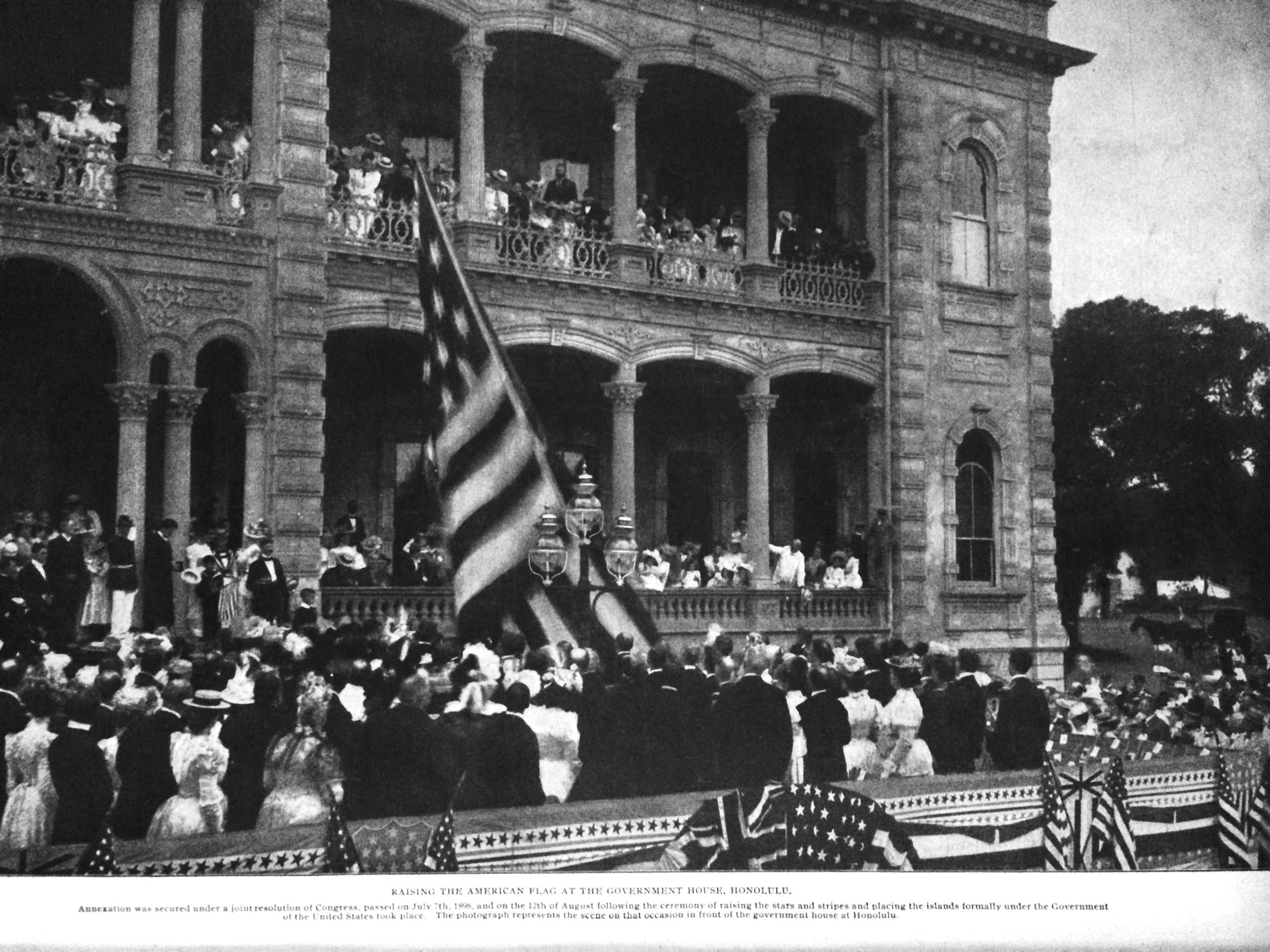
Territory of Hawaii
On August 21, 1959, President Eisenhower signed the proclamation admitting Hawaii as the fiftieth state, and the celebrations in Honolulu lasted for days. But the moment of statehood was the end of a story, not the beginning of one. For fifty-nine years before that signing, Hawaii had existed in a peculiar American limbo: annexed but not admitted, governed but not fully represented, populated by citizens who paid federal taxes and fought in federal wars but could not vote for the president who sent them. The Territory of Hawaii, established in 1900 and dissolved in 1959, was the arena in which modern Hawaii took shape, forged by labor conflict, military occupation, racial politics, and an extraordinary campaign for self-determination that succeeded against long odds.
Annexation and Its Discontents
The territory's origins were bound up in the overthrow of the Hawaiian monarchy. In 1893, a group of American and European businessmen, backed by U.S. Marines, deposed Queen Liliuokalani and established a provisional government. Five years later, on July 4, 1898, Congress passed the Newlands Resolution annexing the Republic of Hawaii. The Hawaiian Organic Act of 1900 formally organized the territory, appointing a governor selected by the president and establishing a territorial legislature. But the legal machinery papered over a deeper wound. As the U.S. Congress itself acknowledged in the 1993 Apology Resolution, the overthrow occurred with the active participation of American agents and citizens, and the Native Hawaiian people never directly relinquished their claims to sovereignty through any plebiscite or referendum. The territory's first governor, Sanford Dole, had been president of the republic that replaced the monarchy. The transition from kingdom to republic to territory happened within a single decade, and the people whose ancestors had governed these islands for centuries had no meaningful say in any of it.
Martial Law and the War Years
The Japanese attack on Pearl Harbor on December 7, 1941, transformed the territory overnight. Within hours, Governor Joseph Poindexter declared martial law, suspending civilian government and handing control to the military. Lieutenant General Walter Short became military governor, and for nearly three years, the Army ruled Hawaii. Civilian courts were closed. Military tribunals replaced them. Censorship was imposed on newspapers, mail, and telephone calls. A curfew darkened the islands each night, and blackout regulations covered every window facing the sea. The martial law period tested the constitutional limits of military authority over American civilians, and the Supreme Court later ruled in Duncan v. Kahanamoku (1946) that the military tribunals had been unlawful. But that ruling came after the fact. During the war years, Hawaii's residents of Japanese ancestry, who made up roughly a third of the population, lived under particular scrutiny, though the mass internment that devastated Japanese American communities on the mainland was never fully imposed in the islands, partly because Hawaii's economy could not function without its Japanese labor force.
Labor, Race, and the Big Five
The territory's economy was dominated by the Big Five, a handful of corporations with roots in the missionary and sugar plantation era: Castle & Cooke, Alexander & Baldwin, C. Brewer, American Factors, and Theo H. Davies. These firms controlled sugar, pineapple, shipping, banking, and much of the land. Plantation labor was organized along racial lines, with workers imported from China, Japan, Portugal, the Philippines, Korea, and Puerto Rico. The result was one of the most ethnically diverse populations in the United States, but diversity did not mean equality. The great waterfront and sugar strikes of the 1930s and 1940s, organized by the International Longshoremen's and Warehousemen's Union, reshaped the territory's power structure. The 1946 sugar strike was the first industrywide work stoppage in Hawaii's history, and the 1949 dock strike shut down the islands' lifeline to the mainland for 171 days. These labor battles, fought by workers of every ethnic background, broke the Big Five's grip on territorial politics and laid the groundwork for the multiracial Democratic coalition that would dominate Hawaiian politics for decades.
The Long Road to the Fiftieth Star
Hawaii's campaign for statehood began almost as soon as the territory was organized, but the path took nearly six decades. Race was the central obstacle. Congressional opponents, particularly southern Democrats, objected to admitting a state where white residents were a minority and where interracial marriage was commonplace. Cold War anxieties added another layer: the powerful ILWU was accused of Communist sympathies, and the Smith Act trials of 1953, known locally as the Hawaii Seven case, cast a shadow over the statehood movement. Delegate Joseph Farrington and later John Burns championed the cause in Washington, building alliances and countering the racial arguments with appeals to democratic principle. The 442nd Regimental Combat Team, composed largely of Japanese Americans from Hawaii, had compiled the most decorated unit record in U.S. Army history during World War II, a fact that statehood advocates cited repeatedly. When Alaska was admitted in January 1959, Hawaii's case became irresistible. The Hawaii Admission Act passed Congress in March, a plebiscite in June showed 94 percent support, and on August 21, 1959, the territory ceased to exist. The new state excluded several outlying islands, including Palmyra Island and the Midway Islands, which remained under federal jurisdiction.
From the Air
The Territory of Hawaii encompassed all of the Hawaiian Islands, centered approximately at 21.31N, 157.80W (Honolulu, Oahu). The former territorial capital, Iolani Palace and the surrounding government district in downtown Honolulu, is visible from low altitude on Oahu's south shore. Pearl Harbor (PHRL), the site that catalyzed martial law, lies 8 miles west of downtown. Daniel K. Inouye International Airport (PHNL) serves as the primary field. The territory's sugar plantation legacy is visible in the patchwork fields of central Oahu and Maui's central valley. Best appreciated from 3,000-5,000 feet AGL over Honolulu's government district, with views extending to Pearl Harbor and the Waianae Range.