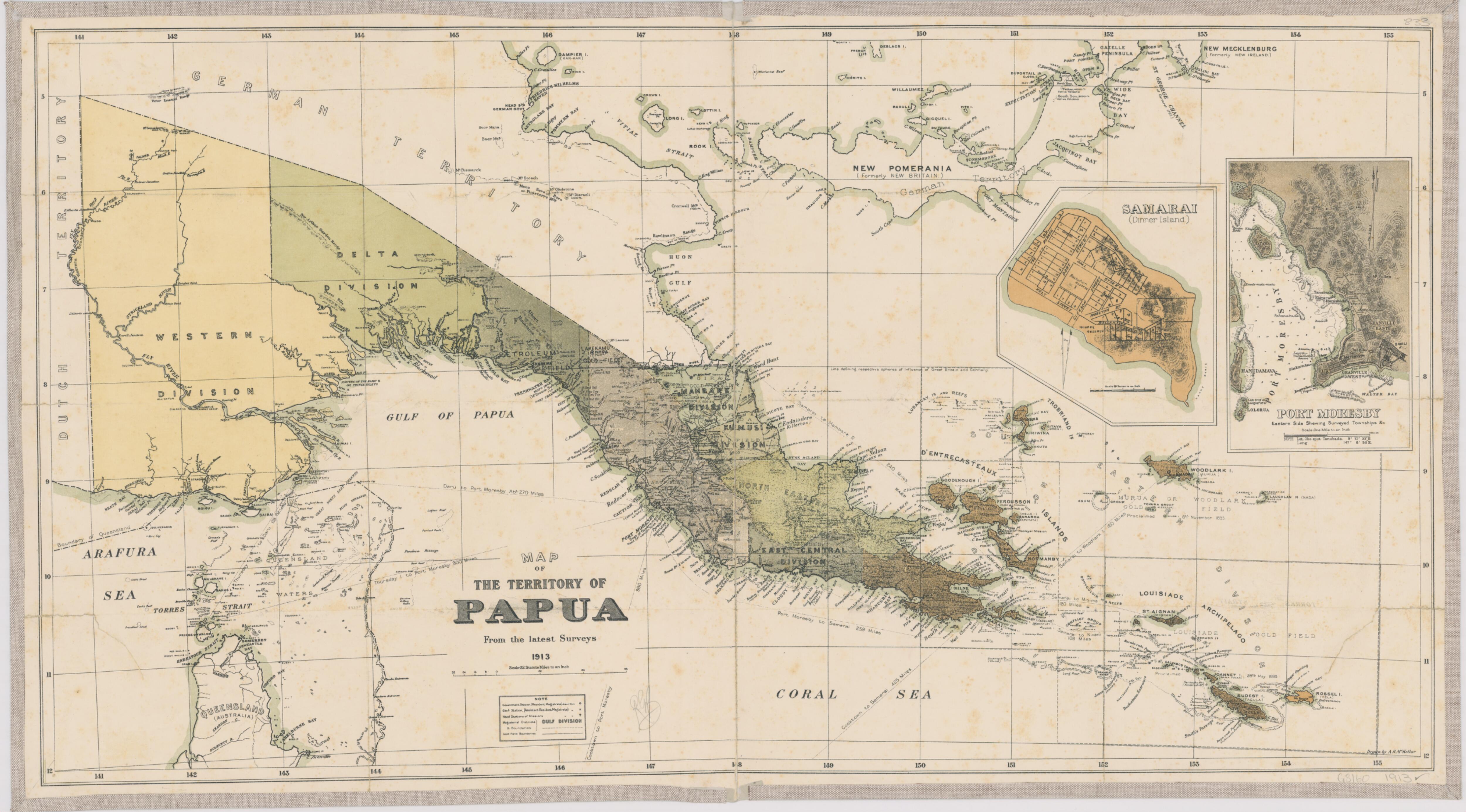
Territory of Papua
In November 1882, a German newspaper called the Allgemeine Zeitung ran an article urging Berlin to annex New Guinea. Queensland's Premier read it and panicked. By 4 April 1883 his police magistrate from Thursday Island had sailed to Port Moresby and declared most of the island a British possession in Queen Victoria's name - an action the British government disavowed within weeks. The Territory of Papua would be born from this kind of anxious improvisation, and for most of the next century its borders, its laws, and even its name were determined somewhere other than New Guinea itself.
Borders Drawn Elsewhere
The map that emerged from the 1880s was not one Papuans drew. London, Berlin, and The Hague divided the second-largest island on Earth among themselves. The Dutch held the west, where they had claimed presence since the 1600s. Germany took the northeast, naming it Kaiser-Wilhelmsland, in 1884. Britain took the southeast, organizing it as British New Guinea in 1888. None of these administrations spoke to the indigenous peoples of the island, whose hundreds of distinct language groups and kinship systems had shaped the place for forty thousand years. The borders they drew persist: the line between Papua New Guinea and Indonesian West Papua follows the old Dutch-British divide almost exactly. What the colonizers called boundary was, for the people who lived across them, absurdity.
The Interregnum
On 18 March 1902, King Edward VII issued letters patent transferring British New Guinea to Australia. But the Australian parliament did not pass the enabling legislation - the Papua Act - until November 1905, and the Territory of Papua was not formally constituted until 1 September 1906. Four years of legal ambiguity followed, during which the territory operated under old British New Guinea institutions while answering to a government that had not yet worked out what it wanted to do. One cause of delay was a fight in Canberra over alcohol: temperance advocates wanted universal prohibition in the territory, while others wanted licensing left to local option. The compromise that passed the act in 1905 prohibited alcohol sales to Papuans while allowing liquor licenses for Europeans - a two-tier policy emblematic of the colonial era that followed.
The Goaribari Expedition and What Followed
In March 1904 the acting administrator, Christopher Stansfield Robinson, led what was called a punitive expedition to Goaribari Island, seeking to avenge the 1901 killing of the missionaries James Chalmers and Oliver Tomkins. Several Papuans were shot dead. The missionary Charles Abel, from a rival mission, wrote to the Australian press alleging a massacre. The government convened a royal commission. Robinson, under scrutiny, died by suicide. A further commission in 1906 recommended removing most of the senior colonial officials, and Hubert Murray became lieutenant-governor - a post he held for 34 years, until 1940. Murray's long tenure is often remembered in Australian sources as enlightened. Papuan historians note that its enlightenment was relative, and that the people killed at Goaribari had names and families that no royal commission recorded.
War and Independence
The Pacific War brought the island its first outside invasion on a scale that could not be dismissed. Japan occupied most of the German-former, Australian-administered Territory of New Guinea to the north, and much of Dutch West Papua. The Territory of Papua itself was largely protected by the Owen Stanley Range - mountains that Japanese forces tried and failed to cross via the Kokoda Track in 1942, stopped by young Australian reservists and, critically, by Papuan carriers whose knowledge of the trails kept the Australian line supplied. The Battle of Milne Bay in September 1942 was the first outright defeat of Japanese land forces in the war. After 1949 the two territories administratively merged as Papua New Guinea, and on 15 September 1975 the merged entity became an independent nation under Prime Minister Michael Somare. The colonial name fell away. What replaced it was a country of 800 languages and a constitution written in-house - a sovereignty that had, in some real sense, been there all along.
From the Air
The former Territory of Papua covered the southeastern half of New Guinea island, bounded by the 141st meridian east with Indonesian-held West Papua and by the Owen Stanley Range with the former Territory of New Guinea to the north. Port Moresby (9.48 S, 147.15 E) was the capital. For airborne context: the Owen Stanley Range runs northwest to southeast and peaks above 13,000 feet (Mount Victoria 4,038 m). The Kokoda Track crosses the range at roughly 9.0 S, 147.7 E. Milne Bay at the island's eastern tip is 10.4 S, 150.4 E. Jacksons International Airport (AYPY / POM) near Port Moresby is the region's primary hub. The terrain the Territory encompassed is mountainous and often cloud-obscured; long IFR legs over the range require careful altitude planning.