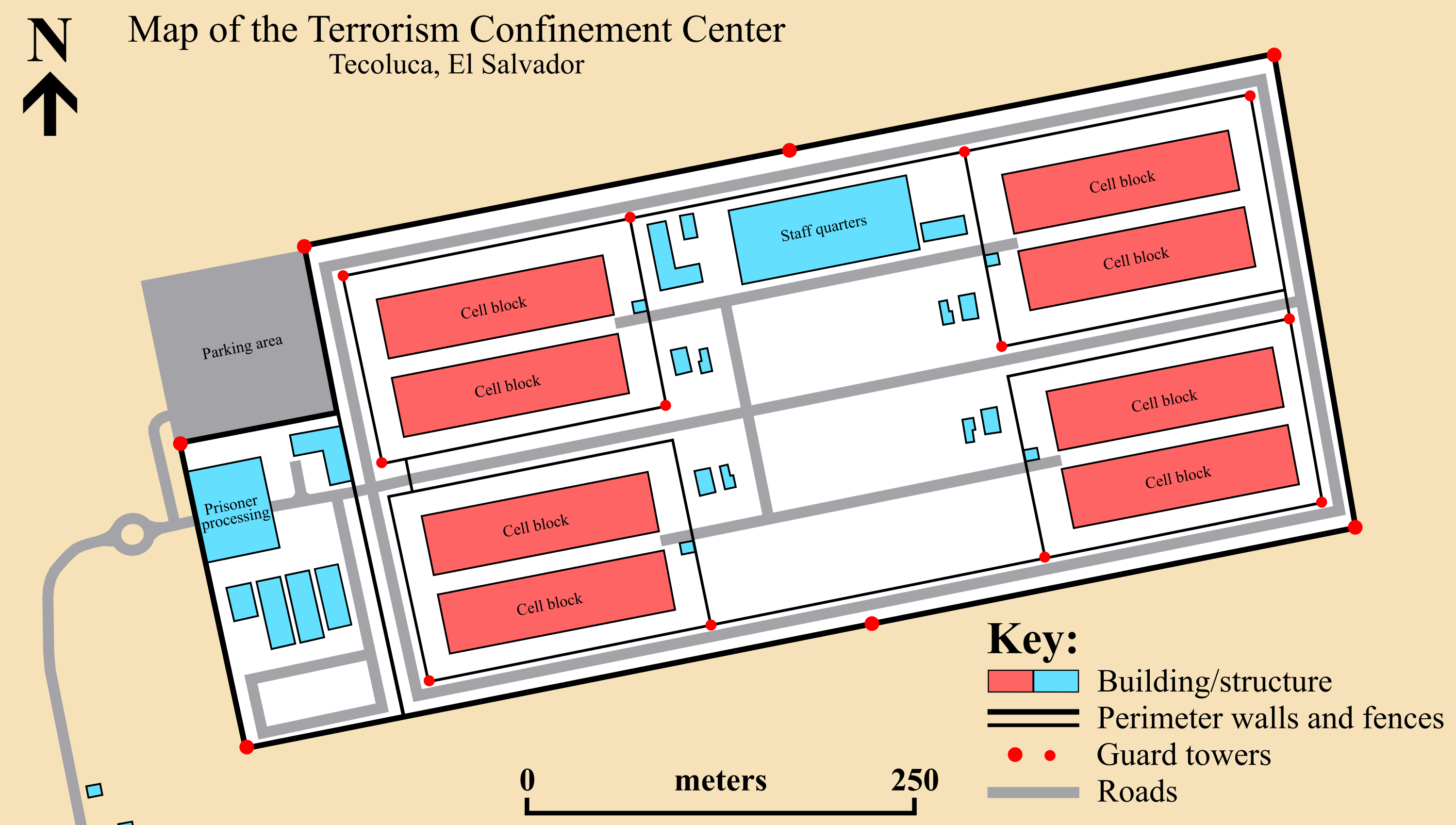
Terrorism Confinement Center
The cells never go dark. Twenty-four hours a day, artificial light floods the 256 cells of the Terrorism Confinement Center -- CECOT, as it is styled -- each one packed with an average of 156 inmates. Built in late 2022 at the base of the San Vicente volcano, in a remote stretch of El Salvador's San Vicente Department, the prison opened in January 2023 and immediately became the most visible symbol of President Nayib Bukele's gang crackdown. With capacity for 40,000 inmates and plans to double that number, CECOT is the largest prison in Latin America. It is also, depending on whom you ask, either the solution to one of the Western Hemisphere's worst gang violence crises or a monument to mass incarceration without due process.
The Violence That Built the Walls
To understand CECOT, you have to understand what came before it. Beginning in the 1990s, gang members deported from the United States after the Salvadoran Civil War brought the culture of MS-13 and Barrio 18 back to El Salvador, where both organizations metastasized. By 2015, El Salvador's homicide rate had reached 103 per 100,000 people -- among the highest in the world. That same year, the Supreme Court designated both gangs as terrorist organizations. Then came March 2022: over three days, gangs killed 87 people, with 62 murdered on a single day, the deadliest since the civil war ended in 1992. The Legislative Assembly declared a state of exception, suspending constitutional rights and enabling mass arrests. Within seven months, 55,000 suspected gang members were in custody. CECOT, built at a cost of $100 million, was where many of them would end up.
Concrete, Steel, and Scripture
The facility covers 23 hectares, with the government controlling 140 hectares of surrounding land. Eight cell blocks hold the prison population. Each cell gets two toilets, two washbasins, and two Bibles. Prisoners wear all-white uniforms, have their heads shaved every five days, and are permitted outside their cells only for 30 minutes -- for exercise, Bible study, online court hearings, or placement in solitary confinement. No education. No recreation. No family visits. No phone calls. CCTV cameras and armed guards monitor every cell around the clock, and 600 soldiers and 250 police officers staff the grounds. The Red Cross recommends a minimum of 3.4 square meters of cell space per prisoner; CECOT provides an average of 0.6. Prison director Belarmino Garcia has stated that NGOs are not permitted inside.
An Export Model for the Americas
CECOT's influence has rippled across the continent. In January 2024, Ecuador's president announced plans for two 12,000-inmate prisons modeled on the facility; one of them, El Encuentro, opened in November 2025. Honduras announced a 20,000-inmate version. Guatemala began constructing its own Cecot-inspired prison. Costa Rica's president toured the facility in December 2025 and announced construction of a similar institution would begin in 2026. Bukele himself proposed a companion facility for white-collar criminals -- the Corruption Confinement Center, or CECOC -- to be built in the same department. The Associated Press called CECOT the "crown jewel" of the gang crackdown. El Pais dubbed it "the Alcatraz of Central America." Colombia's president Gustavo Petro used a different comparison: "concentration camp."
The Abrego Garcia Question
In March 2025, the United States deported over 200 people to El Salvador under the Alien Enemies Act of 1798, alleging they were Venezuelan and Salvadoran gang members. They were sent directly to CECOT. Among them was Kilmar Abrego Garcia, a Salvadoran citizen whose case drew intense media scrutiny when it emerged he had been deported due to an "administrative error." A 60 Minutes investigation found no criminal charges against 179 of those deported. After his eventual return to the United States in June 2025, Abrego Garcia's attorneys filed documents alleging he had endured severe beatings, sleep deprivation, inadequate nutrition, and psychological torture during his time at CECOT. The Venezuelan detainees, released in July 2025 through a three-country prisoner swap, described similar treatment. Amnesty International called CECOT evidence of an "alarming precedent of repressive cooperation between governments." A former member of the UN Subcommittee for the Prevention of Torture described the prison as a "concrete and steel pit" designed to "dispose of people without formally applying the death penalty." Bukele has disputed every allegation of abuse.
From the Air
Coordinates: 13.53N, 88.81W. CECOT is located near Tecoluca in the San Vicente Department, at the base of the San Vicente volcano (Chinchontepec), which rises to 2,182 meters and is the second-highest volcano in El Salvador. From altitude, the facility's rectangular perimeter and guard towers are visible in a remote, sparsely populated area. The surrounding 140 hectares of government-controlled land create a visible buffer zone. Nearest significant airport is El Salvador International (MSLP) at Comalapa, approximately 50 km southwest. The San Vicente volcano is the dominant landmark for orientation.