Teruel Cathedral
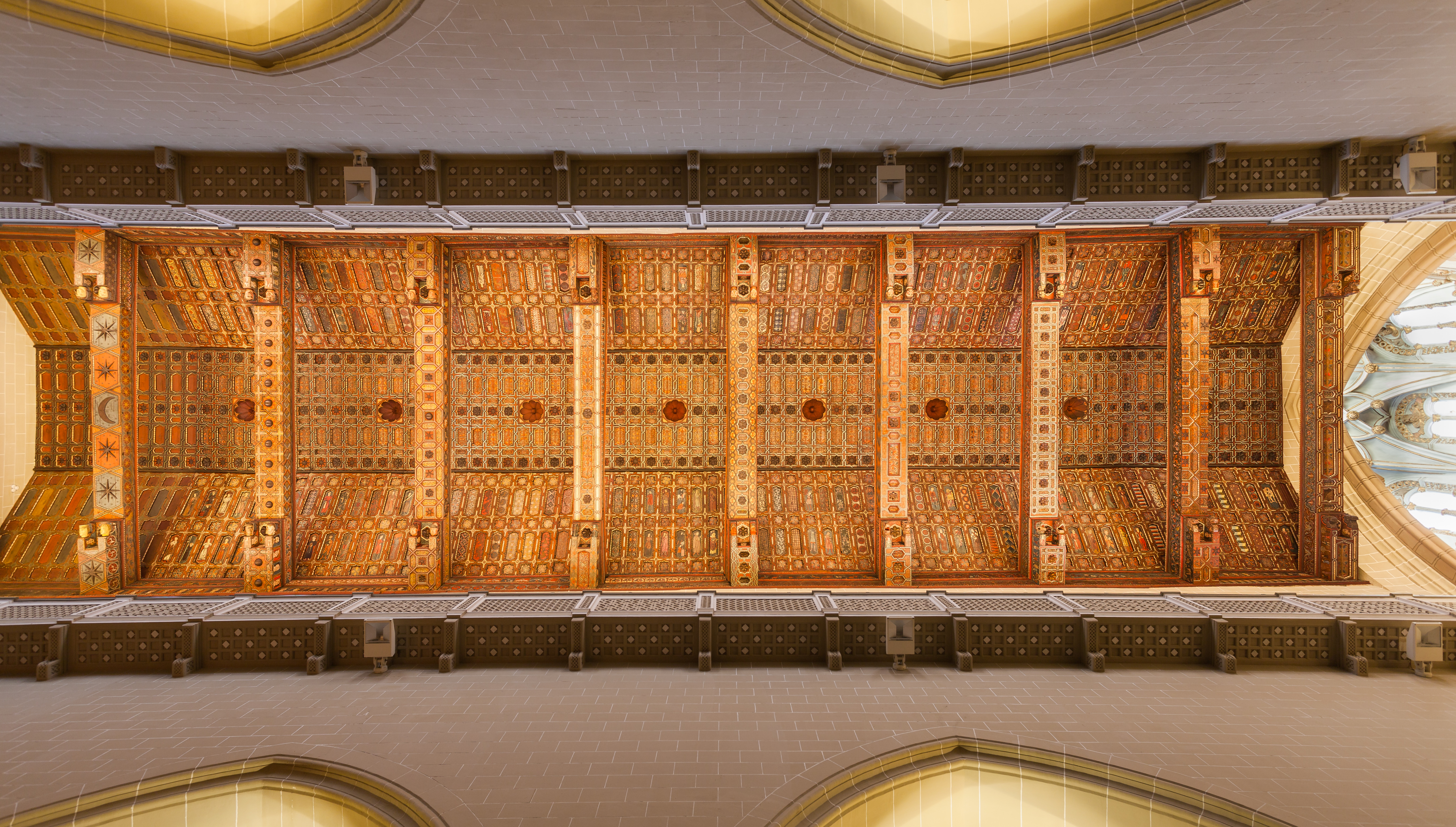
Hidden behind a false ceiling for over a century, the medieval paintings went unseen by anyone. Craftsmen, officers, fantastic beasts, historical figures -- all rendered in vivid color across 32 meters of coffered woodwork in the central nave of Teruel Cathedral. When the 18th-century Neoclassical overlay was eventually removed, the 14th-century paintings beneath emerged in remarkable condition, protected from weather and wear by the very aesthetic fashion that had tried to conceal them. It was as if the cathedral had wrapped its greatest treasure in a protective blanket of forgetfulness.
Where Cultures Built Together
Mudejar architecture is what happens when conquerors need the conquered to build for them. After the Christian reconquest of Teruel, Muslim craftsmen, the Mudejars, remained as skilled laborers, and their aesthetic traditions of geometric tilework, brick patterning, and decorative glazed ceramics fused with the Romanesque and Gothic forms favored by their new rulers. Work on the church of Santa Maria de Mediavilla began in Romanesque style in 1171 and reached a milestone with the erection of the Mudejar tower in 1257. In the second half of the 13th century, the Mudejar alarife (master builder) Juzaff restructured the old Romanesque building, replacing it with three Mudejar naves of masonry and brick. The result was neither purely Christian nor purely Islamic in character. It was something new, a hybrid born of coexistence and pragmatic necessity.
The Sistine Chapel of Mudejar Art
Most Mudejar ceilings are coffered, serving a decorative purpose only. The ceiling of Teruel Cathedral's central nave is different: its framework is structural, supporting the roof while also serving as a canvas for an extraordinary cycle of 14th-century paintings. Officers, artisans, kings, and creatures from medieval bestiary fill the coffers, each panel a window into the imagination and social hierarchy of the period. The ceiling earned the nickname the Sistine Chapel of Mudejar art, and while the comparison to Michelangelo may be generous, the scale and preservation of the work are genuinely exceptional. When Neoclassical tastes swept through Spain in the 18th century, the painted ceiling was covered by a fashionable false ceiling. The covering remained until modern restorers discovered the original paintings underneath, their colors still vivid after centuries of darkness.
Towers and Light
The Mudejar tower, begun in 1257, is among the oldest of its type in Spain. Its base is a barrel vault that doubles as a passageway, allowing pedestrians to walk through it, a practical feature that has kept the tower integrated into the daily life of the town for over 750 years. Three of its four sides are covered with azulejos and ceramic glaze in intricate geometric patterns, while the top was capped with an octagonal roof lantern in the 17th century. The cathedral's other lantern tower, designed in 1537 by Juan Lucas Botero and built by Martin de Montalban, brought the Plateresque style into the Mudejar framework. Built on an octagonal plan supported by squinches, it was designed to illuminate the Renaissance altarpiece carved by sculptor Gabriel Yoly in 1536, flooding the interior with light from above.
World Heritage and Civil War Scars
In 1423, Antipope Benedict XIII, the Aragonese pontiff known as Pope Luna, elevated the church to collegiate status. It did not become a cathedral until 1587, when the diocese of Teruel was established. In 1909, architect Pau Monguio designed its southern facade in the Neo-Mudejar style, blending Neo-Romanesque semicircular archivolts with the geometric decorative language of the original builders. The Spanish Civil War brought artillery bombardments that damaged the ceiling, though subsequent repairs preserved most of the medieval paintings. In 1986, UNESCO inscribed the tower, ceiling, and lantern tower as part of the Mudejar Architecture of Aragon World Heritage Site, recognizing the cathedral as a place where Islamic and Christian building traditions merged into something that belongs fully to neither world and entirely to both.
From the Air
Located at 40.34N, 1.11W in Teruel, a mountain city in Aragon, eastern Spain, at approximately 3,000 feet elevation. The cathedral's Mudejar tower with its distinctive ceramic tilework is visible from moderate altitude. Teruel's historic center is compact and situated on elevated terrain. Nearest airports include Valencia (LEVC) approximately 145 km southeast and Zaragoza (LEZG) approximately 170 km north. Recommended viewing altitude: 2,000-4,000 feet AGL.