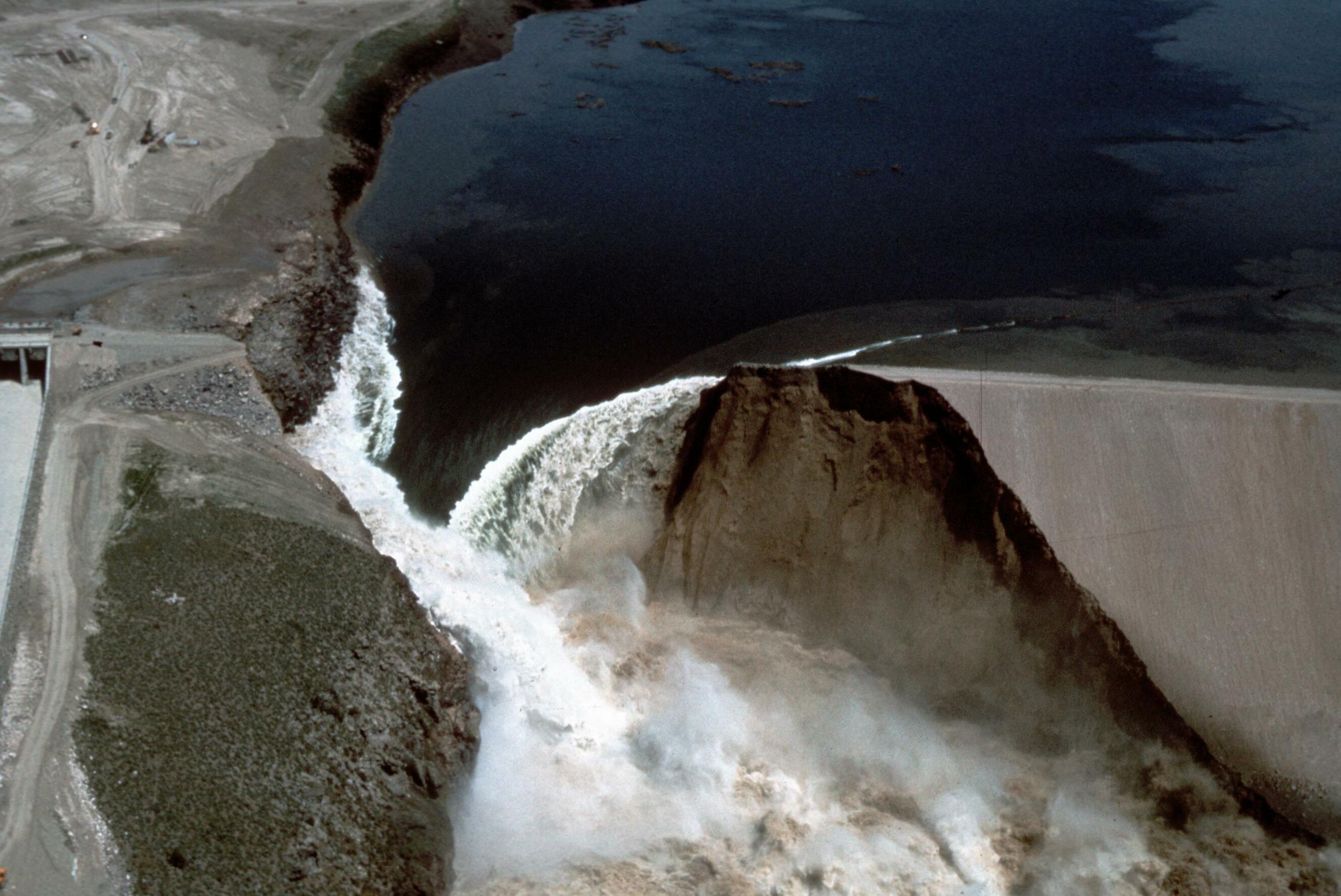
Teton Dam
At 11:55 AM on June 5, 1976, the crest of Teton Dam sagged and collapsed into the reservoir it had never finished filling. Two minutes later, the right-bank third of the main dam wall disintegrated. What followed was a flood that exceeded the average flow of any river on Earth except the Amazon. By 8:00 PM, the reservoir was completely empty. Eleven people were dead, 16,000 livestock drowned, and the small agricultural communities of Wilford and Sugar City had been scoured from the landscape. The dam was never rebuilt.
Built on Cracked Foundation
The Bureau of Reclamation proposed the Teton Dam in 1963 after the region suffered severe drought in 1961 followed by devastating floods in 1962. Congress authorized the project without opposition. But geologists knew the site was problematic from the start. The canyon walls consisted of basalt and rhyolite, volcanic rocks considered unsuitable for dam construction due to their high permeability. Test cores showed the rock was highly fissured; the widest cracks measured several feet across. The U.S. Geological Survey documented five earthquakes within miles of the site in the previous five years, two of significant magnitude. These concerns were 'considerably watered down' during a six-month redrafting process before reaching the Bureau.
Racing to Fill
The dam was completed in November 1975 and began filling at the standard rate. Heavy snows that winter brought heavier spring runoff than anticipated. The construction engineer requested permission to double the filling rate. A month later, despite monitoring showing groundwater flowing a thousand times faster than anticipated, the rate was doubled again. The Bureau injected massive amounts of grout into the fissured rock: 496,515 cubic feet of Portland cement, 82,364 cubic feet of sand, 132,000 pounds of bentonite, and 418,000 pounds of calcium chloride, pumped into 118,179 linear feet of drilled holes. It was not enough.
Eleven Minutes of Collapse
When the dam failed, it released water at a rate many times greater than Niagara Falls. The flood struck communities immediately downstream: Wilford at the mouth of the canyon, Sugar City, Salem, Hibbard, and Rexburg. Five of the eleven deaths occurred in Wilford. The town of Sugar City was wiped from the riverbank entirely. In Rexburg, population 10,000, an estimated 80% of structures were damaged. Thousands of logs from a lumber yard became battering rams, striking a bulk gasoline storage tank that ignited and sent flaming slicks racing across the flood waters. The combination of water, debris, and fire practically destroyed the northern part of town.
The Path of Destruction
The flood waters traveled west along the Henrys Fork of the Snake River, flowing around both sides of the Menan Buttes and damaging the community of Roberts. Idaho Falls, further downstream on the flood plain, had time to prepare. At the American Falls Dam, engineers increased discharge by less than 5% before the flood arrived. That dam held, and the flood was effectively over, but tens of thousands of acres of fertile topsoil had been stripped from farmland near the river. The Bureau of Reclamation set up claims offices in Rexburg, Idaho Falls, and Blackfoot. By January 1987, the federal government had paid 7,563 claims totaling $322 million.
Engineering's Hard Lessons
Investigators identified 'piping' as the probable cause: water seeping through permeable loess soil in the dam's core and fissured rhyolite in its abutments, eroding internal channels until the structure failed. The investigating panel could not determine whether the piping started from water flowing under unprotected fill through unsealed rock joints, or from cracking caused by differential strains in the core material. Their conclusion was stark: 'The fundamental cause of failure may be regarded as a combination of geological factors and design decisions that, taken together, permitted the failure to develop.' The dam cost $100 million to build. It was never rebuilt, and today only ruins remain in the Teton River canyon, a monument to engineering hubris and the power of moving water.
From the Air
Located at 43.91N, 111.54W on the Teton River in eastern Idaho, between Fremont and Madison counties. The dam site lies in a canyon that opens onto the Snake River Plain. Downstream communities affected by the 1976 flood include Wilford, Sugar City, Rexburg, Roberts, and Idaho Falls. Nearest airports include Idaho Falls Regional Airport (KIDA) approximately 25 miles southwest. The dam ruins remain visible in the canyon. Best viewed from 3,000-5,000 feet AGL to appreciate both the canyon topography and the flood plain below.