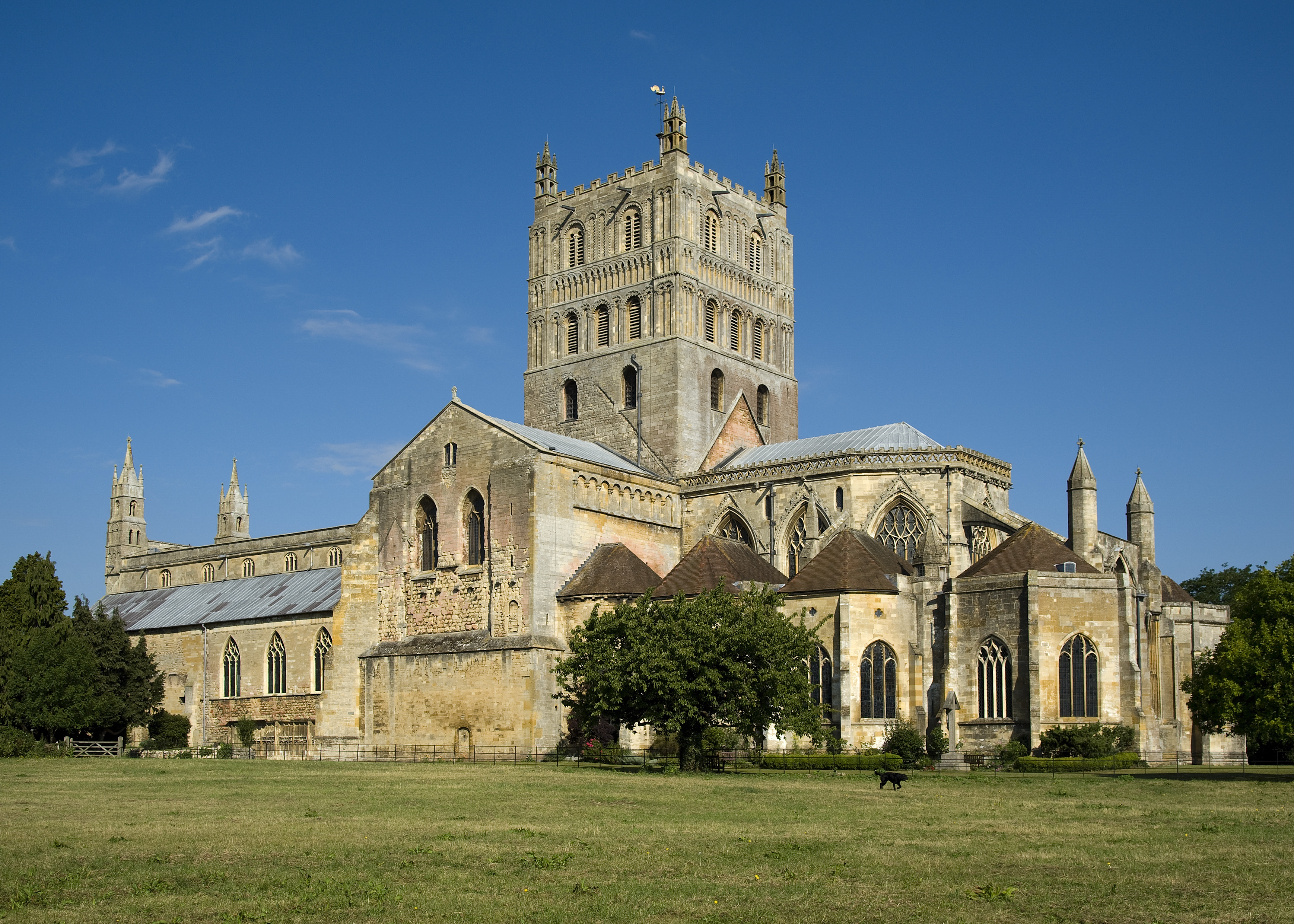
Tewkesbury Abbey
The people of Tewkesbury paid 453 pounds for their abbey. When Henry VIII dissolved the monasteries in 1539, the great church faced demolition -- its lead roof to be melted down, its bells sold for scrap, the stone left to crumble. But the townspeople argued that the abbey was their parish church, which they had the right to keep, and they purchased it from the Crown for exactly the value of the materials that would have been salvaged. It was one of the shrewdest property deals in English history. Today Tewkesbury Abbey is larger than fourteen of England's cathedrals, and its Norman crossing tower -- probably the largest and finest Romanesque tower in the country -- still dominates the flat landscape where the Severn and Avon rivers converge.
From Hermit's Cell to Benedictine Fortress
Christian worship in Tewkesbury began with Theoc, a Northumbrian missionary who built a cell near the confluence of the rivers in the mid-seventh century. A monastery followed in 715, though nothing of it survives. In the tenth century, the foundation became a priory subordinate to Cranborne Abbey in Dorset. Everything changed in 1087 when William the Conqueror gave the manor of Tewkesbury to his cousin Robert Fitzhamon, who, together with Abbot Giraldus, founded the present abbey in 1092. Building of the church began in 1102. Fitzhamon was wounded at Falaise in Normandy in 1105 and died two years later, but his son-in-law Robert FitzRoy, an illegitimate son of Henry I, continued the work. By the high Middle Ages, Tewkesbury was one of the richest abbeys in England.
Sanctuary Violated
After the Battle of Tewkesbury on 4 May 1471, defeated Lancastrian soldiers fled into the abbey seeking sanctuary. The victorious Yorkists, led by King Edward IV, forced their way inside. The bloodshed that followed was so severe that the building had to be closed for a month, purified, and reconsecrated before worship could resume. A brass plate in the floor marks the grave of Edward of Westminster, Prince of Wales, killed in the battle at age seventeen -- the only Prince of Wales ever to die in combat. Behind the high altar, the bones of George, Duke of Clarence, and his wife Isabel Neville rest in an inaccessible burial vault behind a glass window. Clarence, brother to both Edward IV and Richard III, was later reportedly drowned in a butt of malmsey wine.
The Building Speaks
The abbey's architecture tells multiple stories at once. The great west front features a recessed Norman arch, unique in England, soaring over sixty feet. Inside, the nave's cylindrical columns rise in austere Romanesque grandeur. The choir was rebuilt between 1321 and 1335 with radiating chantry chapels, and the tower and nave vaults were reconstructed in the mid-fourteenth century with elaborate lierne vaulting. The abbey's organ, known as the Milton Organ, was originally built for Magdalen College, Oxford, by Robert Dallam. After the English Civil War, it was moved to Hampton Court Palace, where the poet John Milton may have played it. It arrived at Tewkesbury in 1737 and has been rebuilt several times since.
A Town's Cathedral
Tewkesbury Abbey is not technically a cathedral -- it has no bishop's seat. It is a parish church, maintained by and for the people of Tewkesbury, as it has been since that 453-pound purchase in 1539. Sir George Gilbert Scott led a major restoration in the late nineteenth century, and the Severn's flood waters have reached inside the abbey on more than one occasion, including during severe floods in 1760 and again in July 2007. The abbey grounds are protected from development by the Abbey Lawn Trust, originally funded by an American benefactor in 1962. Westminster Abbey may contain more medieval monuments, but no other English church comes close. The abbey's collection of aristocratic tombs -- Despensers, de Clares, Beauchamps -- reads like a register of medieval English power.
From the Air
Located at 51.990N, 2.160W in Tewkesbury, Gloucestershire, at the confluence of the Rivers Severn and Avon. The massive Norman crossing tower is clearly visible from the air. Nearest airports: Gloucestershire Airport (EGBJ) approximately 8nm south, Coventry (EGBE) approximately 35nm northeast. Best viewed from 2,000-3,000ft.