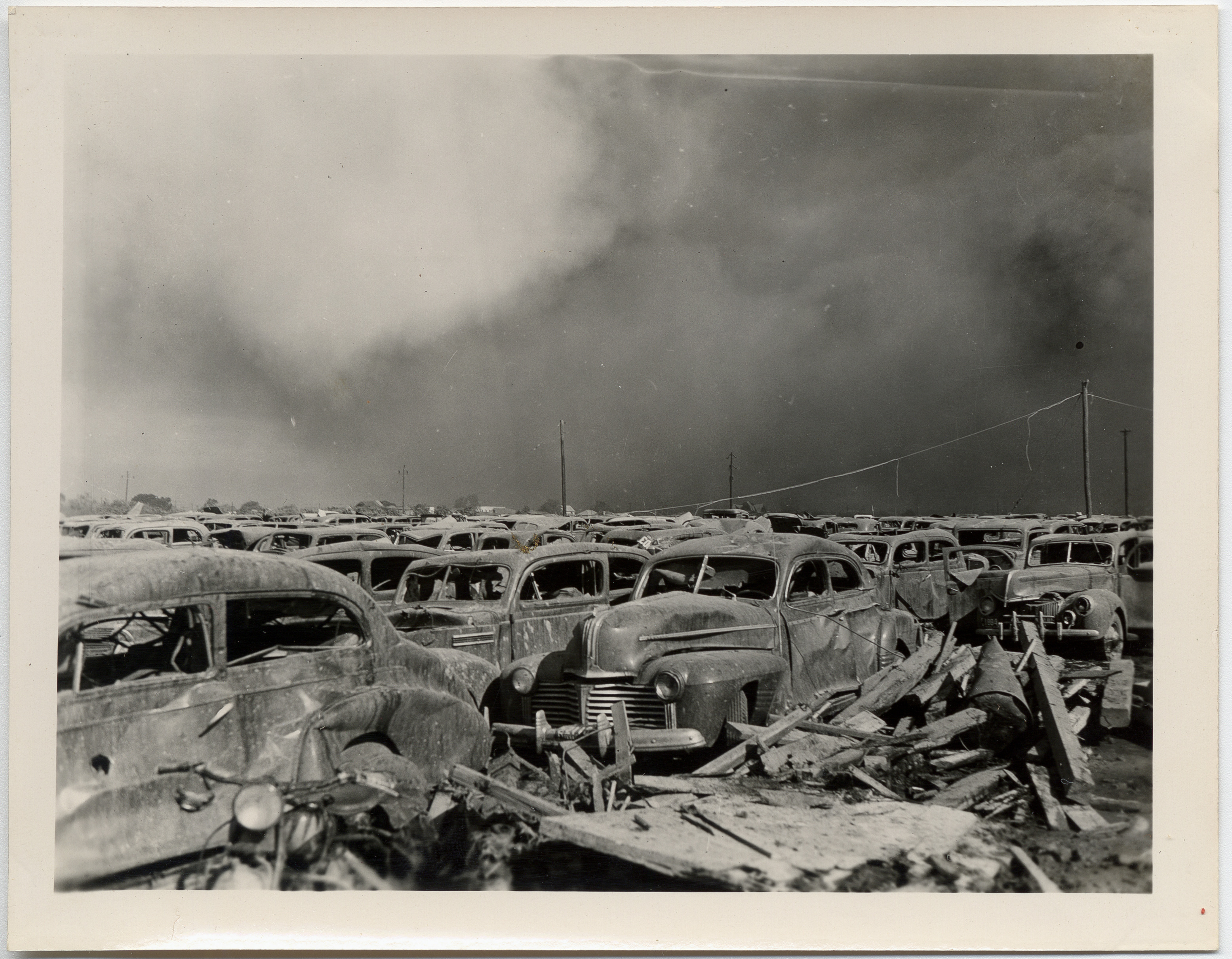
The Texas City Disaster: When Fertilizer Leveled a Town
On the morning of April 16, 1947, the French cargo ship Grandcamp sat at dock in Texas City, Texas, loading a cargo of ammonium nitrate fertilizer bound for Europe. A fire broke out in the hold. The captain, hoping to save his cargo, ordered the hatches sealed and steam pumped into the hold. At 9:12 AM, the Grandcamp exploded with a force equivalent to 2.3 kilotons of TNT - nearly as powerful as the Halifax Explosion of 1917. The blast killed the entire Texas City fire department, knocked two sightseeing planes out of the sky, and triggered a chain reaction that destroyed much of the industrial waterfront. Nearly 600 people died. It was the deadliest industrial accident in American history.
The Fire
The Grandcamp had been loading cargo for three days when longshoremen noticed smoke rising from Hold 4 on the morning of April 16. The hold contained 2,300 tons of ammonium nitrate fertilizer in paper bags. Workers tried to extinguish the fire with water jugs and fire extinguishers, but the fire only grew.
Captain Charles de Guillebon made a fateful decision. Rather than flood the hold with water and ruin the cargo, he ordered the hatches battened down and steam pumped into the hold to smother the flames. The steam had the opposite effect - it raised the temperature and pressure inside the sealed hold, accelerating the chemical reaction that would destroy his ship and much of Texas City.
The Spectators
The burning ship drew crowds. Smoke billowed in brilliant colors - orange, yellow, red - as the chemicals burned. Workers on nearby docks stopped to watch. Schoolchildren gathered at fences. The entire 27-man Texas City Volunteer Fire Department responded, positioning their trucks on the pier next to the ship.
Some spectators noticed something strange: the water around the Grandcamp was boiling. The steel hull was glowing red. Just before 9:12 AM, flames began shooting from the hatches. The ship was no longer burning - it was about to detonate.
The Blast
The explosion was felt 250 miles away in Louisiana. The anchor of the Grandcamp - weighing several tons - was hurled 1.5 miles and embedded itself in the ground. The blast created a 15-foot tidal wave that swept the waterfront. Windows shattered 40 miles away in Houston.
The entire Texas City fire department was killed instantly. A Monsanto chemical plant adjacent to the dock was destroyed, killing 145 of its 450 workers. Two sightseeing planes circling overhead were knocked from the sky. The blast wave flattened 1,000 buildings and damaged 3,500 more. Fires broke out across the industrial district.
The Second Explosion
The nightmare wasn't over. The cargo ship High Flyer, moored 600 feet from the Grandcamp, had also been loading ammonium nitrate. The Grandcamp's explosion had set it ablaze. Workers tried to move the High Flyer away from the docks, but the fires and debris made it impossible.
At 1:10 AM on April 17, the High Flyer exploded. Though casualties were lower - most of the area had been evacuated - the second blast destroyed what the first had left standing. The port of Texas City had effectively ceased to exist. Two ships, two explosions, and a city in ruins.
The Reckoning
The final death toll was 581, with over 5,000 injured. The economic damage was $100 million in 1947 dollars - over $1 billion today. The disaster led to the first class-action lawsuit against the United States government, with survivors arguing that the government had known ammonium nitrate was explosive but had failed to regulate its handling.
The lawsuit reached the Supreme Court, which ruled against the plaintiffs. But the disaster transformed industrial safety regulations. The Occupational Safety and Health Administration, created in 1970, cites Texas City as a foundational case study. Ammonium nitrate handling procedures were revolutionized. The port of Texas City was rebuilt and remains active today, but the memory of April 16, 1947, has never faded.
From the Air
Texas City (29.38N, 94.90W) lies on Galveston Bay, southeast of Houston. William P. Hobby Airport (KHOU) is 30km northwest; Scholes International at Galveston (KGLS) is 15km south. The port remains active with petrochemical facilities. The explosion site is now an industrial area. A memorial park marks the location. The Grandcamp anchor is displayed as a memorial. Weather is Gulf Coast subtropical - hot, humid, hurricane risk June-November.