Texas State Capitol
The builders of the Texas State Capitol were not paid in cash. They were paid in land -- more than three million acres of it, out in the Panhandle, a tract so vast it became the XIT Ranch, the largest cattle ranch in the world. This was one of the biggest barter transactions in recorded history, authorized by an article of the Texas constitution adopted in 1876 to fund a capitol worthy of the state's ambitions. The total cost, counting the land and all expenses, came to $3.7 million. What Texas got in return was a building that stands taller than the United States Capitol in Washington, D.C., sheathed in sunset-red granite, and dedicated on San Jacinto Day 1888 with a speech by Senator Temple Houston, son of Sam Houston himself.
Four Capitols and a Fire
The current building is the fourth to serve as the Texas capitol in Austin. The first was a two-room wooden structure at the corner of Eighth and Colorado streets that had housed the government of the Republic of Texas and continued in use after statehood. A limestone replacement went up in 1853 on the site of the present building, but it burned in 1881. A temporary capitol was thrown together across the street at Eleventh and Congress Avenue in 1882, and it too eventually burned down in 1899. The state had already decided to go bigger. Architect Elijah E. Myers designed the Italian Renaissance Revival structure in 1881, and civil engineer Reuben Lindsay Walker oversaw construction from 1882 to 1888, employing as many as a thousand convicts and migrant workers at a time. The cornerstone was laid on March 2, 1885 -- Texas Independence Day -- and the building opened to the public on April 21, 1888, San Jacinto Day, before construction was formally complete.
The Granite That Came by Crooked Rail
The original plan called for the building to be clad in limestone quarried from Oatmanville, present-day Oak Hill, about ten miles to the southwest. But the Hill Country limestone had a fatal flaw: its high iron content caused ugly rust stains when exposed to weather. Business partners George W. Lacy, Nimrod L. Norton, and William H. Westfall, owners of Granite Mountain near Marble Falls, offered the state a remarkable gift -- all the sunset-red granite needed to sheathe the building, free of charge. A new 2.3-mile spur of the Austin and Northwestern Railroad was built to transport the stone from Granite Mountain Quarry to the Austin train terminal. The spur had one notorious problem: a bend in the tracks too sharp for the heavy loads, causing trains to occasionally derail and dump their cargo of pink granite along the route. Many of those fallen rocks still sit where they landed, a local curiosity. The project's 900 workers included 86 granite cutters brought from Scotland to shape the stone.
Guarding the View
Texas takes the visibility of its capitol personally. In 1931, Austin enacted an ordinance limiting building heights to preserve the capitol's visual preeminence on the skyline. The rule held for three decades until 1962, when developers announced the Westgate Tower, a high-rise residential building to be built adjacent to the capitol grounds. Governor Price Daniel opposed it, and State Representative Henry Grover introduced a bill to condemn the property, which lost in the Texas House by just two votes. The Westgate went up in 1966, followed by the Dobie Center in 1968 and a series of ever-taller downtown bank towers. The state responded in 1983 with legislation defining 30 protected viewing corridors radiating out from the capitol, prohibiting any construction that would break the sight lines. The City of Austin adopted matching rules, so the corridors are protected under both state law and municipal zoning code.
Fire, a Goddess, and an Underground Expansion
On February 6, 1983, a fire broke out in the apartment of Lieutenant Governor William P. Hobby Jr. inside the capitol. A guest of Hobby's was killed, and four firemen and a policeman were injured. The blaze came dangerously close to destroying the building, which was packed with accumulated archives and framed with exposed cast iron. The state used the extensive rebuilding to modernize the structure. In November 1985, the original Goddess of Liberty statue was lifted from the dome by helicopter. A new aluminum replica, cast from molds of the original zinc statue, was placed on the dome in June 1986 by the Mississippi National Guard, since Texas lacked the lifting capacity for the approximately 3,000-pound figure. The original statue now resides at the Bullock Texas State History Museum. To solve a chronic space shortage, the state built a four-story underground extension beneath the north plaza in 1993, a $75 million project that nearly doubled the capitol's usable square footage. At ground level, the only evidence of this vast subterranean space is a grid of skylights disguised as planter rows and a striking open-air inverted rotunda.
Monument and Living Government
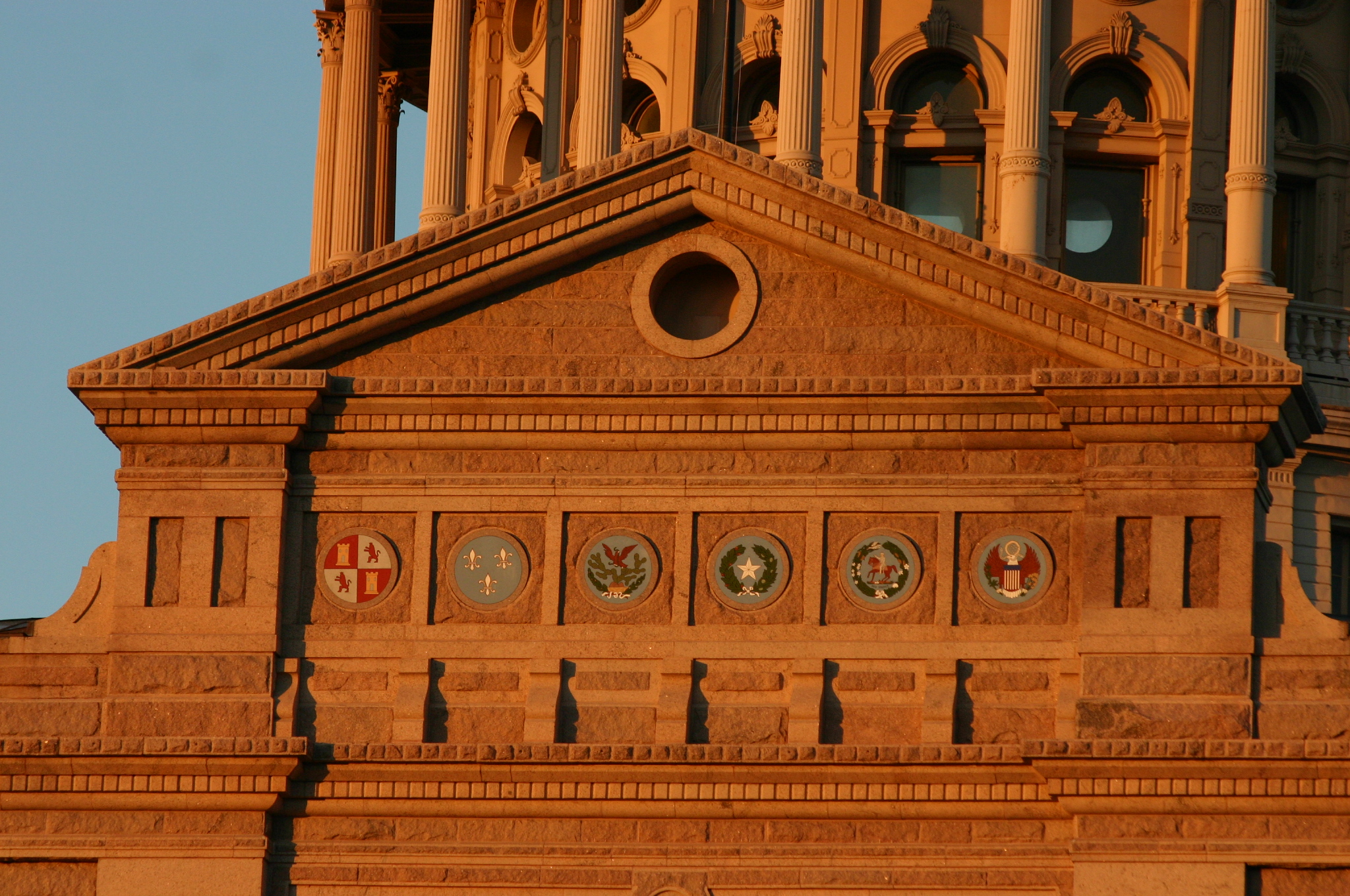
The capitol grounds tell their own stories through a collection of monuments: Terry's Texas Rangers, the Heroes of the Alamo, Hood's Texas Brigade, the Volunteer Firemen, and the Texas Capitol Vietnam Veterans Monument, dedicated in 2014. A granite monument bearing the Ten Commandments provoked a legal battle that reached the U.S. Supreme Court in 2005, with the justices ruling 5-4 in Van Orden v. Perry that its display was constitutional. Inside, terrazzo mosaics depict the seals of the six nations that have governed Texas. A comprehensive interior and exterior restoration completed in 1995 cost about $98 million, and in 1997 the park-like grounds received an $8 million renovation. The building that started as a land swap between politicians and ranchers remains the seat of Texas government, its dome topped by the Goddess of Liberty, its sunset-red walls glowing against the Austin sky exactly as the Scottish granite cutters and Texas convict laborers left them.
From the Air
The Texas State Capitol is located at 30.275N, 97.741W in downtown Austin, Texas, at the north end of Congress Avenue. The building's distinctive dome is a primary visual landmark for the entire Austin metro area, visible from considerable distance due to the protected view corridors that prevent taller buildings from blocking sight lines. The sunset-red granite exterior provides a warm contrast to the surrounding modern buildings. Austin-Bergstrom International Airport (KAUS) is approximately 6 nm to the southeast. Best viewed at 2,000-5,000 feet AGL. Congress Avenue running south to Lady Bird Lake and the University of Texas campus immediately to the north provide orientation references.