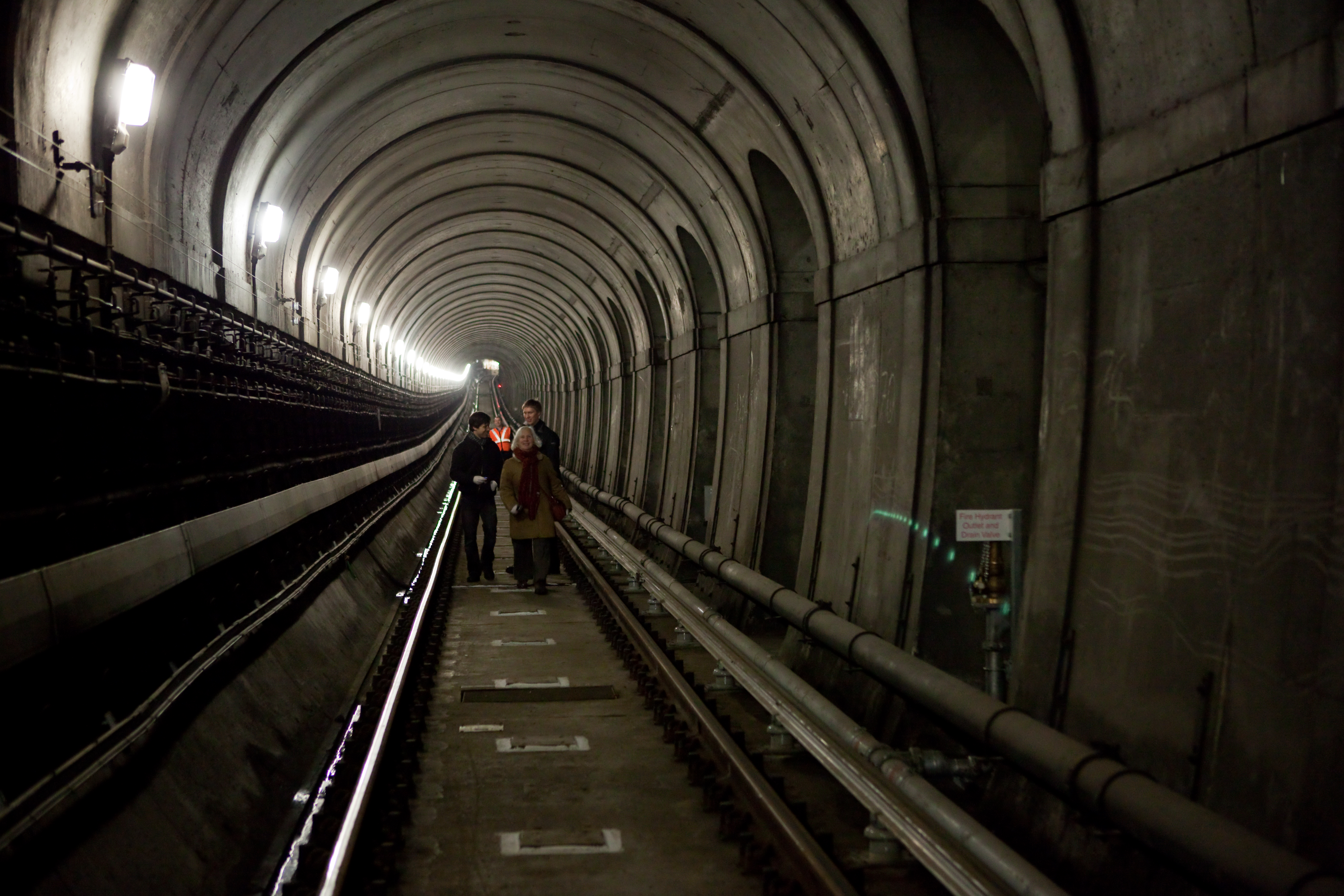
Thames Tunnel
Six men drowned building it. The river broke through five times, filling the workings with black Thames water and sewage. Construction took eighteen years, ran catastrophically over budget, and nearly killed the young engineer who would become Victorian Britain's most celebrated builder. The Thames Tunnel, completed in 1843, was the first tunnel ever driven successfully beneath a navigable river, and the engineering innovations it required changed underground construction forever.
The Impossible Crossing
By the early nineteenth century, the Thames was a barrier strangling London's growth. Bridges served the west, but east of London Bridge, where the river widened and the docks crowded both banks, there was no crossing at all. Previous tunnel attempts had collapsed. Marc Isambard Brunel, a French-born engineer living in London, believed he had the answer: a tunnelling shield, inspired, the story goes, by observing the shipworm Teredo navalis boring through timber. His patented shield was a massive iron frame divided into thirty-six compartments, each occupied by a miner who excavated the clay face one small section at a time while the frame supported the ground above. Workers bricked the permanent lining into place behind the advancing shield. The method was revolutionary but agonizingly slow, progressing sometimes as little as eight to twelve feet per week.
Flood, Fire, and Ruin
The tunnel ran beneath a riverbed far thinner than surveyors had believed. On 18 May 1827, the Thames burst in for the first time. Marc Brunel's son, Isambard Kingdom Brunel, just twenty years old, helped plug the breach and personally descended in a diving bell to inspect the damage. The worst irruption came on 12 January 1828: the river poured in again, sweeping workers through the tunnels. Six men died. Isambard was among the injured, carried unconscious from the flooded workings. He was sent to Bristol to recuperate, where he heard about a competition to build what became the Clifton Suspension Bridge. Lack of funds halted construction for seven years. The sealed tunnel sat idle beneath the river, becoming something of a morbid curiosity.
The Eighth Wonder of the World
In 1834, a Treasury loan of 247,000 pounds revived the project. Further floods struck in 1837, 1838, and 1840, but the shield inched forward. When the tunnel opened to pedestrians on 25 March 1843, it was an immediate sensation. The American traveller William Allen Drew called it the eighth wonder of the world, and an estimated million people visited in the first three months. Twin arched arcades, each 1,300 feet long, connected Rotherhithe on the south bank to Wapping on the north. Merchants set up souvenir stalls. Gas lamps lined the walls. But the tunnel had been designed for horse-drawn carriages, and the spiral ramps needed to bring vehicles down to the tunnel level were never built for lack of money. Reduced to a pedestrian thoroughfare, it became less fashionable over time.
Into the Iron Age
The East London Railway Company purchased the tunnel in 1865 for 800,000 pounds, and the first train ran through it on 7 December 1869. The generous headroom Marc Brunel had specified for carriages proved more than adequate for trains. The tunnel served London Underground's East London Line for over a century before closing for a major upgrade. When it reopened on 27 April 2010 as part of the London Overground network, it became the oldest tunnel structure in the world's oldest underground railway system. At Rotherhithe, the original entrance shaft has been repurposed as the Brunel Museum, its walls still blackened with soot from a century and a half of steam locomotives. In 1991, the American Society of Civil Engineers designated the Thames Tunnel an International Historic Civil Engineering Landmark. Trains still rattle through Marc Brunel's twin arches every few minutes, carrying commuters who rarely glance up at the brickwork that nearly cost a generation of engineers their lives.
From the Air
Located at 51.5031N, 0.0544W, running beneath the Thames between Rotherhithe (south) and Wapping (north) in east London. The Brunel Museum shaft is visible at the Rotherhithe end. Nearest airports: London City (EGLC) 3 nm east, London Heathrow (EGLL) 16 nm west. Best viewed at 1,000-2,000 ft AGL. The tunnel entrance is near the Surrey Quays area.