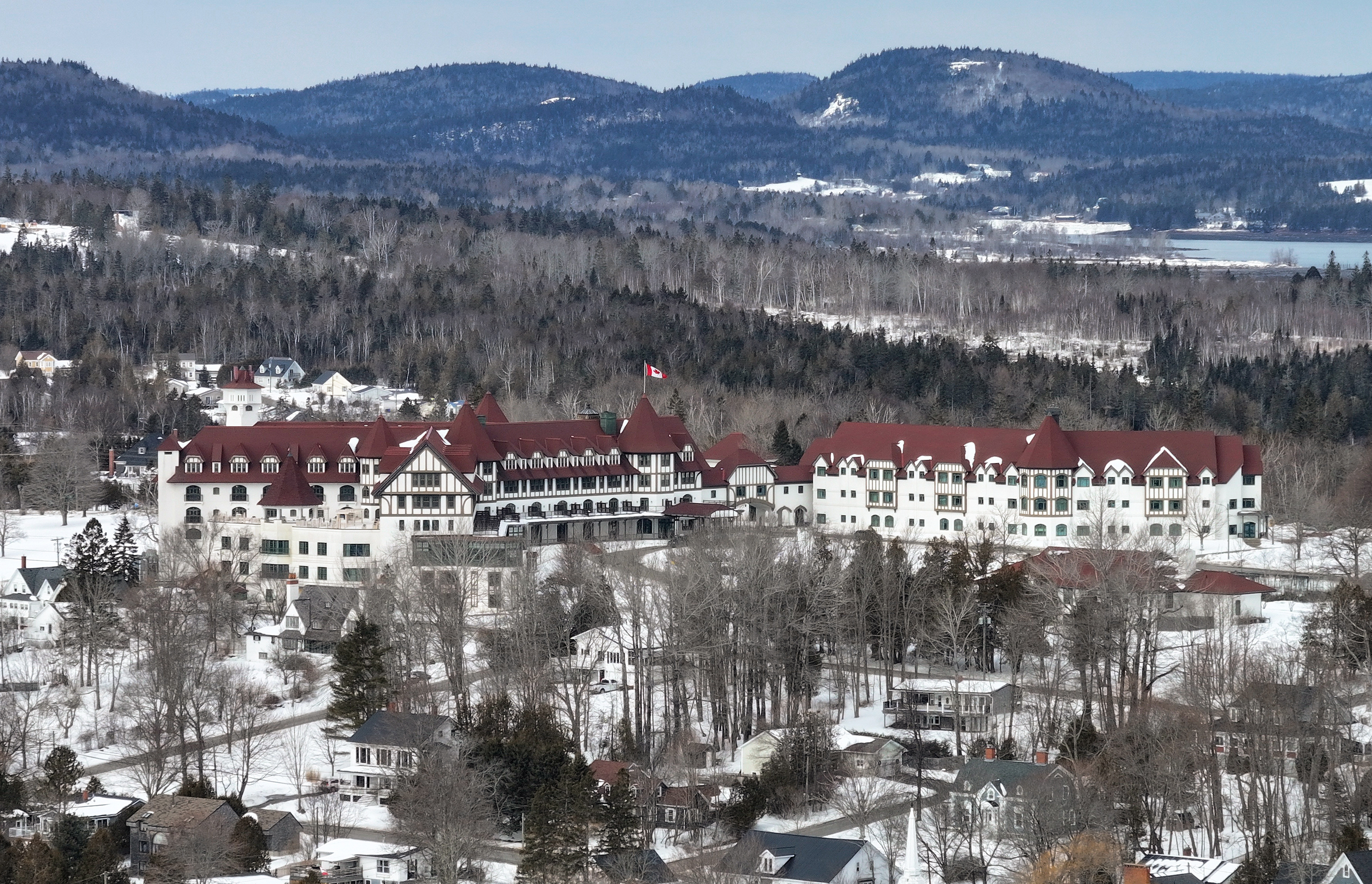
The Algonquin Resort
"No hay fever here." That was the pitch. In the late nineteenth century, when wealthy residents of sweltering inland cities like Montreal, Boston, and New York sought relief from summer heat and its attendant miseries, advertisements for the Algonquin Hotel in St. Andrews, New Brunswick, promised something almost medicinal: clean air from the Bay of Fundy, the restorative powers of the local Samson Spring, and "a general air of restfulness." The hotel also offered saltwater baths -- seawater pumped uphill from Passamaquoddy Bay to tanks in the attic, dispensed through specially designed bathtubs with four taps, two fresh and two salt. It was a remarkable sales proposition, and it worked. The Algonquin became the most famous building in New Brunswick, a Tudor Revival landmark whose guest list reads like a roll call of North American power.
Fire and Reinvention
The original Algonquin was a massive wooden Shingle Style building erected in 1889 by the St. Andrews Land Company, which had been established six years earlier by American businessmen who recognized the tourism potential of this bay-side town. Designed by a Boston architecture firm, the 80-room hotel opened in June 1889 and immediately became the centerpiece of St. Andrews' emerging identity as a summer retreat. Wings were added in 1908 and 1912 to accommodate growing demand. Then, in 1914, fire consumed everything except those two newer wings. The replacement rose on the same footprint -- a four-story Tudor Revival structure of concrete with a faux half-timbered facade and red slate roof, designed by the Montreal firm of Barott, Blackader and Webster. This is essentially the building that stands today, its distinctive silhouette one of the most photographed in the province. Additional wings came in the early 1990s and early 2010s, but the 1914 character endures.
The Railway and the Resort
The Algonquin's fortunes were inseparable from the Canadian Pacific Railway. George Stephen, the CPR's first president, was a major shareholder in the New Brunswick Railway, which served St. Andrews. When Stephen retired in 1888, his successor William Cornelius Van Horne inherited both the railway interest and a fascination with the town. Van Horne leased the NBR to the CPR for 990 years on July 1, 1890, and that same summer visited St. Andrews, where he promptly purchased nearby Ministers Island and began building his estate. In 1903, the CPR bought the Algonquin outright, added golf courses, and folded it into its hotel chain. A 1902 promotional brochure called it "an incomparable resting-place and retreat from the cares of business and the heat and dust and bustle of the city." Because most guests arrived by passenger train, the CPR built a grand transfer station at McAdam, New Brunswick, with a 30-room hotel on its second floor -- essentially a waiting room with beds for travelers bound for St. Andrews.
Presidents, Princes, and Prime Ministers
The Algonquin's guest register is a condensed history of North American politics. Theodore Roosevelt stayed here, as did Franklin Delano Roosevelt and Lyndon B. Johnson. Prince Charles and Diana, Princess of Wales, visited during their marriage. John A. Macdonald, Canada's first prime minister, was a guest, and virtually every subsequent Canadian prime minister has followed. The hotel was, for decades, the kind of place where political deals were made over dinner and international relationships were cultivated on the golf course. Its location -- close enough to the American border to feel accessible, remote enough from major cities to feel exclusive -- made it a natural gathering point for people who valued discretion as much as comfort. The resort's influence extended beyond its walls, shaping St. Andrews itself. Wealthy guests established elaborate summer cottages in the surrounding countryside, creating a seasonal community of privilege that persists in modified form today.
Changing Hands, Enduring Appeal
The CPR sold the Algonquin in 1970, beginning a period of ownership changes that tested the resort's resilience. The Government of New Brunswick leased the property in 1973 and purchased it outright in 1984, including the golf courses and private beach at Katy's Cove. Throughout these transitions, the hotel continued to operate under the Canadian Pacific Hotels brand. When CPR acquired Fairmont Hotels in 1999, the Algonquin became a Fairmont property until the chain parted ways with the province in 2011. The hotel was sold in 2012 to New Castle Hotels and Southwest Properties, underwent renovation, and reopened in 2013 as a Marriott Autograph Collection hotel -- the first in Canada. In 2023, InnVest Hotels purchased both the resort and its golf course. Through every change of ownership and brand, the fundamental appeal has remained: a grand hotel on a hill overlooking Passamaquoddy Bay, where the air off the Fundy still carries the same promise it did in 1889.
From the Air
Located at 45.08°N, 67.05°W atop a hill in St. Andrews, New Brunswick, overlooking Passamaquoddy Bay. The Tudor Revival hotel with its distinctive red roof and half-timbered facade is visible from the air, along with the adjacent golf courses stretching toward the bay. Ministers Island is visible to the northeast. Nearest airport is St. Stephen Airport (CYHP), approximately 25 km to the northwest. The hotel, town waterfront, and bay create a scenic panorama best appreciated at 2,000-3,000 feet AGL.