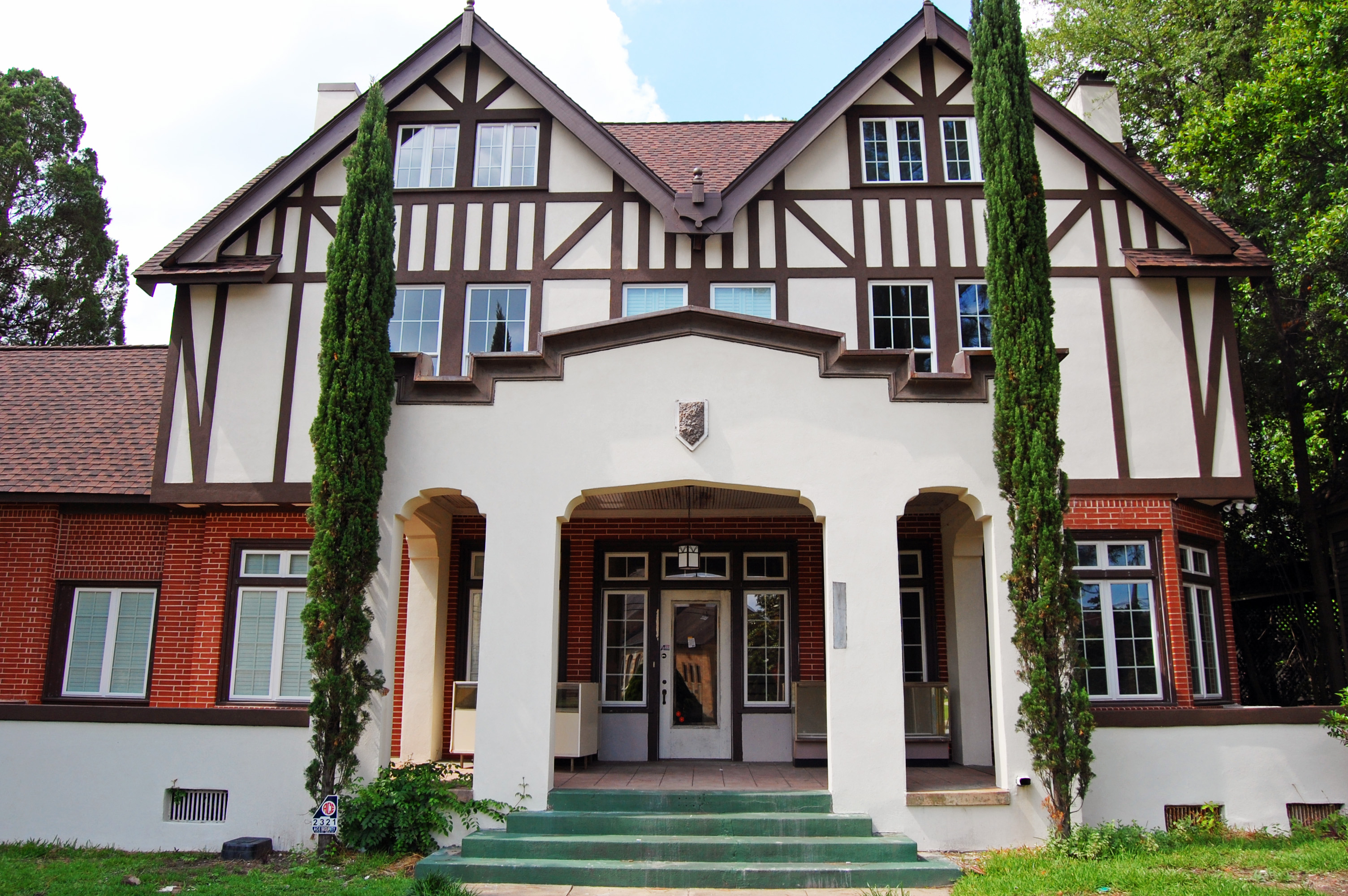
The Allman Brothers Band Museum
Dickey Betts wrote "Ramblin' Man" in the kitchen. Not a studio, not a rehearsal space, but the actual kitchen of a rented house on Vineville Avenue in Macon, Georgia. Down the hall, in the living room, he had already composed "Blue Sky." Gregg Allman, meanwhile, was upstairs writing "Midnight Rider" and "Ain't Wastin' Time No More." For three years in the early 1970s, this 18-room Tudor Revival home served as a communal headquarters for one of the most influential bands in American rock history. The musicians simply called it the Big House.
Two Hundred and Twenty-Five Dollars a Month
In 1970, Linda Oakley, wife of bassist Berry Oakley, rented the Big House from Day Realty for $225 a month. The location was everything. Capricorn Records, the band's recording studio, sat just blocks away. So did H&H Restaurant, where a woman named Mama Louise fed the musicians when they could not afford to pay. The first tenants packed the house to the seams: Berry and Linda Oakley with their daughter Brittany, Berry's sister Candy, Duane Allman with his wife Donna and their daughter Galadrielle, and Gregg Allman. The house became a creative hothouse, a place where the line between living and making music dissolved entirely. Songs drifted from room to room at all hours, and the band's signature sound -- a fusion of blues, jazz, and country that would define Southern rock -- crystallized within these walls.
Tragedy and Eviction
The Big House era ended with heartbreak. On October 29, 1971, Duane Allman was killed in a motorcycle accident in Macon. He was 24. Almost exactly a year later, on November 11, 1972, Berry Oakley died in a motorcycle crash just three blocks from the site of Duane's accident. He was 24 as well. The losses shattered the band. Members drifted apart, the communal spirit fractured, and in January 1973, Linda Oakley was evicted from the Big House. The rooms that had hummed with improvisation went silent. For two decades, the house changed hands and deteriorated, its musical history known only to devoted fans who made pilgrimages to Vineville Avenue to photograph the facade.
From Bed-and-Breakfast to Shrine
Kirk and Kristen West bought the Big House in the summer of 1993, intending to convert it into a bed and breakfast. The renovations required, however, proved far too extensive. Instead of giving up, they pivoted. The house was entrusted to the Big House Foundation, a nonprofit established to transform the property into an interactive museum dedicated to the Allman Brothers Band. The restoration took years of painstaking work. Rooms were returned as closely as possible to their early-1970s appearance, with Linda Oakley herself consulting on the details, including the decoration of Duane Allman's bedroom. The museum finally opened in November 2009 and today holds the world's largest collection of Allman Brothers Band memorabilia -- instruments, stage costumes, handwritten lyrics, concert posters, and personal artifacts that tell the story of a band that changed American music from a rented house in central Georgia.
Macon's Musical Geography
The Big House does not exist in isolation. It anchors a neighborhood steeped in musical history. Capricorn Records, founded by Phil Walden, turned Macon into a recording capital of the South, attracting artists from across the region. The nearby H&H Restaurant, where Mama Louise Hudson became a surrogate mother to the band, still stands as a testament to the community that embraced these musicians. Macon itself, a city of churches and magnolias at the geographic heart of Georgia, has produced an outsized share of American musical talent, from Little Richard to Otis Redding. The Allman Brothers fit squarely in that lineage -- outsiders who came to Macon and found a city that let them become exactly who they were meant to be.
From the Air
The Big House Museum sits at 32.846N, 83.656W in central Macon, Georgia, on Vineville Avenue in a residential neighborhood. From the air, Macon is identifiable by the Ocmulgee River curving through the city center and the cluster of church steeples in the downtown historic district. The museum neighborhood lies northwest of downtown. Nearest airports: Middle Georgia Regional Airport (KMCN) approximately 8nm south of the city center, and Robins Air Force Base (KWRB) about 12nm south. Herbert Smart Downtown Airport (KMAC) sits just 2nm east of the museum.