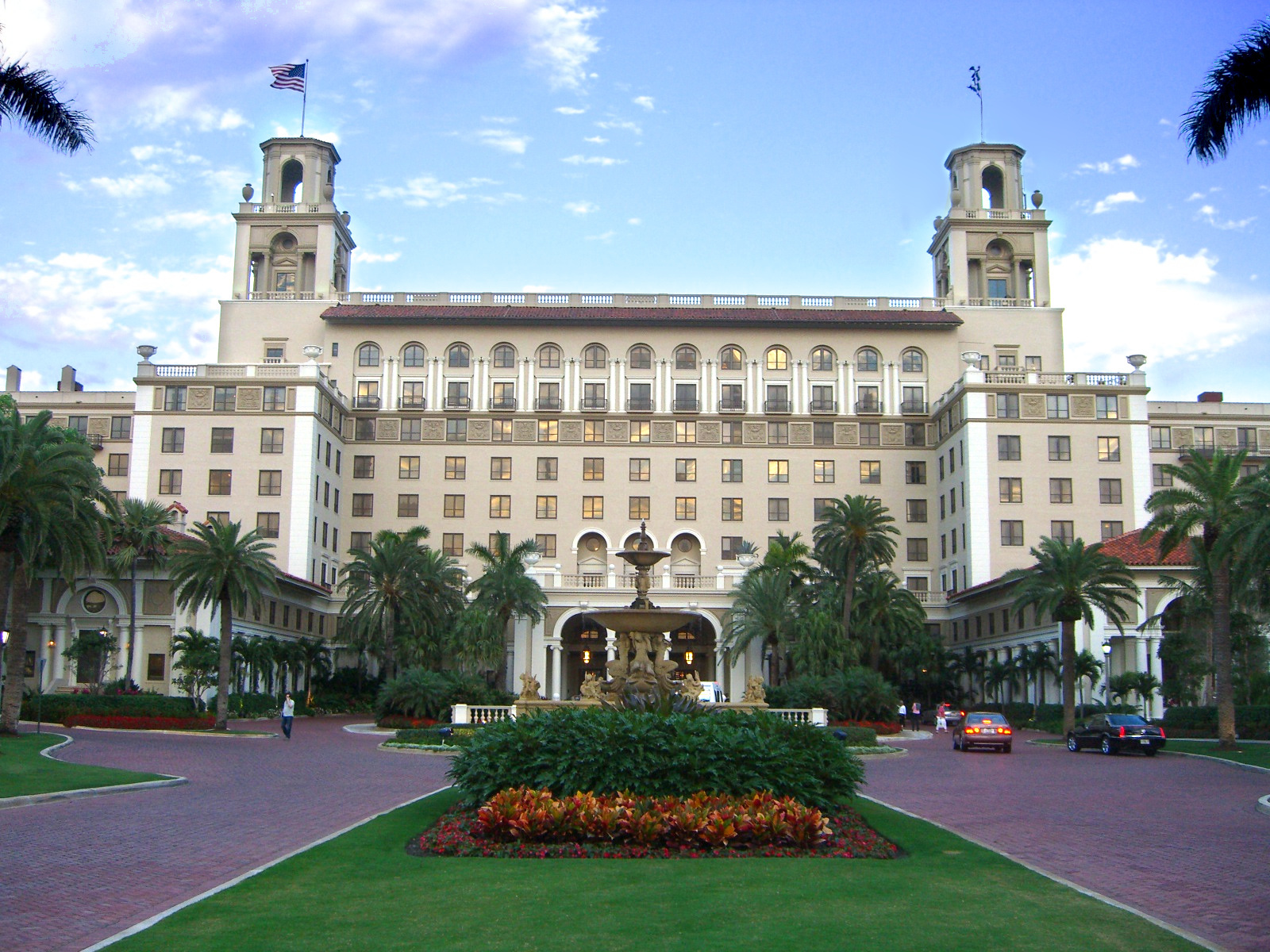
The Breakers Palm Beach
Guests kept asking for rooms "over by the breakers." It was 1901, and the oceanfront hotel that Henry Flagler had built just five years earlier on his Palm Beach barrier island still carried the modest name Palm Beach Inn. But the Atlantic surf crashing against the shore had given the place its real identity, and Flagler relented. The renamed Breakers became the first oceanfront hotel south of Daytona Beach, a destination for the industrial fortunes of the Gilded Age. What stands on that site today is the third building to carry the name -- the first two were consumed by fire -- and its Italian Renaissance facade, modeled after the Villa Medici in Rome, has anchored Palm Beach society for a century.
Flagler's Gamble on the Shore
Henry Flagler was already reshaping Florida when he decided Palm Beach needed a second hotel. His Royal Poinciana Hotel, perched along the Lake Worth Lagoon, was thriving, and his Florida East Coast Railway was delivering northern tourists by the trainload. In 1895, he broke ground on an oceanfront property -- a Georgian Revival structure originally called the Wayside Inn, then the Palm Beach Inn. It reached full occupancy in its first season. A 1,000-foot pier extended into the Atlantic, and steamboats carried guests to Havana, Nassau, and Key West. Flagler kept expanding: cottages, a casino, a saltwater bath. But during the fourth expansion, on June 9, 1903, fire destroyed the entire structure. Within two weeks, Flagler announced he would rebuild.
Twice Burned, Three Times Built
The second Breakers opened on February 1, 1904 -- a four-story Colonial-style building with 425 rooms where a night's stay cost $4 and included three meals. The guest registers read like a roll call of American industry: Andrew Carnegie, William Randolph Hearst, J. P. Morgan, J. C. Penney, and members of the Astor, Rockefeller, and Vanderbilt families. Then, on March 18, 1925, twelve years after Flagler's death, an electric curling iron left on in a room occupied by the wife of Chicago mayor William Hale Thompson ignited a second catastrophic fire. Among the 400 guests who evacuated were Titanic survivor Margaret Brown, actress Billie Burke, and General Foods heir Marjorie Merriweather Post. People hurled jewelry and furs from windows; most of these treasures were stolen or lost. Approximately 10,000 spectators watched the flames. Damage estimates reached $7 million.
A Roman Villa on the Atlantic
Four days after the 1925 fire, the Flagler heirs announced they would rebuild in fireproof concrete -- no more wooden structures. They hired the architectural firm Schultze and Weaver, designers of New York's Waldorf-Astoria, who modeled the replacement after the Villa Medici in Rome. The 550-room Renaissance Revival masterpiece opened in December 1926, just as the Florida land boom was collapsing and the Great Depression loomed. Its rival, Flagler's own Royal Poinciana Hotel, would close permanently in the 1930s, but The Breakers endured. The building weathered the devastating 1928 Okeechobee hurricane, losing most of its roof, windows, and pier, with sand deposited as high as the third floor. Yet it reopened for business that same December, earlier than the previous winter season.
When the Ballroom Became a Hospital
In December 1942, a federal judge granted possession of The Breakers to the United States Army for use as a military hospital. The transformation was total: the grand ballroom became a recreation hall, the Coconut Grove room a dental clinic, the south loggia an officers' lounge, and the mezzanine was converted into operating rooms. A maternity ward was added, where more than a dozen babies were born. The Army named the facility Ream General Hospital, in tribute to Major William R. Ream, a World War I flight surgeon killed in a plane crash. When the military returned the building after the war, Palm Beach architect John Volk led a swift restoration. The Breakers reopened as a hotel and never looked back.
140 Acres of Permanence
Today The Breakers occupies 140 acres beside the Atlantic Ocean, employing over 2,300 people. It has held a AAA Five Diamond rating since 1996 and was ranked seventh on the American Institute of Architects' Florida Chapter list of the state's most important buildings across 100 years. The property includes 534 rooms, 14 cottages, and the Breakers West Golf Club, added in 1969 along Okeechobee Boulevard. Listed on the National Register of Historic Places since 1973, the hotel remains owned by Flagler's descendants -- a continuous family stewardship that stretches back to its founding in the 1890s. The breakers still crash against the shore, just as they did when guests first asked to be lodged within earshot of the surf.
From the Air
Located at 26.71°N, 80.04°W on the barrier island of Palm Beach, Florida. The Breakers is visible from the air as a large Italian Renaissance-style complex fronting the Atlantic Ocean, with extensive grounds including golf courses. Best viewed at 2,000-4,000 feet AGL. Nearest airport is Palm Beach International (KPBI), approximately 4 nm west. Palm Beach County Park Airport (KLNA) in Lantana is approximately 6 nm south. The 140-acre property is a distinctive landmark on the narrow barrier island.